FUNAAB 14th Commencement Lecturer Advocates Food-Based Solutions to Emerging Diseases, Challenges Youth on Value Creation
FUNAAB 14th Commencement Lecturer Advocates Food-Based Solutions to Emerging Diseases, Challenges Youth on Value Creation
 UmarFarouk123
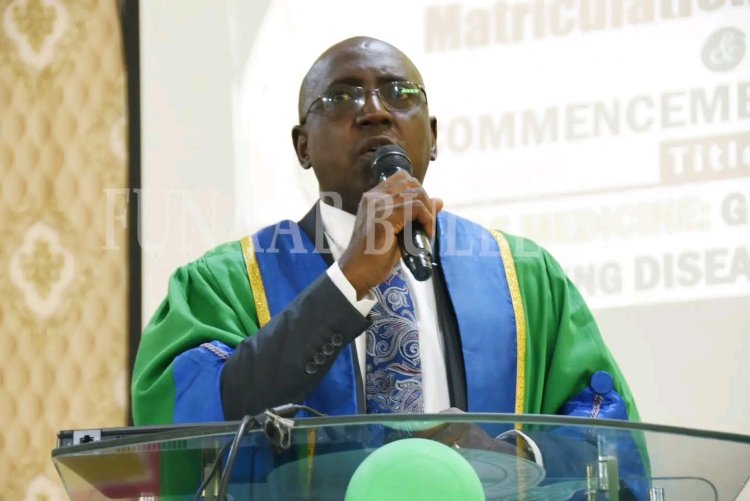
The 14th Commencement Lecturer of the Federal University of Agriculture, Abeokuta (FUNAAB), Prof. Ibraheem Lawal, has advocated for Food-Based Solutions, including integration of agriculture, food systems and healthcare as a strategic response to emerging diseases in Africa, with young people challenged to embrace productive enterprise, innovation and value creation as pathways to national development.
Prof. Lawal, the Provost of the Federal College of Forestry, Ibadan, and an alumnus of FUNAAB, disclosed this on November 18, 2026, while delivering the University's 14th Commencement Lecture, titled “Food as Medicine: Green Solutions to Emerging Diseases in Africa,” at the Professor Oluwafemi Balogun Ceremonial Building.
Speaking against the backdrop of growing health challenges across Africa, Prof. Lawal emphasised that sustainable food systems hold enormous potential for disease prevention, improved healthcare outcomes and economic development. He challenged stakeholders to rethink the relationship between what people grow, what they consume and their overall health, noting that the solutions to several health challenges could begin long before patients arrive at hospitals.
The Commencement Lecturer called for a critical re-assessment of prevailing food and health practices, advocating the scientific validation of traditional knowledge rather than an unquestioning dependence on folklore. He also highlighted the need to examine entire dietary patterns, address the implications of industrialisation and modernise Africa's food heritage to meet contemporary health and nutritional demands.
Prof. Lawal stressed that affordability and economic realities must remain central to developing practical food-based health interventions. He explained that genuine green solutions must go beyond attractive labels to include food safety, sustainable production systems, and an efficient farm-to-cabinet value chain.
He further advocated stronger interdisciplinary collaboration, urging academics and professionals to dismantle institutional and disciplinary barriers that limit innovation in food, agriculture and healthcare. According to him, the emerging green health economy presents significant opportunities for research, entrepreneurship, employment generation and improved public health.
In a direct challenge to young people, particularly the matriculating students, the lecturer posed four fundamental questions for personal reflection and national development: “What do I actively produce?” “What specific regional problem can I solve?” “What real value can I add?” and “How many people can I empower?” He urged the younger generation to move beyond the pursuit of certificates to developing practical solutions, creating wealth and empowering others.
He also highlighted seven pillars of agriculture for health, food, medicine and entrepreneurship, noting the immense opportunities available to young innovators and entrepreneurs at the intersection of agricultural production, healthcare and enterprise.
Addressing the newly matriculated students, the Vice-Chancellor, Prof. Babatunde Kehinde, charged them to embrace discipline, integrity and academic excellence, describing matriculation as a significant academic tradition through which students formally become members of the University.
He urged the students to familiarise themselves with the University's rules and regulations, respect constituted authority and uphold responsible conduct. He reiterated FUNAAB's zero-tolerance policy towards anti-social behaviour and indecent dressing, warning that violations could attract disciplinary sanctions, including suspension, rustication or expulsion.
The Vice-Chancellor also reminded the students that a minimum of 70 percent class attendance was required to qualify for examinations, while failure to register for an academic session would be regarded as withdrawal from the University.
On student leadership and engagement, Prof. Kehinde encouraged constructive dialogue between students and Management, stressing that the Students' Union was established to promote decorum, responsible representation and mutual respect. He cautioned against destructive activities disguised as unionism and reminded the students that they were being prepared for leadership responsibilities in society.
He assured the newly matriculated students of the University's commitment to protecting their rights and welfare, encouraging them to report any incidents of harassment, victimisation or unfair treatment through the Student Affairs Division for appropriate intervention. He further advised them to carry their identity cards, dress decently, seek medical attention when necessary and take advantage of the academic and developmental opportunities available within the University.
Speaking further, Prof. Kehinde reaffirmed FUNAAB's determination to produce graduates capable of addressing contemporary societal challenges through cutting-edge research in agriculture and science, supported by Information and Communications Technology. He reiterated the University's commitment to academic excellence, integrity, accountability, ethical conduct, fairness and high moral standards.
A highpoint was the administration of the Matriculation Oath on the students.