UBA Essay Competition: Judges Raise Alarm as 40% of Students’ Entries Show AI Use
Judges of the 2026 UBA Foundation National Essay Competition have raised concerns over the growing use of artificial intelligence among Nigerian students, revealing that an estimated 35–40 per cent of over 12,000 submitted essays showed signs of AI-generated content.
 judithhh
Judges reveal that 35–40% of entries in the 2026 UBA Foundation Essay Competition showed signs of AI-generated content after assessing over 12,000 submissions.
An estimated 35 to 40 per cent of entries submitted for the 2026 United Bank for Africa Foundation National Essay Competition displayed characteristics associated with artificial intelligence-generated content.
This was contained in the judges’ report on the 2026 UBA Foundation National Essay Competition, obtained by The PUNCH.
The panel of judges who assessed the over 12,000 essay entries and produced the report comprised professors of English from four Nigerian universities.
The authors of the report are Prof Ini Uko (University of Uyo), Profsabe Kabir (Usmanu Danfodiyo University, Sokoto), Prof Emmanuel Omobowale (University of Ibadan) and Prof Samuel Onuigbo (University of Nigeria, Nsukka).
The judges, in their report on the competition, said several essays bore patterns, vocabulary and synthetic structures associated with generative AI tools such as ChatGPT and Gemini.

They identified overly polished American English, repetitive transitional phrases, generic solutions unrelated to Nigeria’s realities, lack of personal experiences and local examples, and AI-style disclaimers as some of the features that raised concerns.
The report read, “A major and alarming concern noted during the assessment was that many of the essays were generated by AI.
“An estimated 35-40% of the scripts displayed the characteristic pattern, vocabulary, and synthetic structure associated with generative AI tools such as ChatGPT, Gemini, and other large language models.”
The judges said the use of AI was noticeable in the submissions, citing phrases such as “In today’s rapidly evolving world” and “Delve into”.
The report stated, “These essays were easily identifiable by their overly polished American English, repetitive transitional phrases like ‘In conclusion, it is pertinent to note…’, ‘In today’s rapidly evolving world…’, ‘Delve into…’, and the presentation of generic, non-contextual solutions such as ‘vertical farming in urban skyscrapers’ and ‘government should invest in blockchain for food traceability’, which lack relevance to the Nigerian smallholder farmer context.”
“Several essays also lacked a personal voice, personal experiences, and local examples, and ended with AI-style disclaimers,” the report added.
The judges also raised concerns about similarities among submissions, noting that several essays contained identical introductory paragraphs, definitions and conclusions.
“Closely tied to the AI issue, very many essays contained similar sentences and clear evidence of template circulation.
“The judges found large clusters of several essays, often from the same school, using identical introductory paragraphs, identical definitions of food security copied from Wikipedia, and identical concluding statements,” the report stated.
According to the report, the similarities suggested the circulation of common prompts, tutorial centre handouts or WhatsApp templates among students and schools.
“For example, several essays began with the exact sentence: ‘Food security is defined by the Food and Agriculture Organization as when all people at all times have physical, social and economic access to sufficient, safe and nutritious food.’ This points to the circulation of a common prompt, a tutorial centre handout, or a WhatsApp broadcast template among students and schools, which completely undermines originality and critical thinking.”
The judges warned that the development undermined the originality and critical thinking the competition was designed to promote.
“The widespread use of AI-generated and templated essays makes it very hard to judge students’ genuine writing ability and critical thinking. It puts honest, original students who make a real effort at a disadvantage,” they stated.
They recommended mandatory AI-detection and plagiarism screening in future editions, clearer essay guidelines, teacher briefing sessions and measures to prevent multiple submissions.
They also proposed that the competition portal be configured to reject entries below 400 words.
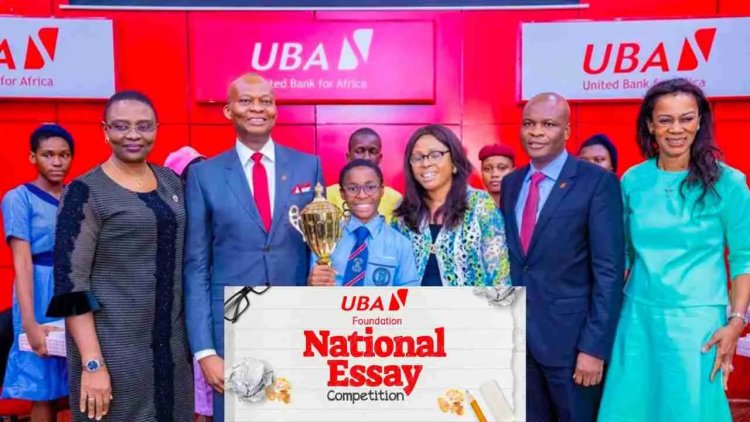
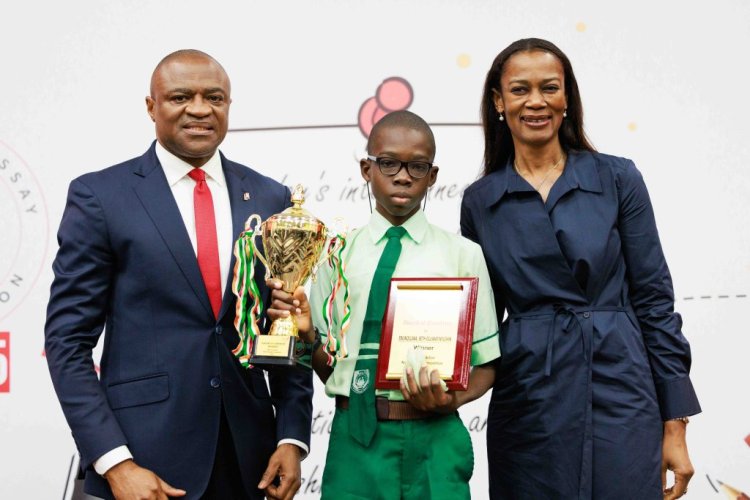
The findings came as 15-year-old Bala Khaira, a Senior Secondary School 3 pupil of Metro International School, Abuja, emerged as the winner of the 2026 competition, securing an N15m education scholarship.
Bala, an indigene of Kogi State, was announced as the winner by the Managing Director and Chief Executive Officer of UBA Foundation, Bola Atta, at the unveiling of the winners held at UBA House, Marina, Lagos, on Tuesday.
She beat more than 12,000 applicants to emerge as the winner of the 16th edition of the competition.
Speaking after her victory, Bala said extensive research contributed to her entry and credited her parents for encouraging her to participate.
She also emphasised the importance of human intelligence and critical thinking over reliance on artificial intelligence.
“This was my first time applying. I dedicate this victory to my parents, who greatly support me in my education and every one of my other endeavours,” she said.
Four other students emerged among the top five winners, sharing in the N40m scholarship pool for the competition.
Udom Unwanabasi of Topfaith International Secondary School, Mkpatak, Akwa Ibom State, emerged as the first runner-up and received an N10m scholarship, while Ndamzi Flourish of the University of Port Harcourt Women Association International Secondary School came third and won N3.5m.
Godsfavour Udo of Federal Government Girls College, Ikot Obioitong, Akwa Ibom State, finished fourth and received an N5m scholarship, while Anyanwu Uchenna of Coral Impacts International School, Abuja, came fifth and won N2.5m.
The 20 finalists, drawn from schools across the country, received laptops and certificates, while the top five were presented with plaques. Bala also received a trophy.
Speaking on the competition, Atta said the topics for the two stages—food security and child marriage—were designed to encourage students to think critically and analytically about issues affecting society rather than rely on artificial intelligence.
“The topics were meant to allow students to be analytical and not use artificial intelligence,” she said.