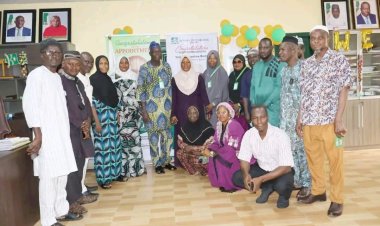
UI Don Advocates Gender-Responsive Family Law Reforms To Promote Justice
UI Don Advocates Gender-Responsive Family Law Reforms To Promote Justice
 UmarFarouk123
A Professor of Family Law, Gender Justice, and Clinical Legal Education at the University of Ibadan, Professor Omolade Olunike Olomola, has called for comprehensive reforms of the Nigerian family law system to promote gender justice, protect vulnerable groups and address structural inequalities in society.
She made the call while delivering the 620th Inaugural Lecture of the University of Ibadan on behalf of the Faculty of Law.
The lecture was titled, "Gender Justice and Intersectionality of Family Law Lifelines."
Professor Olomola explained that family law is the legal framework that regulates marriage, divorce, child custody, inheritance, adoption and other domestic relationships.
She stressed that family law is fundamental to national development because the family, being the nucleus of society, requires the protection of human rights, adding that a just and coherent family law system enables the promotion of gender equality and social cohesion.
The don observed that Nigeria’s plural legal system, comprising statutory, customary and Islamic laws, presents both opportunities and challenges for the administration of justice, particularly in matters relating to family relationships and gender equality.
She stated that gender justice goes beyond ensuring equal treatment for men and women, reiterating that it seeks to dismantle structural inequalities by recognizing how factors such as class, disability, age, ethnicity and economic status combine to shape people’s experiences.
The Family Law and Gender Justice expert cautioned that gender should not be viewed as a concept peculiar to women alone, clarifying that it is a social construct that includes both men and women.
She added that excluding men from gender discourse undermines efforts to achieve balanced and sustainable gender justice.
According to her, though such cases are often underreported because of societal expectations and stereotypes, gender justice equally recognizes that men also experience physical, emotional, psychological and economic abuse and should not be excluded from legal protection and access to justice.
The Inaugural Lecturer explained that while gender equality seeks to provide equal rights and opportunities for everyone, gender equity recognizes that people begin from different positions and may require different forms of support to achieve fairness.
She described gender justice as a broader framework that addresses structural discrimination and inequality by considering how gender intersects with factors such as class, age, disability, ethnicity and other social identities.
Professor Olomola said the concept of intersectionality provides a more inclusive framework for addressing discrimination by ensuring that laws, policies and institutions respond to the realities of individuals facing multiple forms of disadvantage.
She noted that family law must evolve to reflect changing social realities, including women’s empowerment, technological advancement, assisted reproductive technology, changing family structures and increasing economic pressures.
The Inaugural Lecturer advocated an intersectional approach to law-making and policy formulation, explaining that such an approach would improve legal protection, strengthen access to justice, promote inclusive representation, and ensure that remedies adequately address multiple forms of discrimination.
She called for reforms of Nigeria’s marriage laws, recommending the harmonization and strengthening of the country’s family law framework through improved regulation of statutory, customary and Islamic marriages, while advocating the compulsory registration of all marriages.
The Don further recommended the enactment of a Divorce Reform Act, the review of the Child Rights Act to strengthen gender sensitivity and the amendment of the Violence Against Persons, Prohibition Act to provide more comprehensive protection against domestic violence.
She stressed the need for continuous training of judges and legal practitioners on gender justice and intersectionality to ensure fair, equitable and context-sensitive judicial decisions in family law disputes.
Professor Olomola restated that family law should remain a tool for protecting the rights, interests and welfare of individuals within the family and society, emphasizing that sustainable gender justice requires legal reforms, inclusive policies and institutional commitment.
She reiterated that sustainable gender justice requires institutional accountability, inclusive policymaking and continuous legal reforms capable of responding to the realities of contemporary Nigerian society.
The Inaugural Lecturer called for the re-categorization of Family Law as a compulsory course for law students, noting that the prevalence of family disputes and divorce underscores the importance of equipping future legal practitioners with adequate knowledge of family law.
The lecture was the 17th in the series for the 2025/2026 academic session.