TASFUED Unveils 2026–2031 Strategic Agenda, Targets Performance, Innovation and Sustainable Growth
The Vice-Chancellor of Tai Solarin Federal University of Education (TASFUED), Prof. Samuel Oladipo, MNPA, CMCPN, MCAN, FIELPN, has charged members of the University community to embrace a culture of performance, innovation, accountability and strategic thinking as the institution works towards sustainable growth and global competitiveness.
 Philip22

The Vice-Chancellor of Tai Solarin Federal University of Education (TASFUED), Prof. Samuel Oladipo, MNPA, CMCPN, MCAN, FIELPN, has charged members of the University community to embrace a culture of performance, innovation, accountability and strategic thinking as the institution works towards sustainable growth and global competitiveness.

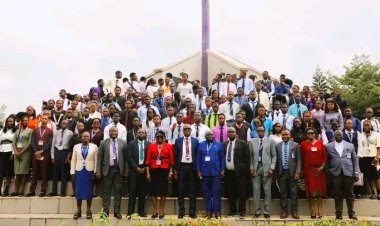
Prof. Oladipo gave the charge while presenting the University’s S.T.A.R.-W.I.N. Strategic Agenda (2026–2031) at the 2026 Extended Management Retreat held recently at the Lagos Airport Hotel, Ikeja, with the theme, “Strategic Consolidation and Governance.”
He said the transition of the University from a state-owned institution to a Federal University of Education required a fundamental shift from traditional administration towards a performance-driven and globally competitive model.
The Vice-Chancellor also presented a scorecard of his administration’s four-month-plus stewardship, highlighting key achievements recorded since he assumed office and outlining ongoing initiatives aimed at improving the University’s infrastructure, aesthetics, transportation and general campus environment.
He disclosed that work on the perimeter fencing of the University campus would resume in a couple of days as part of efforts to strengthen security, clearly define the institution’s boundaries and enhance the physical development of the campus.
He also disclosed that the former Aluta market had been cleared and would soon be transformed, noting that the development would contribute to improving the aesthetic appeal and overall outlook of the University environment.
On shuttle and transportation services within the campus, Prof. Oladipo reiterated his administration’s commitment to properly regulating commercial motorcycle operations. He said all bike operators would be profiled and required to wear reflective jackets before being allowed to operate within the University premises.
“The S.T.A.R.-W.I.N. Agenda was designed to provide a clear framework for translating the University’s vision into measurable results across Colleges, Directorates, Departments, Centres and other units of the institution,” he said.
He identified financial sustainability, technology and digital campus, academic excellence and innovation, research productivity and global ranking, welfare and wellbeing, infrastructure development, and networking as the seven strategic pillars of the agenda.
Prof. Oladipo stressed that the University must move beyond dependence on government funding by developing sustainable revenue streams, strengthening strategic partnerships, improving research productivity and embracing innovation.
The Vice-Chancellor also emphasised the need for comprehensive digital transformation, noting that technology must become integral to teaching, administration, communication and service delivery.
He disclosed that the institution would, within a few weeks, completely discontinue the use of paper in its administration and transition fully to digital operations. He urged those lagging behind to make efforts to catch up with the University’s vision of becoming “the University of the 21st Century.”
He further charged Heads of Academic and Administrative Units to see themselves not merely as administrators but as strategists, innovators, revenue mobilisers and quality assurers whose performance would be assessed based on demonstrable outcomes.
Prof. Oladipo encouraged academic staff to attract research grants, publish in reputable indexed journals and contribute to the University’s global visibility. He also urged Departments and other Units to pursue meaningful partnerships with industry, alumni and international institutions.
He stressed the importance of responsible financial management, effective budgeting, strict compliance with public financial regulations and prudent utilisation of available resources in achieving the University’s strategic objectives.
The Bursar, Mr Kabir Ogunneye, FCA, while delivering his presentation at the retreat, disclosed that the University would commence preparations for the 2027 budget immediately after the retreat.
He stressed that no expenditure could be legitimately incurred without prior budgetary provision, noting that the budgetary process was essential to ensuring financial discipline, transparency and accountability.
Mr Ogunneye warned that spending outside approved budgetary provisions could expose responsible officers to scrutiny by relevant oversight bodies.
He therefore urged Heads of Units and other budget holders to ensure that their requests were properly captured in the budget and aligned with approved expenditure heads.
The Bursar also outlined the University’s proposed expenditure-control process, explaining that requests for overhead items such as stationery and consumables should be supported with invoices from vendors and subjected to price verification by the Audit Department’s Pricing Unit.
According to him, the process was designed to ensure competitive pricing and value for money before requests were forwarded to the Vice-Chancellor for approval.
He added that approved expenditures would subsequently undergo budgetary checks by the Bursary, while released funds would be monitored to ensure that they were used for their approved purposes and that projects were duly executed.
Reinforcing the Vice-Chancellor’s emphasis on results-oriented governance, the Head, Budget and Expenditure Control, Bursary Department, Mr Adeleke Babayeju, FCA, in his presentation titled “From Need to Appropriation to Delivery: A Practical Guide to the University Budgetary Process,” urged Management to reposition budgeting as a strategic management tool that connects institutional needs and priorities with available resources, lawful processes and measurable results.
Mr Babayeju explained that every budget proposal should clearly identify the need being addressed, proposed intervention, cost, timing, funding source, responsible unit and expected measurable outcome.
He advised Departments, Directorates, Colleges, Centres and Units to identify genuine needs and prioritise proposed activities based on strategic relevance, urgency, affordability and expected impact. He also urged them to ensure that cost estimates reflected realistic market conditions and implementation requirements.
The Head, Budget and Expenditure Control, maintained that the ultimate measure of a successful University budget was not the amount spent but the results delivered.
He therefore urged Management to monitor expenditure, commitments, revenue, physical progress and value for money throughout the financial year.
Similarly, a presentation on the Financial Regulations and Compliance Framework for Federal Universities in Nigeria, delivered by the Director, Procurement, Dr Odukunle Odusanya, emphasised the need for strict adherence to laws, regulations and government directives in the management of public funds.
The presentation identified accountability, transparency, probity, value for money, uniformity and fiscal discipline as key objectives of financial regulations.
It also emphasised the importance of proper records, budget performance reporting, audited financial statements, procurement compliance and effective internal controls.
Dr Odusanya warned against financial regulation breaches, including:
- Unauthorised retention or diversion of revenue
- Operation of unauthorised accounts
- Contract splitting
- Unauthorised variation orders
- Payment for unexecuted contracts
- Unretired advances
- Inadequate supporting documents
- Poor asset records
- Failure to implement audit recommendations
He recommended regular training on Financial Regulations, early involvement of Internal Audit in payment processes, strict documentation and records management, periodic compliance reviews and prompt implementation of audit recommendations.
The retreat also focused on strengthening the University’s strategic relationships and diversifying its resource base through an effective Advancement strategy.
In his presentation titled “Driving Growth and Development in the University: Roles of the Directorate of Advancement and the Challenges,” the Director, Advancement, Prof. Kemi Oriola, urged Management to strengthen relationships with students, alumni, industry, donors and other stakeholders as part of efforts to achieve sustainable institutional growth.
He described the Directorate of Advancement as a strategic management function responsible not only for fundraising but also for relationship building, institutional reputation, partnerships, resource mobilisation and long-term development.
Prof. Oriola identified stewardship, alumni relations, development and fundraising, corporate communication and institutional marketing, and data governance as key components of the University’s Advancement model.
He also advocated stronger alumni engagement, University-industry collaboration, research sponsorship, grant opportunities, patent commercialisation, endowment development and capital campaigns for infrastructure, scholarships and professorial chairs.
He recommended a shift from conventional fundraising to “friend-raising” based on trust and sustained relationships.
Prof. Oriola also identified inadequate Advancement infrastructural development, weak donor tracking, underfunding and shortages of professionally trained fundraisers among the challenges requiring attention.
The various presentations collectively reinforced the need for TASFUED to build a culture of strategic thinking, financial prudence, regulatory compliance, innovation, partnership and measurable performance.
Prof. Oladipo therefore urged members of the University community to take collective ownership of the S.T.A.R.-W.I.N. Agenda and align their activities with the strategic priorities of the institution.
He stressed that the success of the University’s transformation would depend on disciplined implementation across all units.
He encapsulated the vision of the strategic agenda in the declaration: “STAR-WIN is how we will Win as a Star University,” reiterating his administration’s determination to position TASFUED as a leading institution of education, research, innovation and development in Nigeria and on the global stage.
The closing session featured a vote of thanks delivered by Mr Ademola Adesanya, FNIM, on behalf of the Chairman and members of the Planning Committee.
Mr Adesanya expressed appreciation to the Vice-Chancellor, Prof. Samuel Oladipo, the facilitators, participants and all those whose contributions ensured the success of the retreat.
He particularly commended the Vice-Chancellor for providing strategic direction through the S.T.A.R.-W.I.N. Agenda and acknowledged the facilitators for their practical insights on budgeting, financial regulations, procurement and institutional advancement.
He urged participants to translate the knowledge gained into measurable action by digitising University operations, budgeting for results, strengthening compliance, treating students with courtesy and developing the University’s alumni network.
Mr Adesanya also called on participants to cascade the lessons and practical tools acquired during the retreat to staff in their respective Directorates, Departments and Units.
He appreciated those who worked behind the scenes to ensure the successful organisation of the programme.
Other members of the Management in attendance at the retreat were the Deputy Vice-Chancellor, Administration, Prof. Adekunle Adeogun, FISN; the Deputy Vice-Chancellor, Academic, Prof. Rotimi Ettu; the Registrar and Secretary to Council, Mr Dapo Oke, FCIA, MNIM; the Bursar, Mr Kabir Ogunneye, FCA; and the University Librarian, Prof. Adebambo Oduwole.