“UI’s Greatness Lies in its Ability to Sustain Knowledge Sovereignty,” says Professor Ogundiran at the Inauguration Ceremony of 14th VC
“UI’s Greatness Lies in its Ability to Sustain Knowledge Sovereignty,” says Professor Ogundiran at the Inauguration Ceremony of 14th VC
 UmarFarouk123
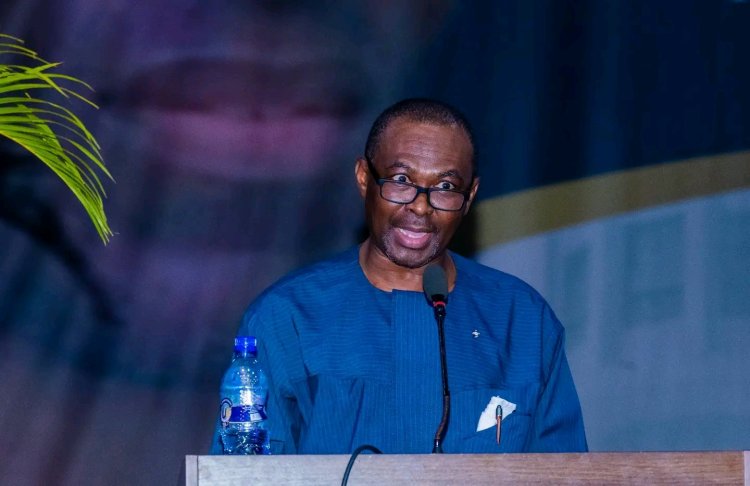
A renowned scholar and an alumnus of the University of Ibadan, Professor Akin Ogundiran of the Northwestern University, USA, has said that the ability of the University of Ibadan to realise its developmental potential does not lie in its age but depends largely on its strength to generate relevant knowledge, develop human capital, solve societal problems and contribute meaningfully to global intellectual discourse.
He made this statement while delivering a lecture at the inauguration ceremony of the 14th Vice-Chancellor of the University of Ibadan, Professor Peter O. Olapegba, C. Psych, FSSAN, FNPA, fspsp.
The lecture was entitled “The African University in a New World: Qualities of Knowledge, Sovereignty and Relevance”.
Professor Ogundiran noted that the University of Ibadan has produced more than three million graduates since its establishment, many of whom have contributed significantly to the development of institutions, communities and society through their professional expertise, creativity and civic engagement.
He added that the university’s contributions extended beyond financial returns to include disease prevention, improved agricultural production, informed citizenship, preservation of cultural heritage and evidence-based public policymaking.
Professor Ogundiran stressed that the future of the University of Ibadan would depend on its ability to combine knowledge production, intellectual sovereignty and societal relevance.
He acknowledged the University of Ibadan’s contribution to his personal intellectual development, and the longstanding relationship between the University of Ibadan and Northwestern University.
He noted that the partnership has produced opportunities for academic exchange and collaboration, disclosing that a congratulatory message has been conveyed to the 14th Vice-Chancellor from Northwestern University by its President, Professor Michael Schill.
The lecturer described the rise from an undergraduate student of the institution to its chief executive as evidence of the transformative power of universities, restating that the academic and professional journey of the Vice-Chancellor demonstrated how access to education, mentorship, determination and institutional support could transform individual lives.
Professor Ogundiran urged universities to create opportunities for students from disadvantaged backgrounds, noting that academic excellence was not necessarily determined by an individual’s background or the circumstances under which he entered the university.
According to him, African universities must move beyond their traditional roles as centres of teaching and research to become drivers of knowledge production, technological innovation, economic development and intellectual sovereignty, stressing the need for them to reposition themselves to respond effectively to the changing global order.
He argued that universities should not be viewed merely as institutions consuming public resources through salaries, infrastructure and government subventions, but as investments that generate substantial economic and social returns.
The scholar identified four major developments that African universities must prepare for: the redistribution of global economic and political power, the growing influence of artificial intelligence, Africa’s expanding demographic and economic significance, and the effects of climate change.
He observed that the concentration of global power and knowledge production was gradually shifting, with countries such as China and India becoming increasingly influential in the global economy and technological landscape.
He, however, cautioned that the growing access to international partnerships and opportunities in Africa would not automatically translate into greater influence.
According to him, African countries must develop the expertise, institutional capacity and strategic coordination required to negotiate effectively and protect their interests in an increasingly competitive world.
He called of African universities to pursue knowledge sovereignty, explaining that the concept involved the ability to determine relevant research priorities, generate reliable knowledge, strengthen local institutions and participate in international partnerships as equal intellectual partners.
He stressed that knowledge sovereignty should not be interpreted as intellectual isolation but as the ability to engage with global knowledge without surrendering Africa’s capacity to think independently.
The Chairman of the occasion, Emeritus Professor Oluwole Akande, D.Phil (Oxon), OON, Pioneer Provost of the College of Medicine, said his chairmanship symbolized the continuity of the rich tradition, distinguished leadership and service of UI, while providing a refined vision between its institutional heritage and the new chapter evidenced in the inauguration of the 14th Vice-Chancellor.
He congratulated the new Vice-Chancellor, stating that his appointment to the distinguished office is an opportunity for him to display his institutional experience, saying that the occasion was significant, not merely because it celebrated the emergence of a new Vice-Chancellor, but also because it provided an opportunity to reflect on the purpose, responsibilities, and future of African universities in a rapidly changing world.
According to him, the University of Ibadan occupies a special place in the history of higher education, not only in Nigeria, but in Africa and as Nigeria’s premier university, it has a proud tradition of scholarship, intellectual leadership, and service to society.
Emeritus Professor Akande called on the university community to preserve the distinguished heritage of UI, while preparing the institution to respond effectively to the demands of a new higher education.
The Deputy Governor of Oyo State, His Excellency, Barrister Abdulraheem Adebayo Lawal, who spoke on behalf of the Governor of Oyo State, His Excellency, Engr Seyi Makinde, commended the University of Ibadan for organising a public and peaceful leadership transition, describing the ceremony as a significant departure from the traditionally private handover process.
According to him, the peaceful transition demonstrated that leadership changes could take place without rancour, urging other universities to adopt the initiative.
The Deputy Governor encouraged the newly appointed Vice-Chancellor to sustain and improve the institution’s global ranking, urging him to work towards placing the university among the top 500 universities in the world.
The 14th Vice-Chancellor of the University of Ibadan, Professor Peter O. Olapegba, C.Psych, FSSAN, FNPA, fspsp, in his inauguration address unveiled a five-year development agenda aimed at repositioning the institution through digital transformation, artificial intelligence, research innovation, improved staff welfare and stronger international partnerships.
He said that his administration will build on the university’s historical achievements while introducing reforms to prepare it for emerging global challenges, adding that the institution, as Nigeria’s premier university has a responsibility not only to preserve its legacy but also to strengthen its capacity to shape national development, influence Africa’s intellectual direction and compete globally.
He described his appointment as an opportunity to serve an institution that had significantly shaped his academic career and assured that his responsibility will go beyond managing the university to preserving its legacy, strengthening its structures and empowering future generations.
According to him, the university’s historical significance should serve as a foundation for transformation rather than an obstacle to institutional progress, pledging that his administration will preserve successful policies and programmes inherited from previous administrations, address existing weaknesses, reform inadequate structures and introduce innovations required to prepare the institution for the future.
Courtesy: UI DIRECTORATE OF PUBLIC COMMUNICATION