UI Becomes First CMS Cooperating Institution in Sub-Saharan Africa Through CERN Partnership
The University of Ibadan (UI) has achieved a major milestone in global scientific research following the formalisation of a collaboration agreement with the European Organization for Nuclear Research (CERN), making it the first cooperating institution in the Compact Muon Solenoid (CMS) experiment in sub-Saharan Africa.
 Philip22
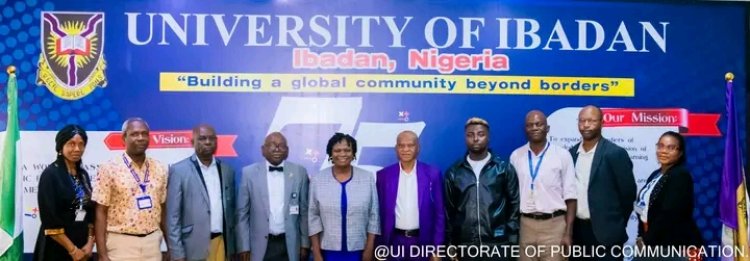
The University of Ibadan (UI) has achieved a major milestone in global scientific research following the formalisation of a collaboration agreement with the European Organization for Nuclear Research (CERN), making it the first cooperating institution in the Compact Muon Solenoid (CMS) experiment in sub-Saharan Africa.

The partnership was established through the signing of a Memorandum of Understanding (MoU) between CERN and the University of Ibadan, a development the University’s Department of Physics described as a significant step towards expanding its international research footprint.
The Deputy Vice-Chancellor (Academic), Prof. T. Arotiba, FWACS, FICD, who represented the Vice-Chancellor, Prof. Kayode O. Adebowale, mni, FAS, fspsp, commended the Department of Physics for securing the collaboration, describing it as a landmark achievement for the University.
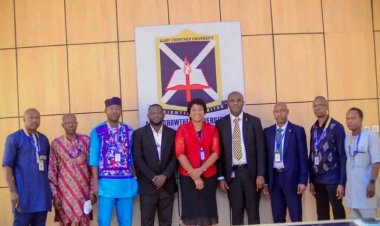
Prof. Arotiba made the remarks during a courtesy visit by the UI/CERN/CMS team to the Vice-Chancellor’s office. The team was led by the Dean, Faculty of Science, Prof. I. A. Oladosu, alongside other members of the University’s research team.
He stated that the collaboration would enhance teaching quality, research output, academic publications, and the University’s contribution to scientific innovation and national development.
The Deputy Vice-Chancellor assured the Department of the University’s commitment to exploring funding opportunities to support the partnership, including proposed research sabbaticals at CERN. However, he requested detailed financial projections to support effective planning and resource mobilisation.
Earlier, the Head of the Department of Physics and Team Leader of the CMS collaboration at UI, Prof. Rachel I. Obed, explained that the partnership places the University among a select group of global institutions involved in cutting-edge research in particle physics, theoretical physics, advanced instrumentation, scientific computing, medical physics, and condensed matter physics.
She noted that the CMS experiment, one of the world’s largest scientific collaborations, operates at the Large Hadron Collider (LHC), the most powerful particle accelerator globally and a facility widely recognised for its role in the discovery of the Higgs boson in 2012.
According to Prof. Obed, the Department of Physics received official approval in 2026 to participate in the CMS experiment, leading to the signing of the agreement that established the University of Ibadan as the first CMS cooperating institute in sub-Saharan Africa.
She described the achievement as historic and acknowledged the support of the Vice-Chancellor, Prof. Kayode O. Adebowale, as well as the Deputy Vice-Chancellor (Research, Innovation and Strategic Partnerships), Prof. Simisola O. Akintola, and the Director of the Research Management Office, Prof. A. S. Jegede, for their roles in advancing the initiative.
Prof. Obed disclosed that one of the immediate benefits of the collaboration is the participation of a University of Ibadan M.Sc. student in Theoretical Physics in CERN’s Summer Student Programme in Geneva, Switzerland.
She added that the partnership would create opportunities for researchers and academic staff to participate in international research projects, analyse large scientific datasets, contribute to joint publications, and take part in frontier scientific discoveries.
The CERN collaborator and Nigerian Coordinator, Martin Gasal, explained that efforts to integrate the University of Ibadan into the collaboration began after a presentation to the Department of Physics in 2025, encouraging the institution to pursue membership.
Also speaking, Nigerian physicist David Dosu, the first intern from sub-Saharan Africa at CERN, described the organisation as one of the world’s leading scientific research centres dedicated to exploring fundamental questions about the origin and structure of the universe.
He explained that increased African participation in CERN has motivated efforts to establish stronger institutional partnerships that support students and academic researchers.

According to Dosu, the agreement gives University of Ibadan researchers and lecturers direct opportunities to contribute to CMS experiments, participate in international publications, access advanced research infrastructure, utilise high-performance computing resources, and engage in long-term scientific collaborations.