
ANCOPSS Demands Nationwide Education Funding, Warns Against ‘Empty Praises’ for Teachers
ANCOPSS has called on governments at all levels to move beyond praising teachers and invest urgently in their welfare, digital skills and school infrastructure
 judithhh

ANCOPSS has urged governments at all levels to improve teachers’ welfare, digital skills and school infrastructure to drive quality technology-based education in Nigeria.
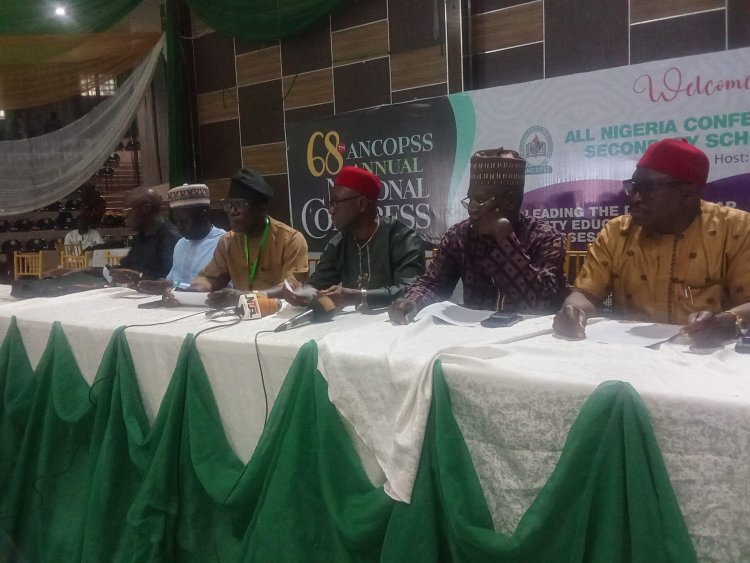
The call was contained in a communiqué issued at the end of the 68th Annual National Congress of ANCOPSS in Kaduna, where secondary school principals from across the country examined the challenges and opportunities presented by technology-driven education.
The communique was read to newsmen by the National President of ANCOPSS, Dr. Robert Ike Okorie, along other officials of the Confederation.
The five-day congress, themed “Leading the Digital Leap, Redefining Quality Education through Technology-driven Assessment and School Management,” warned that Nigeria’s attempt to modernise education would fail if policymakers focused on purchasing technology without developing the people, systems and infrastructure needed to use it effectively.
“Some Nigerian education leaders still fail to understand that modern education system does not focus merely on acquiring technology without building the people, processes, infrastructure, standards, data culture and instructional discipline required to make technology produce educational outcomes,” the principals said.
In one of the strongest observations from the congress, ANCOPSS criticised the contradiction between society’s frequent praise of teachers and the poor support they receive.
“The society praises teachers with the good words such as, ‘teachers are nation builders’ while failing to provide them with fair remunerations, computers, internet access, training,” the communiqué stated.
It added that the situation was particularly troubling because teachers were still expected to prepare students for a rapidly changing digital world.
“Yet, the same system expects them to produce modern students using outdated teaching pedagogies that do not match the fast moving digital world,” the principals said.
The body maintained that teachers cannot be expected to drive digital transformation in schools without the necessary tools, training and welfare packages.
Dr. Okorie, stressed that quality education requires substantial financial commitment and political will.
“We must face the fact that quality education is indeed an expensive venture and as such strongly appeal to governments at all levels to muster the needed political will to appropriately fund education,” Okorie declared.
The principals also raised concerns about the widening digital divide among Nigerian learners, particularly disparities in access to computers, internet connectivity and digital skills.
According to the communiqué, disadvantaged learners without internet access at home, differences in the quality of devices available in schools and unequal levels of computer literacy among students constitute “a huge challenge” to technology-driven education.
The congress further noted that some schools have acquired digital equipment that is subsequently under-utilised because teachers lack the technical knowledge to operate or maintain it, while inadequate funding makes repairs and maintenance difficult.
“Incessant power outages, lack of communication network and internet services in rural and urban areas mitigate against use of digital tools for teaching and learning in our secondary school system,” ANCOPSS observed.
The principals therefore argued that digital transformation must go beyond the procurement of computers and other devices.
ANCOPSS called for a comprehensive digital transformation framework that places equal emphasis on human capacity, change management, data systems and instructional standards.
The body also demanded reliable electricity, appropriate digital devices, internet connectivity and offline learning options, as well as teacher training, technical support and cybersecurity.
It further called for accessibility measures for learners with special needs and adequate logistics to ensure that digital education does not deepen existing inequalities.
On teachers’ welfare, ANCOPSS called for remuneration and working conditions that are competitive with those of other professions, alongside sustained digital-skills training.
The principals also urged governments to make adequate budgetary provisions for digital infrastructure in schools rather than relying on fragmented or short-term interventions.
The congress called for the full implementation of the Technical and Vocational Education and Training (TVET) curriculum to equip Nigerian students for an increasingly technology-driven global economy.
According to ANCOPSS, learners must be prepared for emerging fields shaped by artificial intelligence, automation, renewable energy, biotechnology and digital finance, as well as growing international competition.
The principals also urged education authorities to move away from simply enforcing technology adoption and instead build understanding among teachers and school leaders by demonstrating how specific applications and digital platforms can improve learner engagement and educational outcomes.
ANCOPSS welcomed Kaduna State’s reported allocation of 25 percent of its 2026 budget to education, describing such commitment as the kind of investment that should become standard across the country.
The principals, however, maintained that sustainable improvement in education requires a nationwide commitment rather than isolated interventions by individual states.
The congress was hosted by the Kaduna State ANCOPSS President, Mr. Jonathan Danbaki, and members of his executive committee.
ANCOPSS expressed appreciation to Kaduna State Governor, Uba Sani, for approving Kaduna as the venue for the congress and to the Commissioner for Education, Prof. Abubakar Sani Sambo for his leadership.
The body also acknowledged the Chairman of the Kaduna State Traditional Council and Emir of Zazzau, Amb. Ahmed Nuhu Bamali, for his reception and royal blessings.
The congress thanked delegates and partner organisations, including the Nigeria Union of Teachers (NUT), the All Nigeria Organization of Private Schools Heads (AOPSHON), WAEC, NECO and JAMB, as well as members of the press and security agencies, including the Nigeria Police, NSCDC, DSS and FRSC.
ANCOPSS said Nigeria’s education transformation must ultimately be measured not by the number of computers purchased or policy documents produced, but by whether teachers are properly equipped and learners actually benefit from technology.