Benue South Academics Trained on TETFund Research Grants
Benue South Academics Trained on TETFund Research Grants
 UmarFarouk123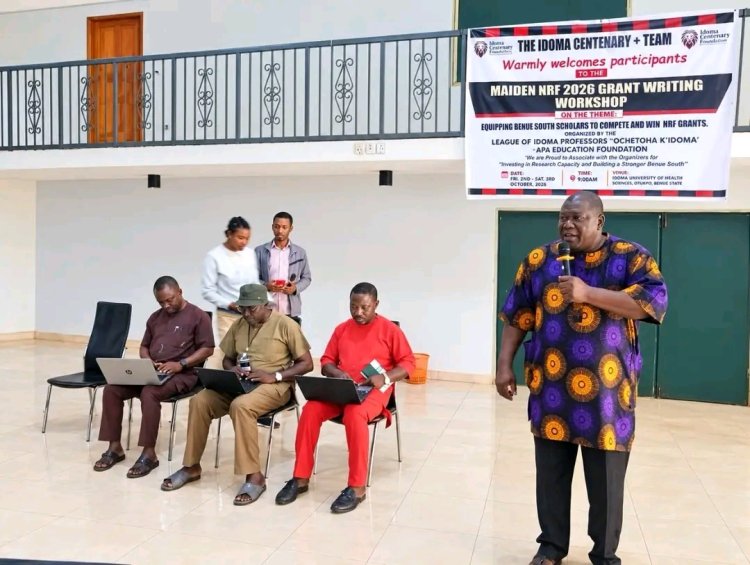
Academics from tertiary institutions across Benue South Senatorial District, also known as Zone C, have been trained on developing competitive research proposals to access the Tertiary Education Trust Fund (TETFund) National Research Fund (NRF) and other funding opportunities.
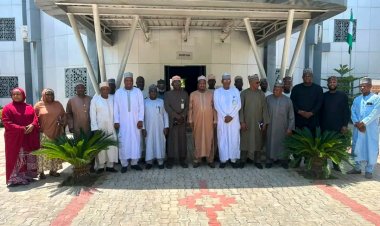
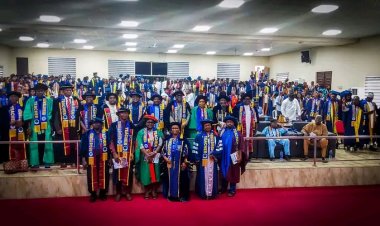
The two-day workshop, held from October 2 to 3, 2026, at the GRA Campus of the Federal University of Health Sciences, Otukpo (FUHSO), was organised by the League of Idoma Professors (LIP), Ochetoha K'Idoma and the Apa Education Foundation (AEF).
The workshop, themed From Ideas to Funded Research, was aimed at strengthening researchers' capacity to develop bankable proposals and improve their chances of securing research grants.
The programme featured lectures and practical sessions on the TETFund NRF, grant writing, concept-note development and proposal preparation.
In his remarks, the Vice-Chancellor (Academic), FUHSO, Prof. Friday Godwin Okibe, who represented the Vice-Chancellor, Prof. Francis Aba Uba, stressed the need for researchers to develop proposals that address pressing societal challenges while remaining fundable.
Prof. Okibe also called for greater collaboration among researchers and institutions, noting that multidisciplinary partnerships enhance the quality and competitiveness of research proposals.
Also speaking, Prof. Yakubu Aboki Ochefu, Professor of Economic History and Development Studies at Rev. Fr. Moses Orshio Adasu University, Makurdi and President of Ochetoha K'Idoma, observed that the success rate of researchers from Zone C in securing NRF grants remains low.
He noted that fewer than 10 scholars from the zone had secured NRF grants in the last five years, describing the situation as a challenge requiring deliberate intervention through sustained mentorship and stronger research networks.
In a goodwill message, the Publicity Secretary of Ochetoha K'Idoma, Mr. Echofu Agada, commended the organisers and congratulated the participants, urging them to remain committed to the training.
Prof. Tonie Okpe, Professor of Sculpture at Ahmadu Bello University, Zaria, gave an overview of the TETFund NRF, emphasising creativity, innovation and originality in research. He also stressed responsible use of Artificial Intelligence, avoidance of plagiarism, multidisciplinary and gender-sensitive team composition, and strict compliance with NRF guidelines to avoid disqualification.
In his session titled The Anatomy of a Winning Concept Note, Prof. Okpe advised researchers to make concept notes systematic, attractive and engaging, while clearly demonstrating societal relevance and adhering to the prescribed structure.
Similarly, Prof. Samuel Odu Odeh, Professor of Human Physiology at the University of Jos, in his session on NRF Grant Writing Training, focused on identifying genuine research problems from societal and knowledge-based gaps. He introduced the 5 Whys approach as a tool for probing underlying causes and cautioned against plagiarism, fabrication and falsification.
The workshop featured practical group exercises where participants developed and presented concept notes for peer review. Facilitators provided feedback on research questions, objectives, methodology and expected outcomes.
In the penultimate lecture on From Concept Note to Full Proposal, Prof. Okpe introduced the SMART framework - Specific, Measurable, Achievable, Relevant and Time-bound - as a guide for crafting clear objectives.
The final lecture, Beyond NRF, was delivered by Prof. Ochefu, who exposed participants to broader funding opportunities for Nigerian and African scholars. He urged researchers to understand the funding landscape, identify suitable funders and utilise funding directories and portals.
Prof. Ochefu stressed that NRF should be seen as a starting point and encouraged researchers to build capacity, strengthen networks and diversify funding sources.
Also speaking, Prof. Joseph A. Okopi, Professor of Virology and Director of Research and Innovation, FUHSO, and a recipient of several grants, urged young researchers to remain persistent despite rejections, noting that perseverance had contributed to his success.
The workshop ended with the presentation of certificates to participants.