Enugu Unveils 268 Smart Green Schools to Transform Public Education
Enugu State has established 268 Smart Green Schools, delivered over 7,000 classrooms and recruited 2,500 technology-proficient teachers as part of a major public education reform.
 judithhh
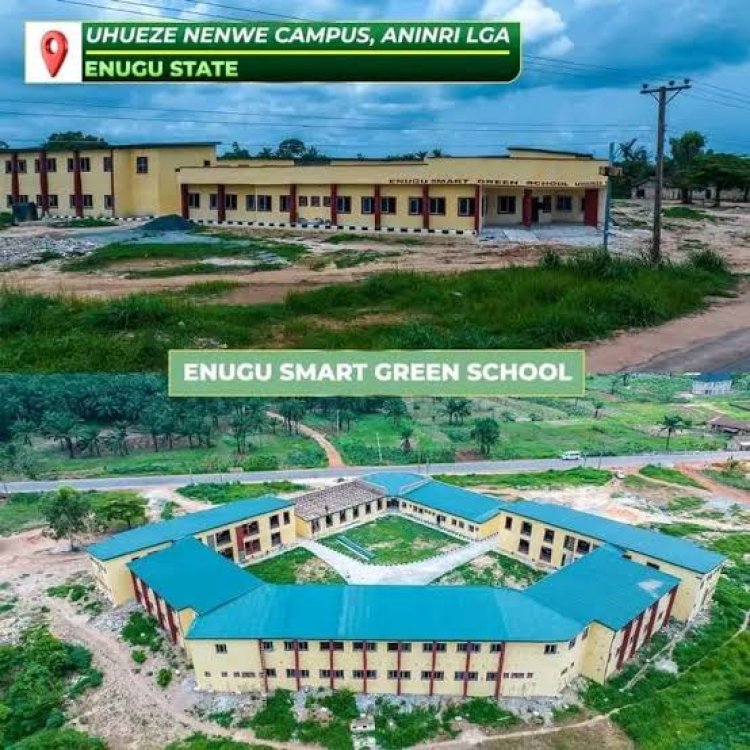
Enugu State has built 268 Smart Green Schools, delivered over 7,000 classrooms and recruited 2,500 smart teachers to transform public education.
Enugu State Government is overhauling its public education system on a scale that has seen it put 268 Smart Green Schools in place and deliver more than 7,000 classrooms, with the larger objective of moving children away from learning largely by memorisation to technology-driven, practical and experiential education.
The reform combines modern teaching methods and digital tools with practical facilities for agriculture, poultry, sports and other hands-on activities. It also involves retraining existing teachers and recruiting new ones with the technological proficiency required to teach in a rapidly changing world.
Secretary to the State Government (SSG), Prof. Chidiebere Onyia, explained the thinking behind the programme when he led members of the Nigerian Guild of Editors (NGE) on a tour of education and other projects in the state.
Onyia said the administration opted for the Smart School model because conventional methods of teaching could no longer adequately prepare children for the world they would inherit.

“None of us wants our kids to go to school in 2026, a 21st-century learning model, with teachers that are sitting and very comfortable with a 20th-century learning model, and we say we are preparing them for the 22nd and 23rd centuries,” he said.
Governor Peter Mbah, during a separate question-and-answer session with the editors, reinforced the point, saying the huge education investment should not be viewed simply in terms of new buildings.
“It is not about structures alone,” the governor said, stressing that the objective was to expose children to 21st-century skills and experiential learning rather than an education system dominated by memorisation.
Mbah said the administration had gone beyond its original target of 260 Smart Green Schools, adding, “we had told you we were going to do 260 Smart Green Schools. We have done 268 now.”
The governor also put the intervention at more than 7,000 classrooms within about two and a half years.
But beyond the physical infrastructure, Onyia said the government realised that new schools equipped with modern technology would achieve little if the teachers remained rooted in old methods.
“We just hired 2,500 smart teachers. We made sure that they had basic technology proficiency,” he said.
Existing teachers are also being retrained, including through about 150 contact hours in basic technology tools, to help them adapt to the new teaching and learning environment.
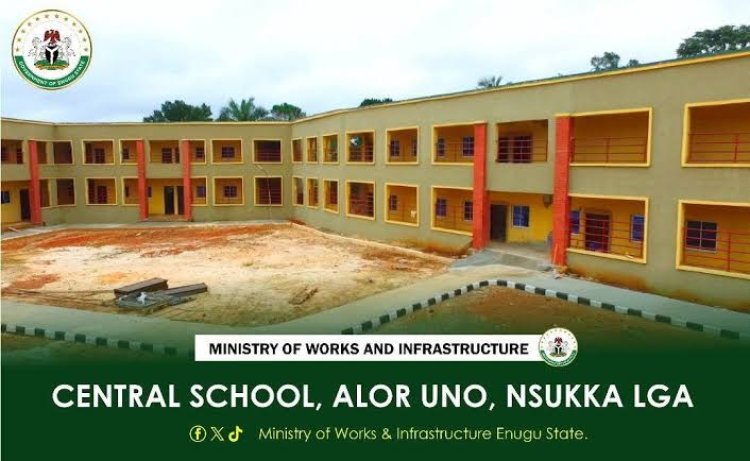
Onyia said government was engaging the Nigeria Union of Teachers in managing the transition but insisted that the standard required to implement the new curriculum would not be compromised.
“We will not put teachers that cannot handle our curriculum. We will not back down. We won’t back down to pressure.”
At the heart of the reform is a deliberate effort to change what happens between teacher and pupil in the classroom.
Rather than simply committing notes and textbooks to memory for examinations, pupils are expected to understand what they learn, interrogate it and apply it to practical situations, arguing that “Students are not just memorising stuff.”
Under the Smart Green School model, digital technology and conventional classroom teaching are combined with practical and experiential learning.
The schools incorporate technology-enabled classrooms and facilities intended to allow pupils encounter in practical terms some of the concepts that would otherwise exist only in textbooks.
The state’s original Smart Green School programme was built around one school in each of the 260 political wards, but Mbah said the number had since risen to 268.
Attention is also shifting to Smart Secondary Schools, which are intended to continue the model for pupils graduating from the basic education system.
One of the Smart Secondary School facilities inspected by the editors at Owo, Nkanu East Local Government Area, is designed to accommodate about 2,000 students in boarding facilities.
“This facility has boarding facilities for 2,000 students,” Onyia said.
The school will combine conventional classrooms with practical facilities for agriculture, poultry, sports and other activities intended to bridge the gap between what students read and what they can actually see, experience and do.
“The whole idea is that technology drives the curriculum and the structure,” the SSG said.
The Smart Secondary School model is being developed across the state’s 17 local government areas, alongside increased government attention to technical and vocational education.
The progression is deliberate: children introduced to technology and experiential learning at the Smart Green School level are expected to continue along the same path at secondary school, rather than return to an education system built predominantly around note-taking and memorisation. Security has also been incorporated into the design of the schools.
Onyia said fibre-optic infrastructure had been laid to support surveillance cameras and connect the facilities to the state’s wider security architecture.
“Right here, we have fibre optics laid also for our cameras. We can see you from here. So, across the state, we are very mindful of security. The Safe Schools Initiative for us is just complementing what we have already.”
The programme also provides for children living with disabilities to be accommodated within the regular school environment.
“Students with disability are not restricted. We want them to be integrated, mainstreamed,” Onyia said.
Education in the government-owned Smart Green Schools, he maintained, remains free, stating, “there is no payment. In our Smart Green Schools, no payment.”
For Mbah and Onyia, therefore, the defining measure of the programme will not merely be the number of schools or classrooms constructed.
The bigger test will be what happens inside them: whether teachers can use technology effectively, whether pupils can translate knowledge into practical skills and whether a child leaving the system is better prepared to solve problems and function in an increasingly technology-driven world.
That is the idea behind Enugu’s attempt to move from learning by memorisation to an education system built for the future.