NSUK Lecturer Calls for Living Wages Through Social Dialogue at ILO International Conference in Italy
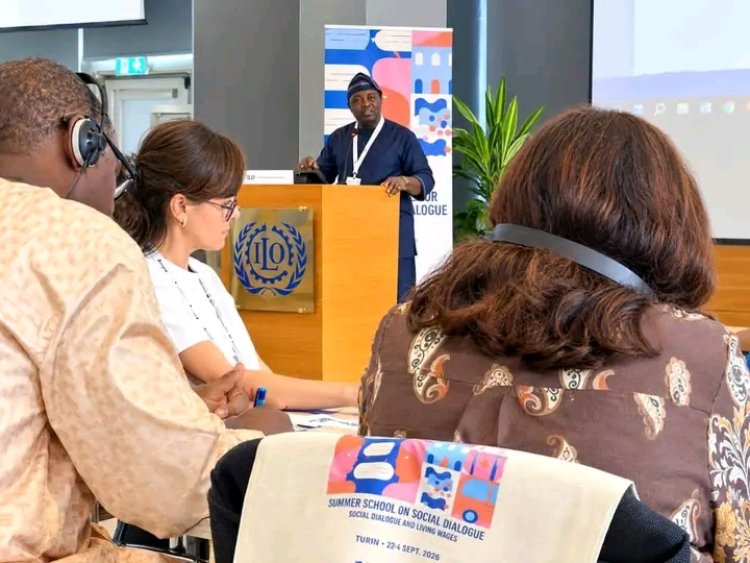
A lecturer in the Faculty of Law at Nasarawa State University, Keffi (NSUK), Dr. Daniel Moses Eyyazo, Esq., has addressed an International Conference/Summer School organised by the International Labour Organisation (ILO) in Turin, Italy.
 Philip22

A lecturer in the Faculty of Law at Nasarawa State University, Keffi (NSUK), Dr. Daniel Moses Eyyazo, Esq., has addressed an International Conference/Summer School organised by the International Labour Organisation (ILO) in Turin, Italy.

Eyyazo, a specialist in Administration of Criminal Justice and Labour Law Justice, is also the National Legal Adviser of the Nasarawa State University Alumni Association.
He spoke on the topic, “Implementing Living Wages Through Social Dialogue: Transforming Corporate Due Diligence into Enforceable Wage Outcomes in Global Supply Chains.”
He delivered the lecture alongside Dr. Nanzy Nzom, an employment expert and alumnus of Nasarawa State University.
The lecture examined the persistent challenge of workers receiving wages that are too low to support a decent standard of living, particularly workers within global supply chains.
Eyyazo noted that although many companies have made commitments to providing “living wages” and governments are increasingly requiring businesses to carry out human-rights due diligence, such measures do not always translate into actual improvements in workers’ pay.
“The lecture proposes social dialogue – especially collective bargaining and meaningful worker participation – as the missing link between corporate promises and real wage improvements,” he said.
Eyyazo identified three reasons social dialogue can contribute to improved wages.
“First, workers understand the real cost of living in their communities. They know the actual cost of food, rent, transportation, education and healthcare. Their participation can therefore make wage calculations more realistic.
“Second, collective bargaining creates accountability because negotiated agreements can contain specific wage obligations, implementation dates and mechanisms for monitoring compliance.
“Third, workers and employers are more likely to accept and implement decisions that they have participated in making,” he explained.
He concluded that social dialogue and collective bargaining remain a bridge between corporate responsibility and actual wage justice.
According to him, when workers, employers and governments participate meaningfully in wage-setting, wage policies become more realistic, accountable and sustainable.
“A fair global economy cannot be created through compliance documents alone; it requires institutions that give workers a genuine role in determining the conditions under which they work and ensuring that their wages allow them to live with dignity,” he added.

No fewer than 26 countries, excluding Nigeria, were represented at the conference.