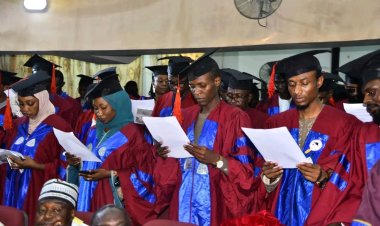
ABU Graduate Enilolobo Tiamiyu Tunde Makes Nigeria Proud, Wins Fully Funded Scholarship to Canada
Ahmadu Bello University (ABU) first-class graduate Enilolobo Tiamiyu Tunde has secured a fully funded Mastercard Foundation Scholarship
 judithhh

ABU first-class graduate Enilolobo Tiamiyu Tunde wins a fully funded Mastercard Foundation Scholarship to study Food and Resource Economics at UBC, Canada
Tunde, who disclosed this in an interview with The Nigeria Education News, was among 42 scholars selected from 11,061 applicants across Africa, with 18 Nigerians making the final list.
The scholarship covers tuition, accommodation, feeding, health insurance and international travel, providing the selected scholars with comprehensive financial support throughout their studies.
Tunde said his first-class degree strengthened his application but noted that academic excellence alone was not enough to secure the highly competitive scholarship.
He said, “The first class really helped me a lot because it made me competitive, but I didn’t add just the first class. I added my work experience, volunteering experience and some leadership experience, and they all counted.”

According to him, the growing awareness of international scholarship opportunities has increased competition, making it necessary for applicants to develop broader profiles that go beyond academic results.
“A lot of people have a first class, a lot of people have two-one, so you really need to stand out in the application,” he said.
Tunde said he discovered the scholarship opportunity on LinkedIn after deliberately following the Mastercard Foundation, UBC and other universities he had identified as potential destinations for further studies.
“I’ve been someone who loves to study abroad, so I always position myself to get information as early as possible,” he said.
He said he applied within a day of seeing the scholarship announcement, describing access to timely information as an important part of his approach to securing international opportunities.
“Basically, for most of the opportunities I got in my life, I got them through LinkedIn, and maybe referrals and all of that,” he said.
Tunde explained that the scholarship selection process involved several stages, beginning with an expression of interest, followed by screening and a detailed application to the Mastercard Foundation.
According to him, successful applicants at that stage received a fee waiver to apply directly to their chosen UBC programme, after which shortlisted candidates proceeded to the interview stage.
He said the application cycle ran from October 2025 to February 2026, with successful candidates receiving their offers in February.
Tunde identified the short application window as one of the major challenges he encountered, particularly the pressure to prepare strong essays and supporting documents within a limited period.
“The time frame is usually short. For you to write a very good essay within a short period of time is kind of really challenging,” he said.
He added that applicants should subject their essays and other application materials to careful review before submission, preferably by lecturers, previous scholarship recipients or other people with relevant experience.

Tunde said several elements of his application helped him stand out, including his academic record, essays, statement of purpose, reference letters, internship, volunteering and leadership experiences.
“My result is number one, and then the quality of my essay made me stand out,” he said, adding that his reference letters and previous experiences also strengthened his application.
Now studying at UBC, Tunde said the master’s programme has exposed him to a different academic environment from the one he experienced as an undergraduate in Nigeria.
He said the Master of Food and Resource Economics programme, which he described as a professional master’s degree, requires a higher level of knowledge and professional engagement.
“The mode of learning here is just kind of different entirely from what we are used to back home,” he said.
Tunde, however, said students should not assume that only first-class graduates can win international scholarships, stressing that a strong second-class upper degree can also provide a competitive foundation when combined with relevant experiences.
“If they don’t have a first class, two-one can still be okay. They should make sure that they have a very strong two-one,” he said.
He urged students still in university to begin building their profiles early by combining good academic performance with volunteering, internships, work experience and leadership activities.
According to him, maintaining good relationships with people is equally important because opportunities are often shared through personal networks.
“You might not be the one that will see the scholarship opportunity. Maybe a friend might just see the scholarship and send it to you,” he said.
Tunde also advised prospective applicants to follow universities, scholarship foundations and other relevant organisations on LinkedIn and other official platforms to receive information about opportunities as soon as they are announced.
He said students should not wait for a scholarship opportunity before developing the qualifications and experiences required to compete for it.
“Your academic record or your academic performance is very, very key in any scholarship you want to apply for. Then you have to complement it with volunteering experience, work experience, as many as possible,” he said.
His selection comes amid growing competition for international scholarships, with 11,061 applicants competing for the Mastercard Foundation opportunity across Africa and only 42 eventually selected, including 18 Nigerians.