ARUA Secretary-General Praises Adebowale’s Administration for Advancing Global Partnerships, Innovation and Institutional Development at UI
The Secretary-General of the African Research Universities Alliance (ARUA), Professor John Owusu Gyapong, has described the tenure of the 13th Vice-Chancellor of the University of Ibadan (UI), Professor Kayode O. Adebowale, mni, FAS, fspsp, as purposeful and impactful, particularly in global partnerships, innovation, institutional growth, digital development and strategic collaborations.
 Philip22

The Secretary-General of the African Research Universities Alliance (ARUA), Professor John Owusu Gyapong, has described the tenure of the 13th Vice-Chancellor of the University of Ibadan (UI), Professor Kayode O. Adebowale, mni, FAS, fspsp, as purposeful and impactful, particularly in global partnerships, innovation, institutional growth, digital development and strategic collaborations.

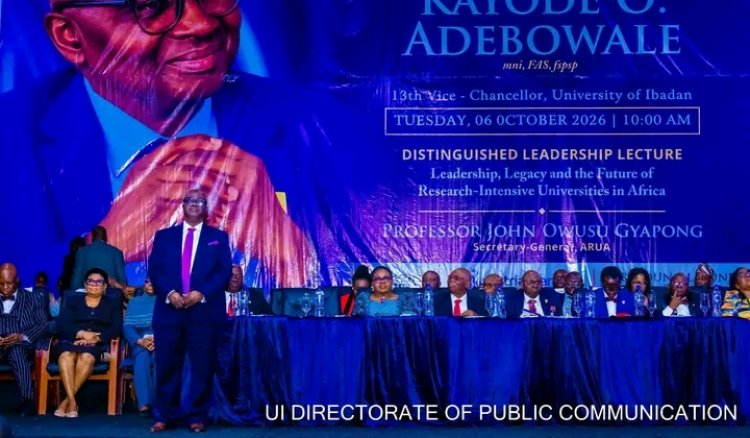
Professor Gyapong made this assessment while delivering a lecture at a ceremony organised to commemorate the end of Professor Adebowale’s tenure as Vice-Chancellor. The lecture was titled “Leadership, Legacy and the Future of Research-Intensive Universities in Africa.”
He noted that Professor Adebowale demonstrated a strong commitment to innovation and institutional development throughout his tenure.
Recalling the outgoing Vice-Chancellor’s mantra, “Innovate or Stagnate,” Professor Gyapong described it as an important reminder that institutions must continuously improve, even when they are already performing well.
He commended Professor Adebowale for his service to the University of Ibadan and the wider African higher education sector, adding that the occasion provided an opportunity to reflect on the kind of leadership, institutions and universities Africa would need in the coming decades.
Professor Gyapong explained that ARUA is a network of research-intensive African universities established to strengthen research capacity and collaboration across the continent. He noted that the University of Ibadan is a founding member of the alliance, which comprises 23 research-intensive universities.
He disclosed that ARUA focuses on several critical areas, including public health, water, energy, non-communicable diseases, artificial intelligence, technology, conflict and urbanisation.
According to him, collaborative initiatives such as mobility programmes for early-career researchers, mid-career fellowships and research conferences have helped African institutions build capacity and share expertise.
He encouraged universities to participate actively in such networks to benefit from shared knowledge, research infrastructure and institutional experience.
The ARUA Secretary-General also challenged African research-intensive universities to move beyond producing academic publications and become institutions that directly address the continent’s developmental challenges.
He identified infrastructure deficits, pandemics, food insecurity, conflict, governance challenges and other socioeconomic problems as major issues confronting Africa.
Professor Gyapong maintained that universities could not remain detached from these challenges because they possessed the data, expertise and human resources required to develop practical solutions.
He further expressed concern about Africa’s poor performance in achieving the United Nations Sustainable Development Goals (SDGs), stressing that the situation should concern academics and research institutions.

He challenged research-intensive universities to provide evidence of the continent’s progress and generate knowledge capable of informing public policies and improving citizens’ lives.
The scholar also noted that sub-Saharan Africa accounts for approximately 17.5 per cent of the global population, yet its contribution to the global research community remains disproportionately small.
He urged African universities to invest substantially in human capital, doctoral education, research infrastructure and systems that support young and emerging scholars.
Professor Gyapong called for increased investment in both basic and developmental research, emphasising that research outputs should be translated into products, policies, enterprises and community-based solutions.
He also stressed the importance of integrating the social sciences into scientific research and advocated stronger partnerships among universities, governments, industry, foundations and civil society organisations to ensure that research responds to societal needs.
The Pro-Chancellor and Chairman of the Governing Council of the University of Ibadan, His Excellency, Chief Adebisi Akande, CFR, represented by Council Member Professor E. B. Alo, described Professor Adebowale’s tenure as a period of significant partnerships, increased research visibility and institutional growth for the university.
He said the end-of-tenure ceremony provided an opportunity to reflect on Professor Adebowale’s leadership and assess the impact of his administration on the institution.
The convener of the ceremony and Deputy Vice-Chancellor, Research, Innovation and Strategic Partnerships, Professor Simisola O. Akintola, explained that the event was organised to review the achievements recorded during the outgoing Vice-Chancellor’s tenure.
She disclosed that the university established approximately 200 partnerships across 27 countries during the five-year period. These included 108 research collaborations, industry partnerships, student mobility agreements and other strategic collaborations.
Professor Akintola said the university’s growing international recognition under Professor Adebowale’s leadership was reflected in global rankings and research indices.
She noted that the University of Ibadan was placed in the 801–1000 band globally in the 2026 Times Higher Education World University Rankings.
According to her, the university also recorded strong performance in the 2026 edition of the AD Scientific Index, where it was ranked among the top universities globally.
Professor Akintola identified people, infrastructure and trust as the three critical pillars of a research-intensive university.
She explained that while people and infrastructure could be measured, trust was built gradually and could easily be lost.
The Deputy Vice-Chancellor noted that the continued return of visiting scholars, funders, industry partners and other international collaborators to Ibadan demonstrated their confidence in the institution and its leadership.
She described this trust as an important part of the outgoing Vice-Chancellor’s legacy.
Professor Akintola also acknowledged the sponsorship of the ceremony by AstriaLearning, through its Chief Executive Officer, Dr. Jeff Bordes, and Mr. Abiodun Olatunji, SAN, describing their support as an example of the meaningful institutional partnerships established by the university.
In his response, the outgoing Vice-Chancellor, Professor Kayode O. Adebowale, stated that the growth of the University of Ibadan was the product of collective effort, emphasising that no Vice-Chancellor could claim sole credit for an institution’s success.
Professor Adebowale recalled joining the University of Ibadan as a student on September 15, 1980. He said that although he knew little about the institution before his admission, the university had since become an important part of his life.
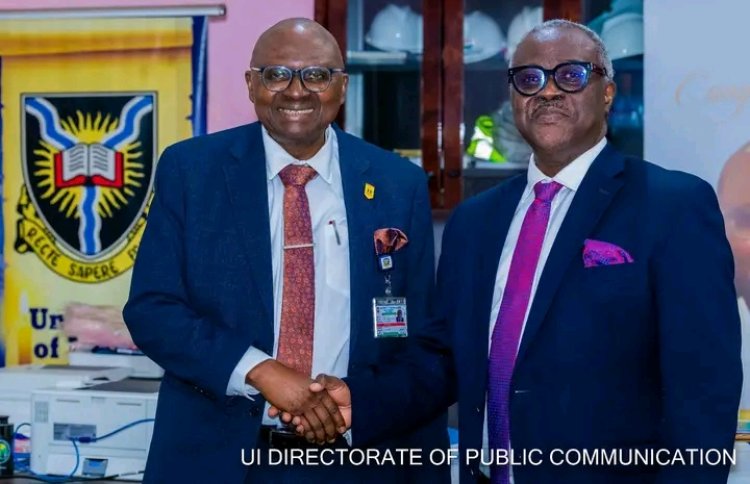
He noted that UI was built on a strong foundation of excellence, integrity and service established by its pioneer principals.
The outgoing Vice-Chancellor urged stakeholders and members of the university community to regard the institution as a collective project and work together to advance its continued development.
He also commended the organising team led by Professor Akintola and thanked the sponsors for supporting what he described as an unprecedented gathering.