
FUNAAB Research Highlights Botanical Solution To African Rice Gall Midge At IFSERAR Seminar
The Institute of Food Security, Environmental Resources and Agricultural Research (IFSERAR), Federal University of Agriculture, Abeokuta (FUNAAB), has showcased research findings on the potential use of botanical extracts as sustainable alternatives to synthetic insecticides in controlling the African rice gall midge.
 Philip22
The Institute of Food Security, Environmental Resources and Agricultural Research (IFSERAR), Federal University of Agriculture, Abeokuta (FUNAAB), has showcased research findings on the potential use of botanical extracts as sustainable alternatives to synthetic insecticides in controlling the African rice gall midge.
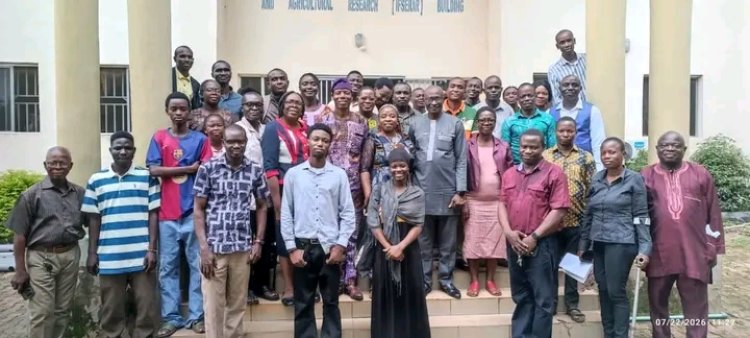
The findings were presented during the institute’s July Monthly Seminar held on Wednesday, July 22, 2026, at the IFSERAR Laboratory.
The seminar, titled “Harnessing the Biopesticidal Potential of Selected Botanical Extracts Against African Rice Gall Midge,” was delivered by Dr. Busola Ayangbemi, who highlighted the impact of the African rice gall midge (Orseolia oryzivora Harris and Gagné) on rice production across Africa.
Dr. Ayangbemi explained that the insect pest affects both irrigated and rain-fed lowland rice fields, causing the characteristic “silver shoot” or “onion leaf shoot” symptoms and potentially leading to up to 100 per cent yield losses in areas where the pest is endemic.
Presenting the research findings, she disclosed that ten botanical extracts were evaluated as environmentally friendly alternatives to conventional insecticides.
According to her, Ageratum conyzoides recorded the highest insecticidal activity, significantly reducing pest infestation and damage while improving plant growth, increasing productive tillers and panicles, and enhancing grain yield.
She noted that Chromolaena odorata ranked second in effectiveness, followed by Ocimum gratissimum.
The researcher further revealed that treating rice seeds with botanical extracts before planting provided systemic protection against the African rice gall midge.
She explained that rice plants grown from treated seeds recorded significantly lower levels of infestation compared to untreated plants, showing that the bioactive compounds remained effective during the early stages of crop development.
Dr. Ayangbemi also emphasised the role of rice varieties in determining treatment effectiveness, noting that the moderately resistant variety BW 348-1 consistently recorded lower infestation levels and higher grain yields compared to the susceptible ITA 306 variety.
She stated that combining host plant resistance with botanical seed treatment could provide stronger protection against the pest and improve sustainable rice production.
The seminar concluded that selected botanical extracts have significant biopesticidal potential and could serve as environmentally friendly substitutes for synthetic insecticides.
Participants noted that incorporating Ageratum conyzoides, Chromolaena odorata and Ocimum gratissimum into integrated pest management strategies could contribute to sustainable agriculture, improved food security and environmental protection across Africa.