TASFUED VC Charges New Appointees on Institutional Transformation Drive, Demands Measurable Performance and Accountability
TASFUED VC Charges New Appointees on Institutional Transformation Drive, Demands Measurable Performance and Accountability
 UmarFarouk123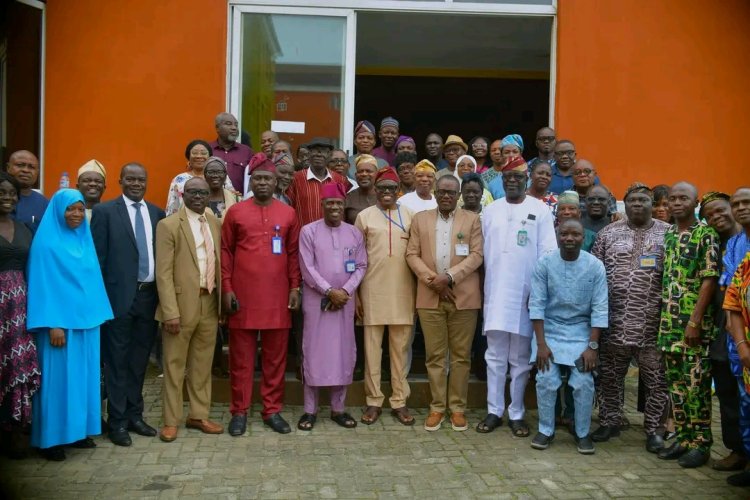
The Vice-Chancellor, Tai Solarin Federal University of Education, TASFUED, Ijagun, Professor Samuel Oladipo, MNPA, CMCPN, MCAN, FIELPN, has charged newly appointed academic leaders of the University to translate the institution’s strategic vision into measurable results through excellence, accountability, quality service and effective leadership.
Professor Oladipo gave the charge while sharing his vision and strategic priorities with the newly appointed Provost, Deputy Provost, Directors, Coordinators and Heads of Department at a one-day training workshop on Strategic Academic Leadership, Stakeholder Engagement and Quality Assurance for Digital Transformation and Institutional Growth, organised by the University Management.
The Vice-Chancellor used the session to acquaint the new academic leaders with the STAR-WIN Implementation and Performance Management Framework, the five-year institutional delivery framework for the 2026–2031 administration. He explained that the framework was designed to translate the administration’s strategic vision into specific targets, assigned responsibilities and measurable outcomes across the University.
Professor Oladipo said the framework would provide a structured mechanism for assessing institutional, College, departmental and individual performance, with emphasis on accountability, evidence-based assessment and continuous improvement.
He identified the seven pillars of STAR-WIN as: Sustainable Funding and Smart Governance; Technology and Digital Campus; Academic Excellence and Innovation; Research Productivity and Global Ranking; Welfare and Wellbeing; Infrastructure Development; and National, Alumni and International Relations.
According to him, performance would be assessed through a 100-point system based on approved targets, timelines and verifiable evidence, with each strategic objective assigned an owner and measurable indicators. He added that performance would be classified under six rating bands: Outstanding, Excellent, Good, Moderate, Weak and Unsatisfactory.
The Vice-Chancellor explained that Academic Excellence and Innovation and Research Productivity and Global Ranking would each attract 20 points, while Sustainable Funding and Smart Governance and National, Alumni and International Relations would carry 15 points each, with the remaining points distributed among the other strategic pillars.
He further disclosed that implementation of the framework would proceed through five phases: Foundation in 2026/27, Consolidation in 2027/28, Acceleration in 2028/29, Internationalisation in 2029/30 and Legacy in 2030/31.
Among the targets of the framework, he said, were increasing internally generated revenue from 10 per cent to 30 per cent; raising quality-indexed publications from 15 per cent to 80 per cent; increasing successful research grants from 10 per cent to 75 per cent; achieving 100 per cent international co-authorship; digitising 95 per cent of core institutional processes; and ensuring full digital training coverage for staff.
Other targets, he added, included reviewing all academic programmes, addressing critical infrastructure defects and achieving complete alumni database coverage by 2031.
Speaking on quality assurance, the Director, Directorate of Academic Planning and Quality Assurance, DAPQA, Professor Jimoh Owoyele, stressed that quality assurance should be treated as a continuous and evidence-based management responsibility rather than an exercise undertaken only in preparation for accreditation or regulatory inspections.
Professor Owoyele described Heads of Department as the University’s quality gatekeepers, urging them to translate University statutes, regulations and National Universities Commission, NUC, requirements into effective departmental practices.
He noted that quality assurance should cover curriculum implementation, teaching and assessment standards, equitable workload distribution, staff development and the effective resolution of students’ academic concerns. He also urged HODs to ensure compliance with the NUC Core Curriculum and Minimum Academic Standards, CCMAS, maintain updated departmental compliance files and continuously identify and address areas of weakness.
The Director cautioned against the manipulation of academic outcomes, emphasising that result analysis should be used to improve teaching and learning. He also called on academic leaders to institute effective controls against corruption, exploitation and favouritism in areas such as fees, assessment, supervision, procurement and conflicts of interest. A practical 90-day action plan was presented to guide newly appointed HODs in strengthening quality assurance systems in their respective departments.
In his presentation on SERVICOM policy and compliance, the Director, SERVICOM, Professor Bayo Akinsanya, challenged academic and administrative leaders to move beyond the mere existence of policy documents and Service Charters by ensuring that approved service standards are reflected in the University’s daily operations.
Professor Akinsanya explained that SERVICOM, meaning Service Compact with All Nigerians, establishes a commitment between service providers and citizens by defining service standards, timelines, rights, responsibilities and mechanisms for redress.
He identified timeliness, accessibility, transparency, responsiveness, accountability, courtesy and fairness as the seven principles underpinning effective service delivery, urging Directors, Coordinators and HODs to take ownership of the services provided by their Units and ensure that stakeholders received the right service at the right time and in the right manner.
The Director described effective complaint management as a critical component of institutional trust, advising staff to receive, record, acknowledge, investigate, resolve and appropriately communicate complaints. He stressed that feedback from complaints should be analysed and used to identify institutional weaknesses and improve University processes.
He also advocated the simplification and digitalisation of institutional processes to eliminate unnecessary delays and improve accessibility, noting that every service should have clearly defined standards, timelines and responsible officers.
The workshop also addressed financial discipline and responsible resource management, with the Director of Procurement, Dr. Odukunle Odusanya, highlighting the financial pressures facing Federal Universities and the need to strengthen revenue generation while ensuring prudent management of available resources.
In his presentation on Finance, Procurement and Resource Management, Dr. Odusanya identified government subventions, student payments, endowments and donations, academic consultancy, business ventures and registered companies as potential sources of institutional revenue.
He, however, stressed that financial sustainability went beyond generating additional income, noting that it also required the prevention of waste, leakages and misuse of resources.
The Director of ICT, Dr. Ademola Adenubi, in his paper presentation, explained the innovations being introduced by the Directorate and their implications for staff and students, particularly in enhancing digital processes, accessibility and institutional efficiency.
The workshop underscored the commitment of the Oladipo-led administration to building a financially sustainable, digitally enabled, academically excellent, research-driven and service-oriented University, while equipping newly appointed leaders with the knowledge and leadership capacity required to translate the administration’s strategic vision into measurable institutional outcomes.
The training was attended by the Deputy Vice-Chancellor, Administration, Professor Adekunle Adeogun, FISN; Deputy Vice-Chancellor, Academic, Professor Rotimi Ettu; Registrar and Secretary to Council, Mr. Dapo Oke, FCIA, MNIM; Bursar, Mr. Kabir Ogunneye, FCA; and University Librarian, Professor Adebambo Oduwole.