Build Financial Resilience on Research Strengths and Alumni Relations, DBN MD Tells PAAU at Maiden Distinguished Lecture
Build Financial Resilience on Research Strengths and Alumni Relations, DBN MD Tells PAAU at Maiden Distinguished Lecture
 UmarFarouk123
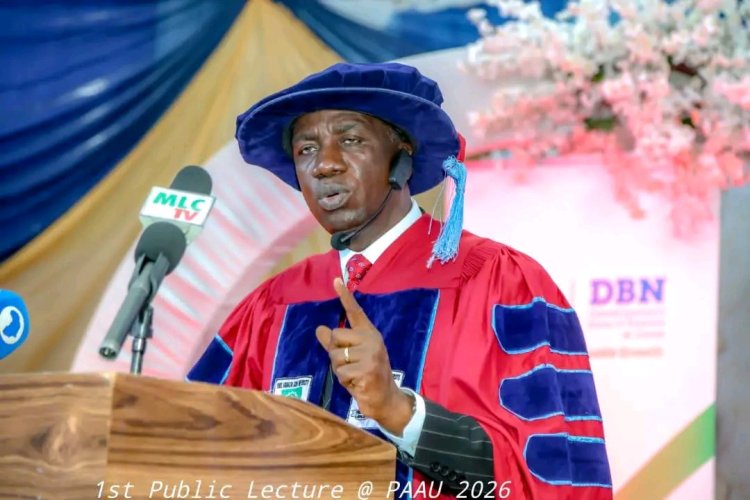
The Managing Director/Chief Executive Officer of the Development Bank of Nigeria (DBN), Dr. Tony Okpanachi, has urged Prince Abubakar Audu University (PAAU), Anyigba, to build a resilient funding base through institutional capacity, distinctive research strengths and organised alumni relationships.
He said capital flows to institutions that demonstrate the ability to use it effectively.
Dr. Okpanachi made the call while delivering the University's maiden Distinguished Personality Public Lecture on Monday, 26th October, 2026, at the University Auditorium. The lecture was themed, The Making of a Great University: Institutions, Resources and Relevance.
Anchoring his presentation on the University's motto, Knowledge for Self-Reliance, the Guest Lecturer explained that the principle should apply not only to graduates but also to the institution itself.
He said the motto represents a promise to students that their education should equip them to earn a living, stand on their own feet and contribute meaningfully to society.
Dr. Okpanachi noted that while education should prepare graduates for productive lives, the University must also develop the capacity to sustain its ambitions, mobilise resources and create lasting value.
He clarified that self-reliance does not mean government should withdraw its responsibility to fund public universities. Rather, he advocated financial resilience that would enable PAAU to withstand funding disruptions, pursue opportunities and diversify its income without depending entirely on government allocations.
Reflecting on the University's development, he noted that PAAU, established in 1999 as Kogi State University, had reached an important stage in its institutional journey, and observed that the increasingly competitive higher education environment requires universities to strengthen their capabilities and demonstrate relevance.
He identified talent, resources and governance as the three pillars of university excellence, explaining that resources without effective governance could be wasted, while talent without adequate support could leave.
He maintained that a great university should be measured not merely by rankings but by its ability to provide solutions to the problems of its surrounding society.
The Guest Lecturer proposed a diversified funding structure comprising government allocations and Tertiary Education Trust Fund (TETFund) support, research grants, consultancy, professional training, alumni contributions, philanthropy, corporate partnerships and properly governed income from university assets.
He cautioned that income-generating ventures must support the University's academic mission rather than divert attention from teaching, research and community service.
He urged PAAU to strengthen its financial and administrative systems, including project accounting, procurement, research management and reporting, to improve its ability to attract and manage external funding, stressing that availability of funds alone does not guarantee development without capacity to deploy them effectively.
Dr. Okpanachi described the University's alumni community as a valuable strategic asset, recalling that 26,160 graduates received degrees at a single ceremony in January.
He said alumni could contribute through professional networks, mentorship, internships, research collaboration, advocacy and industry partnerships, in addition to financial donations.
He recommended that the University establish a recognised alumni platform, maintain a reliable graduate database and create chapters where graduates live and work, stressing that sustained support depends on trust, meaningful engagement and a strong sense of belonging.
He added that research discoveries require effective partnerships, financing and pathways to practical application to achieve commercial or societal impact, and encouraged the University to collaborate with established research centres, strengthen doctoral training and develop systems that support innovation, intellectual property management and industry engagement.
Outlining five priorities, Dr. Okpanachi called for focused research investment, a dedicated advancement function, a deliberate resource mobilisation strategy, stronger research-to-impact systems and an annual report measuring institutional outcomes.
He identified research income, grants secured, graduate employment, industry partnerships, alumni engagement and demonstrable impact on Kogi State as useful indicators of progress.
He urged the University to begin with capable personnel, clear responsibilities and measurable targets, noting that institutional advancement requires deliberate decisions and consistent implementation.
He concluded that while earlier generations had established and developed the University, the present generation must position it to become distinctive, quoting Thandika Mkandawire: And if Africa will have to run, the university will have to sprint.
Earlier, the Director of Advancement, Support and Linkages, Rev. Fr. Professor Nicholas Ojoajogwu Okpe, described the lecture as a historic milestone in PAAU's pursuit of academic excellence and societal relevance, saying institutions, resources and relevance are interconnected pillars of development.
In his address, the Vice-Chancellor, Professor Salisu Ogbo Usman, described the maiden lecture as the inauguration of an enduring platform for intellectual engagement and institutional development.
He emphasised the importance of strengthening town-and-gown relationships and expressed appreciation to Dr. Okpanachi for delivering the lecture, while commending the Directorate of Advancement, Support and Linkages for facilitating the initiative.