FUTES-IYIN Records 129 Google Scholar Entries in First Year as VC Commends Academics
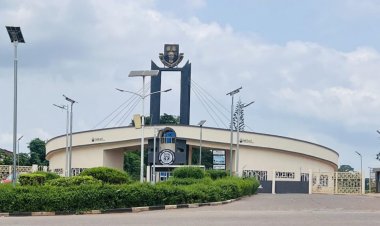
The Federal University of Technology and Environmental Sciences, Iyin-Ekiti (FUTES-IYIN), has recorded 129 entries in the Final Harvest of Academia Google Scholars 2026, marking another early milestone in the research visibility of the young institution.
 Philip22

The Federal University of Technology and Environmental Sciences, Iyin-Ekiti (FUTES-IYIN), has recorded 129 entries in the Final Harvest of Academia Google Scholars 2026, marking another early milestone in the research visibility of the young institution.
The achievement comes amid other recent academic successes involving the university's lecturers. These include the recognition of four academics among Nigeria's top 500 researchers in the Scopus ranking and the inclusion of two lecturers in the 2026 Stanford-Elsevier global ranking of the world's top two per cent scientists.
FUTES-IYIN commenced academic activities in January 2026 and remains in the early stages of developing its academic and research profile.
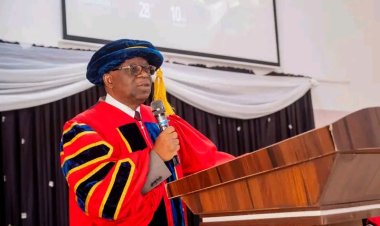
Reacting to the development, the Vice-Chancellor, Professor Gbenga Aribisala, commended the university's academics, describing their growing visibility as an encouraging indication of the intellectual capacity within the institution.
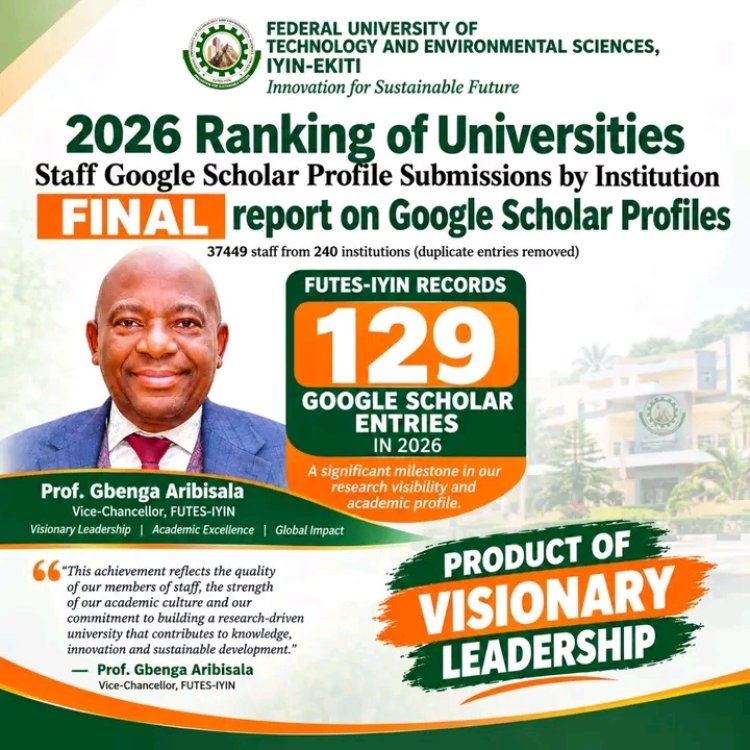
“For a young university, this is an encouraging development. It reflects the quality of academics we have and the importance we attach to building an institution where scholarship, research and innovation are taken seriously,” he said.
Google Scholar provides a platform for discovering researchers' publications, exploring their scholarly contributions and tracking citations.
According to Aribisala, the 129 entries further demonstrate the university's emerging presence in the academic and research community.
The Vice-Chancellor explained that the institution's ambition extended beyond establishing the physical infrastructure required for academic activities to creating an environment where qualified academics could contribute to knowledge and address societal challenges.
“A university is built not only on infrastructure, but also on the quality of its members of staff, the ideas they generate, and the contributions they make to society. Our responsibility is to provide an environment in which our academics can teach, research, publish and collaborate with colleagues within and outside Nigeria,” he added.
Aribisala disclosed that the university's long-term priorities would include sustaining academic standards, encouraging quality publications and creating opportunities for research capable of addressing practical needs.