Professor Simeon Abiodun Ige Delivers 31st Inaugural Lecture Of Prince Abubakar Audu University, Anyigba
Professor Simeon Abiodun Ige Delivers 31st Inaugural Lecture Of Prince Abubakar Audu University, Anyigba
 UmarFarouk123
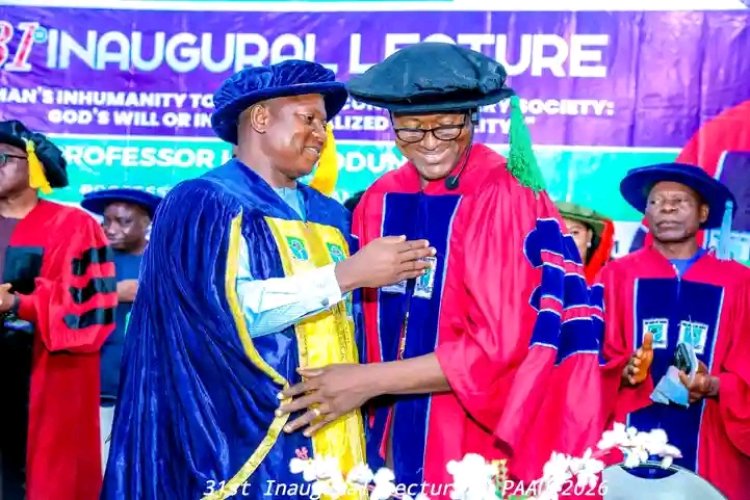
A Professor of New Testament Studies in the Department of Religious Studies, Prince Abubakar Audu University, Anyigba, Professor Simeon Abiodun Ige, has called for a comprehensive national overhaul, moral reactivation and greater empathy towards poor and marginalised Nigerians to address injustice, deprivation and the widening gap between the rich and the poor.
Prof. Ige made the call while delivering the 31st Inaugural Lecture of the University on Tuesday, 3rd November 2026, on the topic: "Man's Inhumanity to Man in the Contemporary Society: God's Will or Institutionalized Partiality?"
The Inaugural Lecturer explained that the lecture examined the problem of human cruelty, injustice and lack of compassion, with particular attention to the attitude of the rich towards the poor in contemporary society.
He noted that man's inhumanity to man manifests in different forms, including oppression, exploitation, discrimination, denial of rights, violence, hatred and the unjust treatment of fellow human beings.
Prof. Ige explained that the condition of the poor, oppressed and marginalised in society raises important moral and religious questions about the responsibility of individuals, institutions and government in addressing human suffering.
He added that poverty remains a major challenge in Nigeria, particularly where people are unable to access basic necessities of life, including food, clothing and shelter.
The Professor of New Testament Studies noted that the growing disparity between the rich and the poor has continued to deepen social inequality, making it difficult for the disadvantaged to enjoy opportunities and live with dignity.
He explained that the lecture considers the biblical understanding of wealth and poverty, examining how different biblical traditions presented the rich, the poor and the responsibilities of individuals towards people in need.
Prof. Ige noted that the biblical teachings on wealth and poverty provide important moral and ethical insights into the treatment of the less privileged, particularly the need to demonstrate compassion, fairness and concern for the welfare of others.
The Inaugural Lecturer stressed that the existence of poverty should not automatically be interpreted as evidence of divine punishment or lack of faith, noting the need for a balanced religious understanding of the circumstances of the poor and the responsibilities of the wealthy.
He maintained that the relationship between wealth and poverty should be examined beyond religious assumptions, particularly where institutional arrangements and human actions contribute to the deprivation and suffering of the disadvantaged.
Prof. Ige further examined the place of the poor and needy in biblical teachings, drawing attention to the moral responsibility of individuals and religious institutions to protect vulnerable people and provide assistance to those in distress.
He explained that the teachings of the New Testament emphasise compassion, care and practical support for people experiencing hardship, adding that genuine religious commitment should reflect in the way people treat one another.
The Inaugural Lecturer also examined the responsibility of the Church towards the poor in Nigeria, noting that religious institutions have important roles to play in addressing both the spiritual and physical needs of their members and the wider society.
He noted that while some churches have programmes through which money, materials and other forms of assistance are provided to the poor and needy, more attention should be given to the economic realities confronting the disadvantaged members of society.
Prof. Ige expressed concern that the pursuit of material prosperity and the accumulation of wealth could undermine the Church's responsibility towards the poor when the needs of vulnerable people are neglected.
He noted that the Church should remain a reflection of the values and teachings of Jesus Christ by demonstrating concern for the suffering of the poor and ensuring that religious activities do not worsen their economic difficulties.
He explained that the Church's responsibility to the poor should not be limited to occasional distribution of money and materials but should also include practical interventions that promote economic empowerment and sustainable improvement in their living conditions.
He stressed that the Church, like other institutions in society, should be evaluated by its commitment to justice, compassion and the welfare of people who are vulnerable and disadvantaged.
On the major issues confronting the poor in contemporary Nigerian society, Prof. Ige drew attention to institutionalised injustice, partiality, deprivation, oppression and the denial of fundamental human rights.
He explained that these conditions are sustained when those entrusted with positions of authority use institutional structures and opportunities to advance the interests of a privileged few at the expense of the wider population.
The Inaugural Lecturer noted that the concentration of opportunities and resources in the hands of privileged individuals, alongside the neglect of poor and defenseless people, contributes to the widening gap between the rich and the poor.
He maintained that the situation in which the rich continue to get richer while the poor become poorer is unacceptable, describing it as anti-development and contrary to the moral expectations of society.
Prof. Ige stressed that the suffering of poor people, oppressed workers and marginalised groups should not be regarded as God's will, but rather as a consequence of institutionalised injustice and the failure of individuals and authorities to uphold fairness and human dignity.
He called for a change in the development trajectory of Nigeria and Africa, stressing that meaningful political, social and economic progress requires a complete overhaul of existing practices and a renewed commitment to moral values.
The Inaugural Lecturer emphasised the need for government and privileged members of society to demonstrate empathy towards defenseless workers and poor masses, noting that national development should give priority to those who are most vulnerable.
In his recommendations, Prof. Ige called on the church to recognise that its mission encompasses both the spiritual and physical needs of humanity.
He stressed that the church should ensure that its efforts to minister to the poor do not compound their existing difficulties, but instead provide meaningful support that improves their welfare and dignity.
He further recommended that churches, as employers of labour, should provide employment opportunities for poor people and pay reasonable wages.
He maintained that employment opportunities should not be reserved exclusively for the children and relations of privileged individuals, stressing that qualified children of poor families should also have access to decent and sustainable employment in government and non-governmental establishments.
Prof. Ige also called on churches and government to ensure that policies are properly monitored and fully implemented, noting that the existence of policies alone cannot address social problems without effective execution.
He urged relevant authorities to remove obstacles to the implementation of approved policies and ensure that bureaucrats who frustrate their execution are held accountable.
He maintained that people occupying positions of authority in government and religious institutions should recognise the responsibility attached to their offices and remain conscious of their obligation to serve the public interest.
He stressed that addressing the plight of the poor requires a collective commitment to justice, fairness, accountability and respect for the fundamental rights of every individual.
The Inaugural Lecturer concluded that Nigeria's development should be driven by Nigerians and directed towards improving the conditions of defenseless workers and poor masses, rather than protecting the interests of a privileged few.
He maintained that man's inhumanity to man must be discouraged at every level of society if the country is to attain meaningful political, social and economic development.
Earlier, the Chairman of the Inaugural Lecture Committee, Prof. S. S. Arogba, congratulated the inaugural lecturer on achieving the academic milestone.
In his address, the Vice-Chancellor, Professor Salisu Ogbo Usman, described the 31st Inaugural Lecture as a reflection of the University's commitment to rigorous scholarship, intellectual engagement, the preservation of knowledge and the application of research to societal advancement.
Prof. Usman noted that the lecture was the 14th since the present administration assumed office on 11th February 2026, adding that it came barely a week after the University's First Distinguished Personality Public Lecture, held on 26th October 2026.
He explained that the regularity of the University's intellectual engagements demonstrated its determination to sustain the Inaugural Lecture Series as a platform for sharing scholarship with the wider public.
The Vice-Chancellor described the topic as timely and compelling, noting that the moral worth of any society is reflected in how its people treat one another, particularly those who are poor, vulnerable, disadvantaged or without influence.
He added that hardship, discrimination and injustice in contemporary society should not be accepted as inevitable expressions of divine will, but should be examined as possible consequences of human choices and institutional arrangements that privilege some people while marginalising others.
Prof. Usman stressed that religion or fate should not be used to excuse human conduct and institutional practices for which individuals and society must accept responsibility.
He explained that institutionalised partiality manifests in favouritism, discrimination, unequal access to opportunities, the exclusion of deserving persons and the neglect of people who require protection.
The Vice-Chancellor noted that such practices would weaken public trust, deepen social divisions and frustrate development, stressing that a humane society must be built on fairness, transparent procedures, accountable leadership, equal treatment and respect for the dignity of every person.
Prof. Usman explained that the subject also had significance beyond the University, as the Church, mosque, educational institutions, public agencies, community leaders and policymakers all had important roles to play in promoting fairness, justice and human dignity.
He congratulated Prof. Ige on the academic achievement and commended his sustained contributions to New Testament Studies, teaching, research and the advancement of knowledge.