UNIZIK VC Unveils Five-Year Strategic Plan, Targets Top 5 in Nigeria, Top 20 in Africa by 2031
The Vice-Chancellor of Nnamdi Azikiwe University (UNIZIK), Professor Ugochukwu Bond Anyaehie, has unveiled a five-year Strategic Development Plan aimed at repositioning the university as the leading federal university in South-East Nigeria and placing it among the top five universities in Nigeria and top 20 in Africa by 2031.
 Philip22

The Vice-Chancellor of Nnamdi Azikiwe University (UNIZIK), Professor Ugochukwu Bond Anyaehie, has unveiled a five-year Strategic Development Plan aimed at repositioning the university as the leading federal university in South-East Nigeria and placing it among the top five universities in Nigeria and top 20 in Africa by 2031.
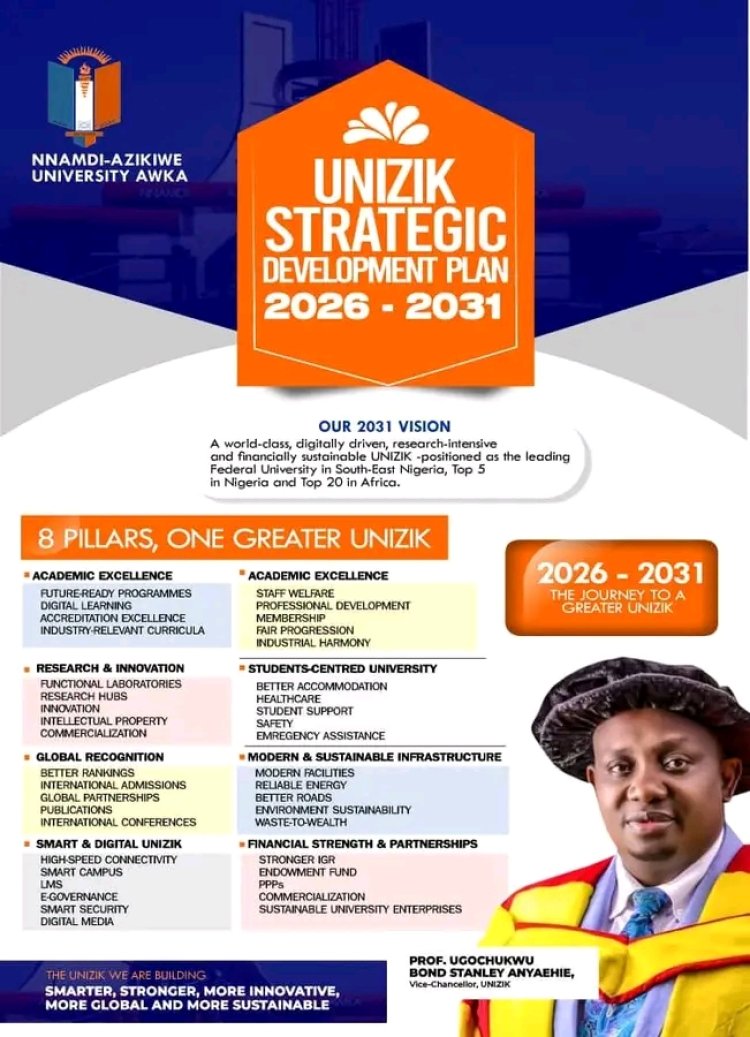
The strategic plan, which covers 2026 to 2031 and is themed “A Greater UNIZIK is Possible,” sets out a comprehensive development agenda focused on academic excellence, research and innovation, digital transformation, staff and student welfare, infrastructure, internationalisation and financial sustainability.
The plan identifies some of the major challenges confronting the university, including unstable power supply, fragmented digital infrastructure, congestion in classrooms and laboratories, delays in the installation of procured equipment and constraints arising from the centralisation of financial resources.
Professor Anyaehie said the new roadmap was designed to provide a coordinated response to these challenges while establishing a clear direction for the university’s growth over the next five years.
A major focus of the plan is the transformation of teaching and learning. Under its Academic Excellence and Curriculum Transformation agenda, the university will strengthen the implementation of the NUC Core Curriculum and Minimum Academic Standards (CCMAS), expand digital and flexible learning opportunities, improve accreditation readiness and ensure that academic programmes are better aligned with emerging industry and labour-market demands.
The university is also placing research and innovation at the centre of its development strategy.
Under the Research Excellence, Innovation and Knowledge Translation pillar, UNIZIK plans to expand applied research, tackle procurement and equipment-installation bottlenecks, strengthen intellectual property protection and create pathways for commercialising research discoveries.
The plan further provides for the establishment of specialised research hubs in clean energy and artificial intelligence, reflecting the university’s intention to participate more actively in solving contemporary technological and societal challenges.
In a related move to raise the university’s profile internationally, the administration will pursue an aggressive Global Visibility, Rankings and Internationalisation programme.
This will include improving the university’s global digital presence and ranking performance, establishing dedicated international admissions structures, supporting publication funding for researchers and hosting international conferences designed to attract scholars and institutions from different parts of the world.
The administration’s Smart University Agenda is another major component of the plan.
UNIZIK is expected to move progressively towards a digitally connected campus through high-speed internet infrastructure, deployment of a Learning Management System, smart security systems, expanded e-governance and modern digital media production facilities.
The digital agenda is expected to improve the delivery of academic programmes while making administrative processes faster, more accessible and efficient.
The welfare and professional development of staff also feature prominently in the five-year plan.
Through the Staff Excellence, Leadership and Culture pillar, the university intends to strengthen staff welfare, provide clearer promotion pathways, expand professional development opportunities and establish structured mentorship programmes while maintaining industrial harmony across the institution.
For students, the plan promises a broader welfare package under the Student Experience, Welfare and Leadership pillar.
Among the priorities are increased student accommodation, stronger psychosocial support, expanded health insurance coverage, emergency financial assistance and improved security across university campuses.
Infrastructure development and energy security are equally central to the roadmap.
The Infrastructure, Sustainability and Resilience pillar provides for the modernisation of university facilities, development of reliable off-grid power solutions, rehabilitation of campus access roads, particularly at the Okofia/Nnewi Campus, and the introduction of waste-to-wealth initiatives.
The emphasis on alternative energy sources is expected to address one of the fundamental constraints affecting uninterrupted teaching, research, laboratory operations and digital services within the university.
Meanwhile, the administration plans to strengthen the university’s financial base through a new approach to internally generated revenue.
Under the IGR, Partnerships, Commercialisation and Financial Resilience pillar, UNIZIK will pursue a decentralised IGR framework, establish an Endowment Fund, expand public-private partnerships and revitalise university-owned commercial enterprises.
The approach is expected to provide additional sustainable revenue streams and reduce the pressure created by dependence on traditional sources of university funding.
With the eight strategic pillars, the Anyaehie administration is seeking to link the university’s academic ambitions with practical investments in infrastructure, technology, research, human capital, student welfare and financial sustainability.
The five-year roadmap ultimately seeks to produce a UNIZIK that is academically stronger, digitally smarter, research-driven, globally visible, student-centred and financially resilient.
The administration’s ambition is clear: by 2031, UNIZIK should not only be the leading federal university in the South-East but also rank among Nigeria’s five best universities and Africa’s top 20.
For the university community, the implementation of the plan will now be the critical test of the declaration at its heart, “A Greater UNIZIK is Possible.”