Bingham University Marks 10th Anniversary of Postgraduate School, Hosts Conference on Research Ethics
Bingham University Marks 10th Anniversary of Postgraduate School, Hosts Conference on Research Ethics
 UmarFarouk123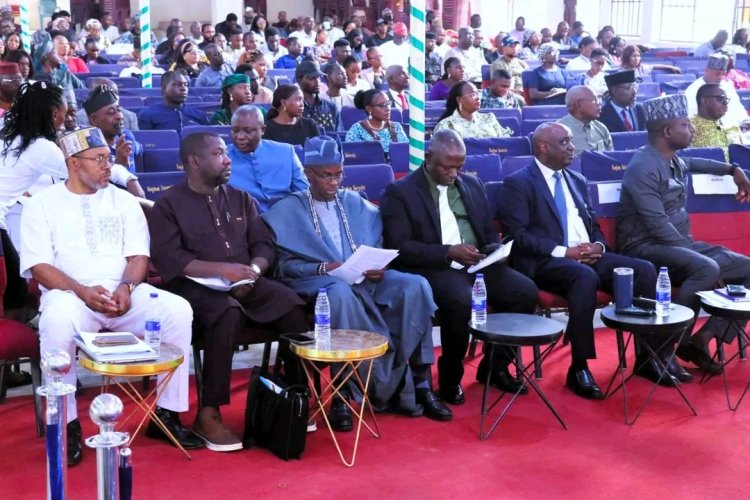
Bingham University has marked the 10th anniversary of its School of Postgraduate Studies with a call on researchers, scholars and institutions to uphold ethical standards and build resilience in an era shaped by artificial intelligence, digital transformation and emerging technologies.
The celebration coincided with the University’s 4th Annual Postgraduate Conference, a two-day event themed, “Navigating Research Ethics and Resilience in the Fifth Industrial Revolution Era.”
Speaking at the opening ceremony, the Vice-Chancellor, Professor Haruna Kuje Ayuba, highlighted the remarkable growth of the School of Postgraduate Studies since its establishment in 2016.
He disclosed that postgraduate student enrolment had risen from fewer than 100 students in 2016 to over 800 in 2026, while the number of academic programmes had expanded from fewer than 15 to 59 across diverse disciplines.
Professor Ayuba observed that the Fifth Industrial Revolution, propelled by artificial intelligence, robotics, big data and the Internet of Things, presents significant opportunities for research, innovation and development. However, he warned that it also raises critical ethical concerns, including data privacy, informed consent, originality and algorithmic bias.
“It is imperative that we uphold the highest standards of research ethics amid these rapid technological changes,” he said. “Researchers must prioritise transparency, accountability and respect for individual rights in order to prevent misuse and harm.”
In his remarks, the Dean of the School of Postgraduate Studies, Professor Okoli Bamidele Joseph, described the anniversary as a celebration of a decade of academic excellence, innovation and impact.
He noted that the conference theme was timely, given the increasing influence of artificial intelligence, automation and converging technologies on research and society.
“As researchers, supervisors and policymakers, we are called to ask difficult questions,” Professor Okoli said. “How do we uphold integrity and rigour in an age of intelligent machines? How do we build institutional, personal and intellectual resilience that enables research to remain trustworthy, purposeful and humane?”
In his keynote address, the Vice-Chancellor of Summit University, Offa, Kwara State, Professor Abiodun Musa Aibinu, spoke on the topic, “Research and Innovation: Gateway to the Transformation of Economies,” with special focus on “Beyond 5G: Light Fidelity (Li-Fi).”
He urged Nigerian universities to reposition themselves as major drivers of the knowledge economy by ensuring that research outcomes are not only published but also visible, accessible and applicable to national development.
He argued that the central question for universities in the Fifth Industrial Revolution should no longer be merely, “What do we know?” but rather, “Who can see it, use it and benefit from it?”
The keynote speaker drew a distinction between knowledge dissemination and knowledge visibility. While dissemination involves sharing knowledge through journal publications, conferences and teaching, he explained that visibility concerns whether such knowledge can be discovered, indexed, accessed, cited, recognised and applied globally.
He described knowledge visibility as the “fourth helix” of the knowledge economy, complementing knowledge generation, dissemination and application.
Professor Aibinu further noted that Nigeria remains largely dependent on a resource-based economy driven by oil, a situation he said has contributed to unemployment, low industrial development and inequality. He called for a deliberate transition to a knowledge-based economy founded on human capital development, intellectual property, innovation, partnerships and knowledge-intensive industries.
He charged postgraduate students to move beyond publishing academic papers to becoming knowledge producers and innovators capable of translating research findings into products, services, policies and jobs.
“Economies are transformed when knowledge moves beyond publication and becomes capability, products, services, policy and jobs,” he said. “Research creates new knowledge; innovation converts knowledge into value; and universities build the people and partnerships that make both sustainable.”
Also speaking at the conference, the Lead Paper Presenter and Director of ICT at the University of Jos, Dr Daniel Inusa Yakmut, presented a paper titled, “Human-Centric AI and the Moral Imperative: Redefining Research Ethics in the Fifth Industrial Revolution Era.” Dr Yakmut noted that AI tools can now draft literature reviews, simulate data and generate citations within seconds.
Dr. Yakmut said the growing role of artificial intelligence in knowledge creation makes it necessary for universities to place human dignity, accountability and ethical responsibility at the centre of research and postgraduate training.
He cautioned, however, that technological capability should not be mistaken for wisdom or truth.
“If machines increasingly participate in the production of knowledge, who remains responsible for the knowledge produced?” Dr Yakmut asked.
He described the Fifth Industrial Revolution as an era that seeks to reconcile technological advancement with human dignity, sustainability and resilience.
He identified emerging ethical risks associated with AI-assisted research, including fabricated or inaccurate citations, synthetic data, paper mills, algorithmic bias and automation bias.
The ICT expert urged universities and research institutions to develop clear AI ethics policies; strengthen the capacity of researchers, supervisors and ethics committees; safeguard research data; invest in African datasets; establish interdisciplinary AI ethics centres; and preserve meaningful human oversight in research processes.
“As artificial intelligence increasingly generates knowledge, humanity must increasingly commit to the responsible production of truth,” he stated.
In his closing remarks, the Deputy Dean of the School of Postgraduate Studies, Dr Oluwasegun Adelaiye, expressed appreciation to the University Management, members of the academia, invited scholars, the keynote speaker and the lead paper presenter for their contributions to the success of the conference.
He stated that the 10-year milestone represents a decade of intellectual investment, scholarly inquiry, institutional learning, knowledge production, and the cultivation of researchers and professionals whose contributions extend beyond the walls of the University.