FUL VC Urges Educators to Harness AI to Transform Teaching and Learning
The Vice-Chancellor of Federal University Lokoja (FUL), Professor Gbenga Solomon Ibileye, has challenged educators, researchers and institutions to move beyond using Artificial Intelligence (AI) merely to automate routine tasks and instead deploy it to strengthen human intelligence, creativity, critical thinking and ethical decision-making.
 Philip22

The Vice-Chancellor of Federal University Lokoja (FUL), Professor Gbenga Solomon Ibileye, has challenged educators, researchers and institutions to move beyond using Artificial Intelligence (AI) merely to automate routine tasks and instead deploy it to strengthen human intelligence, creativity, critical thinking and ethical decision-making.
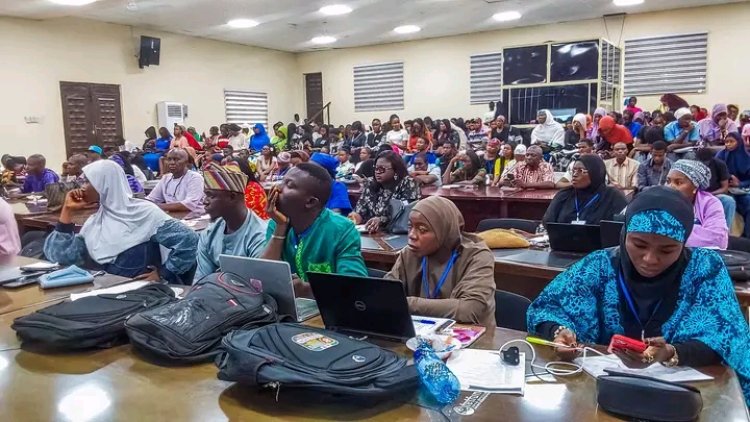
Professor Ibileye made the call while welcoming participants to the 8th International Conference of the Association for Innovative Technology Integration in Education (AITIE), held at the Multipurpose Hall, Felele Campus, Federal University Lokoja.
The conference, themed “From Automation to Augmentation: Reimagining Teaching and Learning Ecosystems in the AI Era,” brought together scholars, researchers, educators, technology experts and other stakeholders to examine the implications of Artificial Intelligence for education.
The Vice-Chancellor, who was represented by Professor Eric Sunday Adewumi, said the rapid development of AI had moved education beyond the traditional use of technology for administrative automation. He described AI as an increasingly important cognitive partner capable of enhancing human intellect, creativity and the way knowledge is constructed and delivered.
He, however, stressed that the adoption of intelligent technologies must not come at the expense of the human qualities that define education.
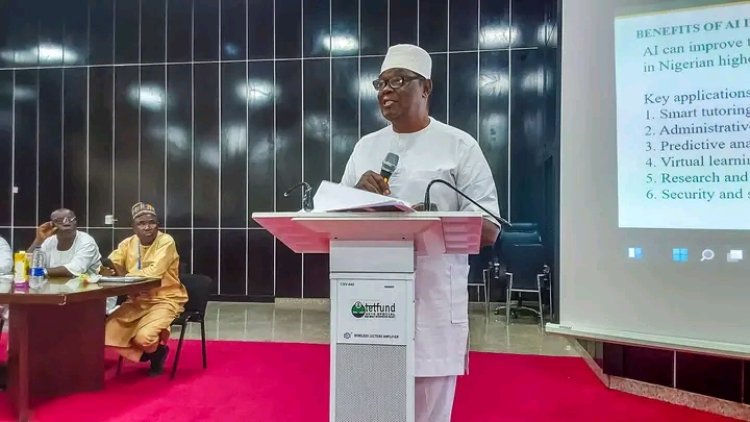
According to him, critical thinking, empathy, mentorship and ethical grounding must remain central to education even as institutions embrace intelligent technologies.
Professor Ibileye said Federal University Lokoja remained committed to innovative research, digital transformation and pedagogical excellence, adding that hosting the AITIE conference reflected the University’s determination to remain at the forefront of educational innovation.
He urged participants to challenge existing assumptions, build new collaborations and return to their institutions with practical strategies capable of producing meaningful transformation.
The Vice-Chancellor’s position was reinforced by the keynote speaker, Professor Sunday Olusanya Olatunji, Professor of Artificial Intelligence and Machine Learning at Adekunle Ajasin University, who called for the development of what he described as “trustworthy intelligence” across the education ecosystem.
In his keynote address, titled “From Automation to Augmentation: Let the Data Speak for Trustworthy Intelligence Across the Education Ecosystem,” Professor Olatunji argued that the future should not be defined by competition between humans and machines, but by their purposeful collaboration.
He presented the Symbiotic Trustworthy Intelligence Framework, built around human intelligence, artificial intelligence and data intelligence. The framework seeks to protect human agency while ensuring that empirical evidence guides the development and use of intelligent systems.
Professor Olatunji’s central recommendations were to preserve human agency, protect the integrity of evidence and ensure that AI-driven decisions remain evidence-based, reproducible, human-centred, ethical and accountable.
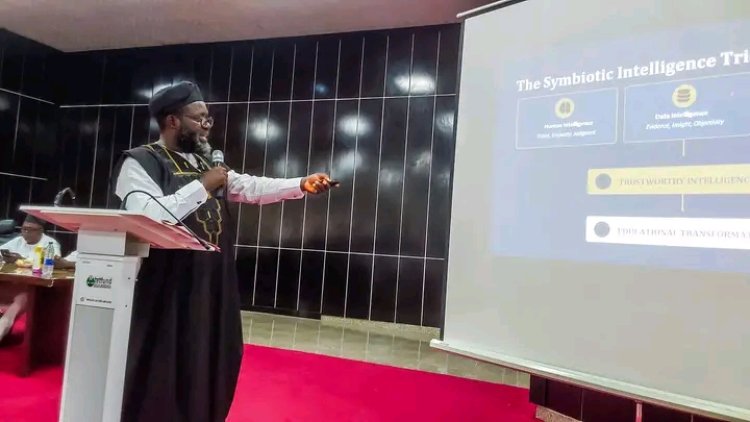
He also introduced the “Let the Data Speak” methodology, which requires researchers to begin with original evidence, establish a baseline, test different versions of data, compare outcomes and increase technological complexity only when empirical evidence justifies it.
The approach challenges researchers to resist the temptation to select sophisticated algorithms simply because they appear more advanced.
Instead, Professor Olatunji advocated a progression from simple models to complex ones, stressing that every modelling decision must earn its justification from empirical evidence.
He further called for wider AI, Machine Learning and Data Science literacy across disciplines, arguing that AI should not remain the preserve of computer scientists but should become accessible to professionals in education, law, medicine, agriculture, engineering, business and other fields.
In a related lead paper, Professor David Kolawole Omole of the Department of Educational Foundations, Federal University Lokoja, argued that Nigerian education must deliberately shift from automation to augmentation if institutions are to obtain the full benefits of AI.
Professor Omole explained that automation focuses mainly on replacing human labour through tools such as automated grading, attendance systems and basic chatbots, while augmentation uses AI as a cognitive collaborator that works alongside educators to personalise learning and strengthen decision-making.
He proposed three major components for an AI-augmented learning architecture: intelligent tutoring and hyper-personalisation, human-AI co-design of contextualised Open Educational Resources, and authentic continuous assessment.
Professor Omole also drew attention to what he described as the “infrastructure tax” confronting institutions in Sub-Saharan Africa, including unreliable electricity, high bandwidth costs and the digital divide. He recommended low-power edge AI systems, mobile-first and compressed learning technologies, as well as stronger national investment in shared computing infrastructure.
For Nigerian higher education, he proposed a practical roadmap centred on curriculum redesign, teacher upskilling and ethical safeguards.
He recommended that teacher education programmes incorporate prompt engineering, educational data analytics and human-AI co-design as core competencies. He also called for institutional frameworks covering data privacy, algorithmic bias and academic integrity, alongside the establishment of local innovation hubs where computer scientists, instructional designers and classroom teachers can jointly develop solutions suited to Nigerian realities.
Professor Omole warned that pursuing efficiency alone could produce classrooms that are technologically advanced but disconnected from meaningful learning.
He therefore urged educators to use AI to amplify the impact of teachers rather than replace them, combining the processing capacity of machines with the empathy, creativity and dedication of human educators.
Also speaking through another paper titled “Making Artificial Intelligence (AI) Work in Nigerian Universities,” Professor Lawrence Achimugu of Prince Abubakar Audu University, Anyigba, called for a deliberate shift from conventional digitalisation to comprehensive AI readiness across Nigerian universities.
Professor Achimugu identified inadequate infrastructure, weak policy frameworks, limited technical expertise, ethical concerns, high implementation costs and unstable power supply as major barriers to effective AI adoption.
He urged government and university authorities to invest in AI infrastructure, staff capacity and data protection, while encouraging institutions to develop responsible AI literacy programmes rather than banning the technology.
He said AI could significantly improve teaching, research and administration through smart tutoring, predictive analytics, virtual classrooms and intelligent administrative systems.
Meanwhile, the National President of AITIE, Professor Amosa Isiaka Gambari, said the conference was designed to help educators and institutions respond practically to the changing realities of teaching and learning in the age of Artificial Intelligence.
Professor Gambari said the question was no longer whether AI would affect education, but how it could be designed to support rather than replace the human side of teaching and learning.
He urged participants to embrace innovation in their classrooms, laboratories and offices while maintaining the human touch in education.
The conference featured discussions around AI-augmented instructional systems, generative AI for courseware, learning analytics, ethical AI, immersive media, infrastructure and policy readiness, alongside practical workshops on human-AI co-design of educational resources and AI-augmented assessment.
The combined message from the conference was that AI adoption in education must move from replacement to partnership, from assumption to evidence, and from technological excitement to responsible institutional transformation.
For Nigerian universities, the recommendations are particularly relevant as institutions confront the need to redesign curricula, strengthen staff capacity, protect student data, close digital gaps and develop locally relevant AI solutions.
Federal University Lokoja’s growing investment in Artificial Intelligence, Data Science, Robotics and Cyber Sciences provides an institutional platform for translating these ideas into practice. Professor Omole noted that the University’s emerging Centre of Excellence in AI, Robotics and Cyber Sciences and its new programmes in Artificial Intelligence and Data Science place FUL at an important point in Nigeria’s emerging AI education landscape.