Federal University Lokoja Unveils Five-Year Partnership Plan, Seeks Strategic Investment to Accelerate Growth
Federal University Lokoja (FUL) has unveiled its five-year Partnership Portfolio 2026–2030, a strategic framework aimed at accelerating institutional growth through sustainable partnerships with government, industry, financial institutions, development partners, alumni and private investors.
 Philip22

Federal University Lokoja (FUL) has unveiled its five-year Partnership Portfolio 2026–2030, a strategic framework aimed at accelerating institutional growth through sustainable partnerships with government, industry, financial institutions, development partners, alumni and private investors.
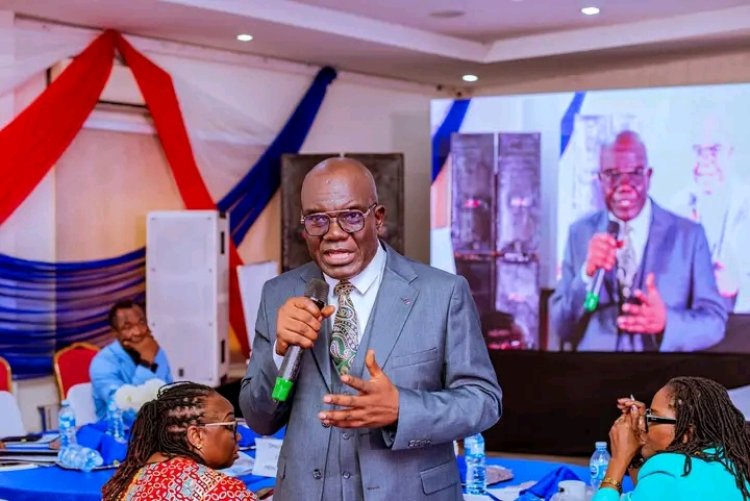
The Vice-Chancellor of the University, Professor Gbenga Solomon Ibileye, unveiled the portfolio at a special investment and partnership convening held in Abuja on Thursday, September 24, 2026.
At the event, Professor Ibileye called for a shift from traditional philanthropy towards strategic investment, shared value creation and sustainable institutional development.
The event, themed “University Governance and the Corporate World: Towards an ‘All-of-People’ Approach to Financing Federal University Lokoja,” brought together university officials, members of the Governing Council, corporate representatives, alumni, development partners and other stakeholders.
Professor Ibileye said the pace of FUL’s development increasingly depends on strategic partnerships and the mobilisation of resources beyond traditional government funding.
He noted that while older universities had benefited from decades of government investment, younger institutions such as FUL need to explore innovative approaches to accelerate their growth.
Established in 2011, FUL is 15 years old in 2026. The Vice-Chancellor described the university as “young, vibrant, ambitious and growing,” stressing the importance of leveraging its people, location, land, knowledge, networks and other assets.

“We are young, but we are not starting from zero. We have a foundation, we have talent, we have location, we have ideas, we have networks and, most importantly, we have the ambition to build an institution capable of making a lasting contribution to Nigeria’s development,” he said.
Professor Ibileye explained that the Partnership Portfolio was not designed to replace government funding but to complement it through innovative and sustainable partnerships.
Presenting FUL as an investment opportunity, he invited potential partners to support projects capable of generating measurable returns while also delivering academic and developmental benefits.
“I am here to invite you to investment, and to speak to you in the language that every serious investor understands, which is the language of returns on investment,” he said.
He also called on alumni and friends of the university to support projects in areas including scholarships, research, infrastructure, entrepreneurship and innovation.
“Do not leave this University the way you met it,” he urged.
The Chairman of the Federal Civil Service Commission (FCSC), Professor Tunji Olaopa, called for a fundamental review of the legal and governance framework governing Nigerian universities to improve resource mobilisation, research and responsiveness to industry needs.

Professor Olaopa said existing university governance structures and establishment laws could create bottlenecks that restrict institutional flexibility. He therefore called on the National Assembly, the Federal Ministry of Education and other relevant stakeholders to amend the laws to give universities greater operational and academic autonomy.
“This will entail initiating amendment to existing university establishment Acts, to grant full operational and academic autonomy to universities,” he said.
He, however, stressed that autonomy should be accompanied by accountability, with financing tied to clearly defined objectives and measurable outcomes.
Professor Olaopa also advocated an “All-of-People” partnership model involving industry, host communities, alumni, trade unions and other stakeholders.
He called for stronger alignment between strategic planning and budgeting, with academic programmes, building projects and recruitment linked to clearly defined key performance indicators.
Olaopa further proposed a diversified funding ecosystem involving government, businesses, universities, communities, alumni, philanthropists and development partners.
Among the funding options he highlighted were community-backed endowments, commercialisation through technology transfer offices and science parks, as well as government matching funds.
The FCSC Chairman said proceeds from innovation, agricultural research and software development could be transparently shared among researchers, students, universities and private-sector partners, with a portion reinvested into research.
Also speaking, the Executive Director of Research Enterprise Systems, Professor Fatai Aremu, said the initiative was based on the understanding that a university is more than a collection of buildings, describing it as a place where possibilities are cultivated and people are empowered.
Professor Aremu said investment in a university ultimately represents an investment in people, human capital and the future of society.
He explained that FUL was seeking to move beyond the traditional approach of depending on one-off financial support towards sustainable partnerships through which stakeholders could contribute to institutional development while creating value for all parties.
“We are here today to do things differently,” he said, describing FUL as a platform of possibilities through which stakeholders could participate in strategic partnerships and investments.
Earlier, the Director of Alumni Relations and Linkages, Professor Abel Joseph, said the initiative was designed to change the perception that financing a federal university is solely the responsibility of government.
He noted that FUL’s rapid expansion had created increasing needs in infrastructure, research funding, student support and innovation, making alternative financing mechanisms necessary to complement government funding.
According to him, the “All-of-People” approach recognises the shared interest of government, alumni, corporate organisations, the host community, parents and other stakeholders in the growth of the university.
He said the initiative forms part of the University’s Vision Plan 2026–2031, which seeks to mobilise collective support for institutional development.
Professor Ibileye subsequently outlined investment opportunities across several areas, including:
• Student accommodation
• Staff and faculty housing
• Conference and hospitality facilities
• Commercial and mixed-use development
• Technology and innovation
• Agriculture
• Renewable energy
He said FUL’s expanding student population and academic programmes were creating infrastructure and service demands that could not be met through government funding alone.
More details on the university’s Partnership Portfolio and investment opportunities are available on the Federal University Lokoja website.