UI Registrar Advocates Strategic Transformation of University Registries
UI Registrar Advocates Strategic Transformation of University Registries
 UmarFarouk123
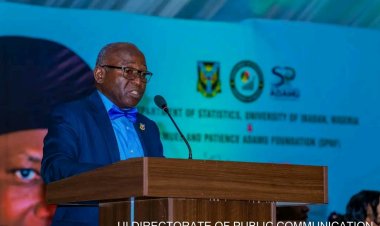
The Registrar of the University of Ibadan, Mr. Ganiyu O. Saliu, JP, FNIM, FCIML, MANUPA, MAUA, fspsp, has called for the transformation of university registries through digitalization, data-driven administration, agile policies and improved service delivery.
He made this call while delivering the 12th edition of the Ladoke Akintola University of Technology (LAUTECH), Ogbomoso Registry Discourse themed: “The Future-Ready University Registry: Leading Institutional Transformation in an Era of Change.”
Mr. Saliu noted that the rapidly changing higher education landscape requires university registries to move beyond traditional administrative practices and assume a more strategic role in institutional development.
He said that the emergence of digitally driven students and stakeholders have created new expectations for university administration, particularly in the areas of speed, transparency, accessibility and efficiency.
The UI Registrar observed that despite the resilience and dedication of Registry professionals, many administrative processes remain heavily dependent on paper-based systems, resulting in slow document retrieval, duplication of efforts, fragmented data management and a tendency towards reactive rather than proactive administration.
He stressed that the traditional model of university administration could no longer adequately serve the demands of the contemporary academic environment, adding that the Registry must evolve from being perceived as a bureaucratic bottleneck to becoming a strategic enabler of the university's vision and mission.
Mr. Saliu said the Registry is the administrative backbone and institutional memory of the university, with responsibilities spanning records management, statutory secretariat services, human resource administration, academic and student administration, policy implementation and institutional compliance.
He advocated a transition from a paper-heavy and manually driven Registry to a digital-first, integrated and stakeholder-centered system, where administrative professionals would function as strategic partners in university governance.
In the light of this advocacy, he stressed that digital transformation should go beyond the procurement of computers to include the deployment of Electronic Document Management Systems, integrated database, secure authentication platforms, and resilient technological infrastructure capable of protecting institutional records and ensuring their accessibility.
He noted that the digitization of university records would improve the efficiency of administrative processes, particularly in areas such as transcript processing, staff administration, student records and institutional documentation.
Mr Saliu also emphasized the importance of data-driven decision-making, stating that the Registry should be equipped to analyze institutional data and provide Management and other relevant organs of the university with reliable information for strategic planning.
He highlighted agility and institutional resilience as essential characteristics of a future-ready Registry, stressing that those administrative systems should remain functional during periods of disruption.
The Registrar identified global competitiveness and rankings, internationalization, transnational education, policy reform, and improved alumni database management as areas where a modern Registry could make significant contributions to institutional growth.
According to him, accurate institutional data was essential to strengthening the university's visibility and competitiveness, while efficient administrative processes could support international staff and student mobility, joint academic programmes and other forms of global engagement.
He also noted that although the Registry was not traditionally regarded as a revenue-generating arm of the university, an efficient Registry could contribute to institutional financial sustainability through improved administrative services, optimized use of resources, efficient transcript processing and accurate alumni records.
Mr. Saliu called for a more empathetic and stakeholder-centered approach to administration, restating that the Registry often serves as a major point of contact between the university and students, staff, parents, prospective students, alumni, scholars, and regulatory agencies.
He urged Registry professionals to acquire the competencies required for effective administration in the 21st century, identifying digital fluency, emotional intelligence, adaptability, integrity, discretion, strategic thinking and resilience as essential qualities of a future-ready Registry staff member.
Mr. Saliu stressed that technological transformation must be accompanied by human transformation, noting that staff resistance to new systems could be addressed through effective communication, continuous capacity building and the identification of change champions across different cadres.
He called for the adoption of practical strategies for achieving transformation in the Registry, recommending a phased paperless Registry initiative, comprehensive review of standard operating procedures, continuous staff training, improved stakeholder satisfaction mechanisms and enhanced staff welfare.
The UI Registrar advocated the establishment of functional physical and virtual Help Desks to ensure prompt responses to enquiries from students and staff, while emphasizing the need to incorporate stakeholder satisfaction into staff performance evaluation.
He urged Registry staff not to view digitalization as a strategy for eliminating administrative jobs, but as a means of enhancing the capacity of staff and strengthening institutional effectiveness, which will make them architects of efficiency, champions of technology, and ambassadors of excellent services.