Professor Elijah Ebenehi Ogbadu Delivers 25th Inaugural Lecture at Prince Abubakar Audu University, Calls for Marketing as Tool to Combat Social Vices
Professor Elijah Ebenehi Ogbadu Delivers 25th Inaugural Lecture at Prince Abubakar Audu University, Calls for Marketing as Tool to Combat Social Vices
 UmarFarouk123
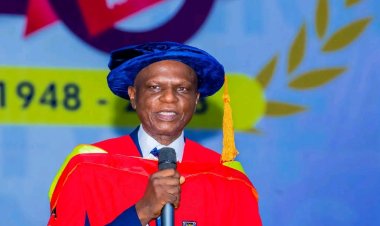
Professor of Marketing, Professor Elijah Ebenehi Ogbadu, has called for the deployment of ethical marketing principles, social responsibility and strategic marketing practices as tools for addressing poverty, insecurity, unemployment and other social vices confronting Nigeria.
He made the call while delivering the 25th Inaugural Lecture of Prince Abubakar Audu University, Anyigba, titled “Marketing, A Societal Saviour: Charting the Course for Future Nigeria,” on Tuesday, August 11, 2026, at the University Auditorium.
Prof. Ogbadu explained that marketing has evolved beyond its traditional focus on selling and distribution into a comprehensive philosophy concerned with quality of life and long-term societal wellbeing. He noted that marketing participants do not only identify the needs and wants of consumers but also adapt business organisations to deliver desired satisfaction in ways that enhance the wellbeing of consumers and society.
The Inaugural Lecturer maintained that although profit remains an important measure of marketing success, it should be regarded as a by-product of doing business well and not the sole objective of business activity. He stressed that marketing organisations must build and maintain legitimacy in the eyes of the public by placing customers and society at the centre of their activities.
Prof. Ogbadu identified poverty, corruption, bad governance, insecurity, drug abuse, poor healthcare, cultism, ethno-religious and communal conflicts, unemployment, examination malpractice, election rigging and unethical business practices among the major social problems confronting Nigeria. He noted that these challenges have contributed to loss of lives and property, anxiety, constrained economic growth, hunger, deprivation, inflation, health challenges, erosion of social values, disunity and declining public confidence in public and private organisations.
Against this backdrop, he argued that marketing, when properly oriented towards societal wellbeing, could provide a practical framework for diagnosing social problems and designing sustainable solutions. He observed that contemporary marketing has moved beyond a narrow profit-driven approach to embrace value creation, stakeholder engagement, employee satisfaction, social responsibility, customer satisfaction and long-term societal welfare.
Speaking on social marketing, Prof. Ogbadu explained that it seeks to influence social behaviour not for the primary benefit of the marketer but for the benefit of the target audience and society at large. He said it could be deployed to promote self-employment, discourage the use of hard drugs, advance public health and traffic safety, and address gambling, alcoholism, cybercrime, prostitution and other harmful behaviours.
The Inaugural Lecturer stressed the importance of marketing ethics, describing it as the practice of good moral conduct, transparency, trustworthiness, responsibility and fairness to consumers and other stakeholders. He urged marketers to uphold honesty, integrity and quality, while avoiding deceptive advertising, adulterated products, unfair pricing, environmental pollution, false claims and other unethical practices.
Prof. Ogbadu also advocated the rebranding of Nigeria to encourage good moral behaviour, discipline and a positive national image. He said charting the course for Nigeria's future is a shared responsibility between government and citizens, noting that national development and social welfare could not be achieved through government action alone.
“While the government is primarily responsible for creating a stable, inclusive, and enabling environment through effective governance, the people are equally expected to obey laws, promote social harmony, invest in personal development, and contribute meaningfully to the nation's human capital,” he said.
He highlighted transformational leadership and transformational followership as critical components of national development, urging leaders to demonstrate integrity, transparency, accountability and discipline, and citizens to participate in civic processes and support positive leadership.
Among his recommendations, Prof. Ogbadu called for the adoption of marketing principles nationwide to enhance customer satisfaction and national development, greater use of social marketing to promote good health, moral conduct, entrepreneurship and innovation, and the enforcement of strong ethical standards across institutions. He also advocated business grants for young graduates to reduce poverty and unemployment, and countermarketing approaches to combat kidnapping, banditry, insurgency, violence, terrorism, drug abuse, crime and other social vices.
Earlier, the Chairman of the Inaugural Lecture Committee, Professor S.S. Arogba, congratulated the Inaugural Lecturer and commended his contributions to scholarship in Business Administration and Marketing.
In his address, the Vice-Chancellor of Prince Abubakar Audu University, Professor Salisu Ogbo Usman, described the lecture as the eighth inaugural lecture delivered since his assumption of office on February 11, 2026, as the 6th substantive Vice-Chancellor. He said the sustained tempo reflects a vibrant research culture in the institution.
Prof. Usman noted that marketing, properly conceived and ethically practised, goes beyond profit to connect human needs with solutions and promote societal wellbeing. He added that the lecture was particularly relevant to Nigeria's current realities, including economic uncertainty, unemployment and the need for sustainable development.
The highlight of the event was the presentation of the inaugural lecture certificate, plaque and medal to the Inaugural Lecturer.
The lecture attracted members of the University Governing Council, Management, Senate, staff, students, scholars, religious and traditional leaders, and other guests from within and outside the University community.