Tunji Alausa Warns Universities, Polytechnics, Colleges Against Fake Accreditation Records
The Federal Government has warned Nigerian tertiary institutions against compromising accreditation standards by presenting false records or borrowing academic staff, equipment and facilities.
 judithhh

Federal Government has warned tertiary institutions against fake accreditation records, borrowing staff and equipment, threatening sanctions and licence revocation.
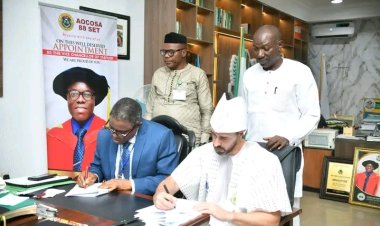
The Minister of Education, Dr. Tunji Alausa, gave the warning during the inauguration of the Ministerial Committee on strengthening the Accreditation and Quality Assurance System of Tertiary Institutions in Abuja. The committee will be led by the former registrar of JAMB, Professor Ishaq Oloyede.
He also stressed that officials who abuse the process will lose their jobs while the licenses of private institutions involved would be revoked. The minister reiterated that the government would no longer tolerate institutions that flout the accreditation process by presenting inflated or misleading records of their academic capacity during the exercise. Alausa said that the quality of graduates produced by Nigerian tertiary institutions must reflect the standards approved by regulatory agencies.
The minister stated that the era of institutions borrowing academic staff, equipment and facilities from other institutions to meet accreditation requirements is gone.

Alausa’s warning came on the heels of controversy surrounding the accreditation of the Law programme of Atiba University, Oyo State. We recall that in August, the Council of Legal Education imposed a 10-year moratorium on the university’s law programme due to inadequate facilities as well as admission and graduation of students without the requisite approval.
We urge heads of all tertiary institutions to heed Alausa’s warning and ensure that the accreditation process reflects the true position of their real staff, equipment and other facilities. Borrowing staff and equipment to pass the accreditation process will amount to academic fraud and dishonesty. For many years, the scourge of renting equipment and personnel for accreditation has plagued Nigeria’s tertiary education sector.
Weeks before regulatory bodies like the National Universities Commission (NUC), the National Board for Technical Education (NBTE), and the National Commission for Colleges of Education (NCCE) arrive for accreditation, an elaborate theatrical production begins. Empty laboratories are suddenly populated with gleaming, state-of-the-art microscopes. Engineering workshops mysteriously acquire heavy machinery.
Most egregiously, prestigious professors from neighbouring institutions are rented for a fee, overnight becoming full-time faculty members on paper. Once the accreditation is over, the borrowed items are sent to their original owners. The visiting professors return to their actual jobs, and students are left with empty shells and a compromised education system.
This aggressive stance is both necessary and long overdue. For too long, make-believe accreditation has seemingly devalued our varsity degrees. When universities function as theatrical stages rather than centres of learning, the primary victims are the students and the broader socio-economic fabric of the country. Graduates are sent into the workforce with degrees in engineering or computer science without ever having operated the basic tools of their trade.
This systemic fraud directly explains the widening gap between higher education and industry readiness, forcing employers to retrain graduates from the scratch. However, while the government’s war on borrowed capacity is morally and structurally justified, it treats the symptom rather than the underlying disease. Why do vice-chancellors, rectors, and provosts resort to these elaborate scams in the first place? The answers lie in chronic underfunding, dearth of qualified academic staff, and the reckless proliferation of institutions.
Public tertiary institutions in Nigeria operate on lean budgets. Capital allocations for laboratories, modern workshops, and up-to-date libraries are grossly inadequate. For many administrators, borrowing equipment is not an attempt at treachery, but a desperate, flawed survival mechanism to prevent their programmes from being shut down. Furthermore, Nigeria faces a severe brain drain. Starved of competitive wages and modern research tools, top-tier academics have left the country in droves, promoting the infamous Japa phenomenon. The pool of available PhD holders and professors is simply too small to serve the hundreds of public and private universities, polytechnics, and colleges of education in the country.
Therefore, technology-driven policing, though commendable, must be matched with equal structural support. The Ministry of Education’s plan to use digital tools as a single source of truth will inevitably expose an uncomfortable reality: a vast number of academic programmes across the country do not have the resources to pass an honest audit. If the government enforces these rules without providing a safety net, we may witness a mass decertification of courses, leaving thousands of students stranded.
To ensure this reform yields lasting quality rather than widespread collapse, the government must adopt a tripartite approach. The government must intentionally inject funds specifically targeted at equipping existing laboratories and workshops. It is contradictory to punish institutions for a lack of equipment while denying them the financial resources required to procuring them. The government’s recent policy adjustments, such as implementing a pause on the creation of new institutions, must be strictly enforced. Instead of building new, underfunded institutions to score political points, resources must be aggressively directed toward expanding and upgrading the capacity of existing ones.
To solve the “borrowed staff” crisis, Nigeria must make the academic profession attractive again. Academic allowances must be paid promptly, research grants must be democratised, and institutional autonomy must be restored to attract local and diaspora talents. Alausa’s warning is timely. It must be heeded by the concerned tertiary institutions.