"Artificial Intelligence Must Be Guided by Ethics for Sustainable Business Growth," Says UI VC
"Artificial Intelligence Must Be Guided by Ethics for Sustainable Business Growth," Says UI VC
 UmarFarouk123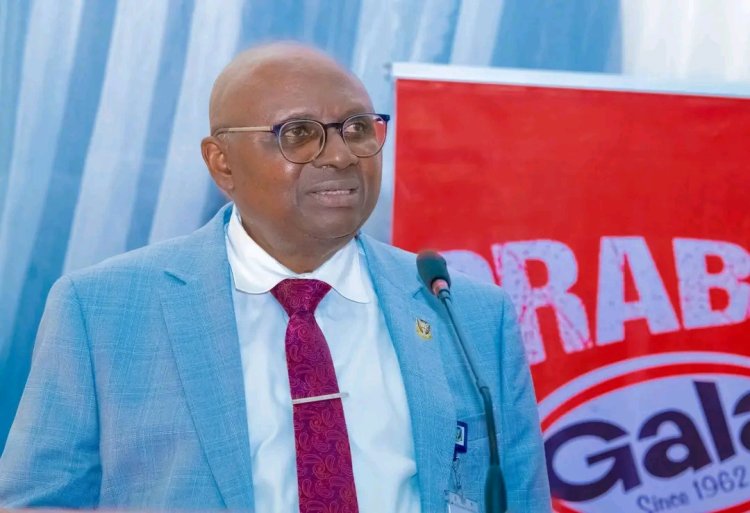
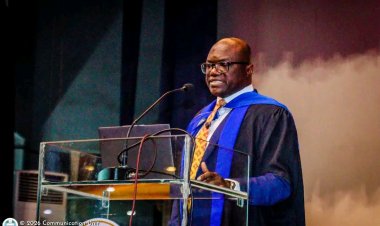
The Vice-Chancellor of the University of Ibadan, Professor Kayode O. Adebowale, mni, FAS, fspsp, has stated that artificial intelligence, AI, must be guided by ethics, human oversight and sound strategy to drive sustainable business growth and national development.
He made the statement at a symposium themed: "Harnessing Artificial Intelligence for Business Survival and Expansion in a Knowledge Economy" organised by the Department of Marketing and Consumer Studies, Faculty of Economics and Management Sciences, University of Ibadan.
Professor Adebowale described the symposium as timely, noting that the world stands at the intersection of rapid advancement of artificial intelligence and the urgent need for business resilience in an increasingly volatile global economy.
He stated that the Fourth Industrial Revolution has positioned data as the new oil and both human and AI as the primary drivers of value creation, adding that AI has evolved from a futuristic concept into a present-day reality.
The VC submitted that AI is democratizing access to capabilities that were once available only to multinational corporations. He observed that despite infrastructure challenges, Nigeria has emerged as one of the world's most enthusiastic adopters of AI.
He stated that many Nigerians now use AI tools to explore business opportunities, solve practical problems and develop new careers. He, however, warned that enthusiasm must be guided by knowledge, ethics, and sound strategy.
The Vice-Chancellor disclosed that the University of Ibadan is developing a comprehensive Artificial Intelligence Policy that will promote ethical use, establish appropriate boundaries for AI deployment, and ensure adequate human oversight.
He reaffirmed the University’s commitment to leading technological transformation through research, innovation and responsible adoption of emerging technologies, adding that universities must bridge the gap between academic knowledge and practical solutions.
Professor Adebowale explained that AI offers businesses opportunities for predictive analytics, operational efficiency, personalized customer engagement, effective risk management and improved decision-making.
He added that technology could help small and medium-scale enterprises lower barriers to market entry, improve resource allocation and compete effectively in global markets.
Given the prevalence of new technologies, he stated that for Nigeria to thrive in the knowledge economy, the country must move beyond consuming foreign technologies to developing indigenous innovations through sustained investment in education, research, development and digital infrastructure.
The Vice-Chancellor identified inadequate digital infrastructure, shortage of AI professionals, poor data governance, weak ethical and legal frameworks, and insufficient human oversight as major challenges requiring urgent attention.
He urged universities to integrate AI literacy across all disciplines and encouraged students to use AI responsibly as a tool for enhancing critical thinking rather than replacing intellectual engagement.
The Director of Local Government Affairs, Mrs. Olanike Akanji, who represented the Honourable Commissioner for Local Government and Chieftaincy Affairs, Oyo State, Honourable Ojo Ademola Obafemi, commended the Department of Marketing and Consumer Studies for organizing a symposium that addressed one of the most significant drivers of contemporary business transformation.
She stated that AI has the potential to improve productivity, enhance decision-making, reduce operating costs, and expand market access for traders, artisans, farmers, cooperative societies, and other small business owners across Oyo State.
Mrs. Akanji said that the Ministry was ready to collaborate with the Department in promoting AI-driven business development initiatives across the local government areas in Oyo State.
The Dean, Faculty of Economics and Management Sciences, Professor A. O. Folawewo, described the theme of the symposium as timely and relevant, noting that technology has transformed the way businesses now operate.
He encouraged participants to take full advantage of the proceedings at the symposium, particularly the keynote addresses and the panel session on how artificial intelligence could influence business and the academia.
The Acting Head, Department of Marketing and Consumer Studies, Dr. S.O. Orekoya, in a welcome address, said that the symposium was the second edition and it was purposed to bridge the gap between academic theory and industry practice by exposing participants to practical applications of AI for business survival and expansion.
Keynote addresses were delivered by Mr. Obinna Nweke, Chief Executive Officer, BeamX Solutions Ltd, and Dr. Oladipupo Sennaike, Chief Executive Officer, Cynergy Solutions Ltd, who explained the role of Artificial Intelligence in driving business innovation, resilience, and sustainable growth.
Panelists at the symposium were Dr Ayo Awosika, GM (Commercials), UAC Foods; Mrs. Amara Ifeanyichukwu-Njoku, Lead Partnership and Clusters, ProvidusUnity Bank; Engineer Seun Osuntoki, Head of Engineering, Mainstack; Ms Funmilayo Adebomi, Founder, Mafio Creatville; and Mr. Oladayo Bello, an SME Consultant to the Oyo State Government.