FUNAAB Commences Three-Day Leadership and Management Training for FCAIB Key Staff
FUNAAB Commences Three-Day Leadership and Management Training for FCAIB Key Staff
 UmarFarouk123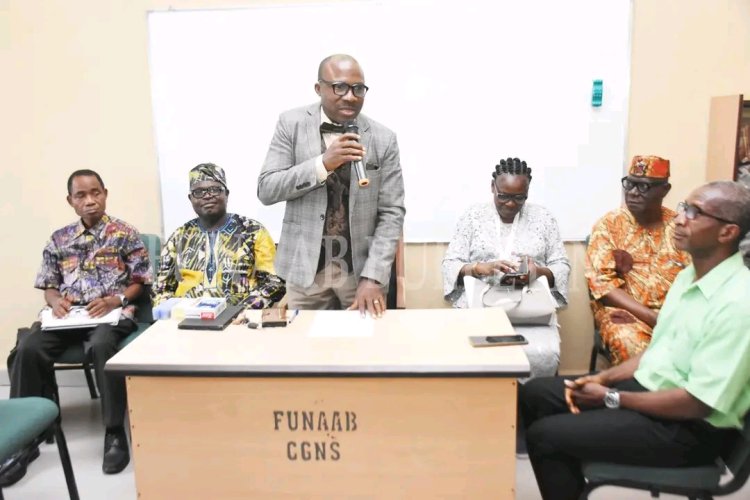
The Institute of Communication and General Studies, ICGNS, of the Federal University of Agriculture, Abeokuta, FUNAAB, on Monday, August 24, 2026, commenced a three-day Leadership and Management Training Course for Principal Officers and Union Leaders of the Federal College of Agriculture, Ibadan, FCAIB.
The programme, held at the ICGNS Auditorium, FUNAAB, is designed to strengthen participants’ leadership and management competencies and equip them with practical knowledge and skills for effective organisational development.
Declaring the training open, the Vice-Chancellor, Prof. Babatunde Kehinde, represented by the Deputy Vice-Chancellor, Academic, Prof. Olusegun Idowu, welcomed the participants and commended their commitment to continuous learning and professional development.
The Vice-Chancellor described leadership as fundamental to organisational success, noting that while management provides strategies and plans, leadership supplies the direction required to translate them into tangible results. He urged participants to engage actively with facilitators, apply the knowledge gained to their workplaces, and remain open to continuous learning.
In her welcome address, the Director, ICGNS, Prof. Remi Aduradola, appreciated the University Management for providing an enabling environment for the Institute to organise the training.
She described the programme as another milestone in the Institute’s leadership and management development initiatives, stressing that sustained capacity building was essential to enhancing institutional effectiveness.
Prof. Aduradola explained that leadership focuses on vision, direction and positive influence, while management centres on organising systems, structures and resources to achieve set objectives. She added that effective leadership fosters innovation and inspires teams, while management complements it through planning, budgeting, staffing, coordination and performance monitoring. She also linked the programme to Sustainable Development Goal 5 on gender equality, SDG 8 on decent work and economic growth, and SDG 16 on strong institutions.
In his goodwill message, the Programme Leader, Philosophy and Leadership Studies, ICGNS, Prof. Emmanuel Akintona, described leadership as essential to the effective functioning and development of organisations and society.
He urged participants to demonstrate exemplary conduct and live up to their responsibilities, stressing that leadership was about people working together towards common goals. He emphasised teamwork, credibility, commitment, discipline and responsibility as critical to organisational success.
Delivering the keynote lecture titled “Leadership and Workplace Romance and the Imperative of Ethical Leadership,” Prof. Olatunji Oyeshile examined the ethical challenges associated with workplace romance. He noted that romantic relationships could occur in virtually every sphere, including formal workplaces, but cautioned leaders to maintain professionalism and ethical standards, particularly in superior-subordinate relationships.
According to him, such relationships could create conflicts of interest and complicate supervision, discipline and performance evaluation if not handled transparently and ethically. Using practical examples from educational institutions, government, religious organisations and businesses, he advised individuals involved in workplace relationships to uphold appropriate professional standards.
The three-day programme is expected to provide participants with practical insights into effective leadership, ethical decision-making, teamwork, workplace relationships and organisational management.
By Raymond Osemene
FUNAAB, August 24, 2026