FUTA Expands Greenhouse Farming, Targets Agribusiness and Export
The Vice-Chancellor of the Federal University of Technology, Akure (FUTA), Professor Adenike Oladiji, has reaffirmed the institution’s drive to tackle food insecurity through expanded agricultural innovation, research deployment, and technology-driven farming systems.
 Philip22

The Vice-Chancellor of the Federal University of Technology, Akure (FUTA), Professor Adenike Oladiji, has reaffirmed the institution’s drive to tackle food insecurity through expanded agricultural innovation, research deployment, and technology-driven farming systems.

She gave the assurance during a tour of ongoing projects across the university as part of activities marking her fourth anniversary in office on Friday, 22nd May, 2026, noting that FUTA is deliberately positioning itself for large-scale agricultural production with strong export potential.
Professor Oladiji disclosed that the university has completed and operationalized 11 greenhouse structures measuring 5 by 30 metres each, constructed with reinforced imported steel and locally assembled components. The structures are irrigated using a locally designed drip system and currently support the cultivation of bell pepper and habanero pepper crops, with each greenhouse hosting between 550 and 600 plants.
The greenhouse project is supervised by a technical team led by Professor Ayo Olalusi, supported by Professor Kehinde Jaiyeoba and Professor Jav Olumurewa, alongside student participants engaged in practical training and research exposure.
She explained that the initiative is designed to deliver year-round crop production, reduce dependence on seasonal farming, and create a scalable model for agribusiness development. According to her, FUTA’s agricultural expansion is supported by the Tertiary Education Trust Fund (TETFund), particularly in poultry production, feed milling, and controlled-environment agriculture.
The Vice-Chancellor also acknowledged the Federal Government’s support through a ₦1 billion agriculture grant for institutions, which she said has significantly strengthened FUTA’s agricultural infrastructure and output capacity.

Professor Oladiji added that the university is integrating students and industrial trainees into its agricultural systems to build practical competence in modern farming and value-chain development, while also exploring pathways for commercial-scale operations that can serve both local consumption and export markets.
Professor Olalusi, who conducted the Vice-Chancellor round the greenhouse facility, described the F1 bell pepper variety as an early-maturing hybrid with strong agronomic advantages, including disease resistance, high yield performance, and superior fruit quality, with an average weight of 250–280g and size dimensions of 10–11cm width and 11–12cm length. He noted that the variety is optimized for greenhouse propagation and positioned FUTA as a technical hub for knowledge transfer in controlled-environment agriculture.
Beyond greenhouse farming, Professor Oladiji highlighted improvements in the university’s poultry production system, noting the reactivation and modernization of the livestock unit. She stated that the farm now operates with automated systems, including newly installed battery cages accommodating 4,160 layers, alongside in-house feed production to enhance efficiency and reduce operating costs.
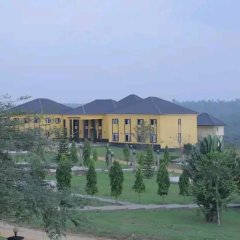
The Vice-Chancellor also inspected several infrastructural projects, including the remodeled Akindeko Hostel with 653-bed capacity across 145 rooms in eight blocks, a common room, reading facilities, and a mini-mart. Other facilities visited included the Public Health Laboratory Museum remodeled for research and documentation purposes, the upcoming School of Nursing laboratory, and newly constructed guest chalets designed to support visiting academics and researchers.
She noted that these developments were funded through a combination of TETFund interventions, internally generated revenue, and support from stakeholders within the Akure community.

Professor Oladiji reaffirmed FUTA’s long-term commitment to innovation-driven agriculture, research commercialization, and national development, emphasizing that the university will continue to scale its agricultural and infrastructural investments to deliver measurable impact.