FUNAAB Wraps Up Two-Day DIGISOL Digital Innovation Hub Workshop
FUNAAB Wraps Up Two-Day DIGISOL Digital Innovation Hub Workshop
 UmarFarouk123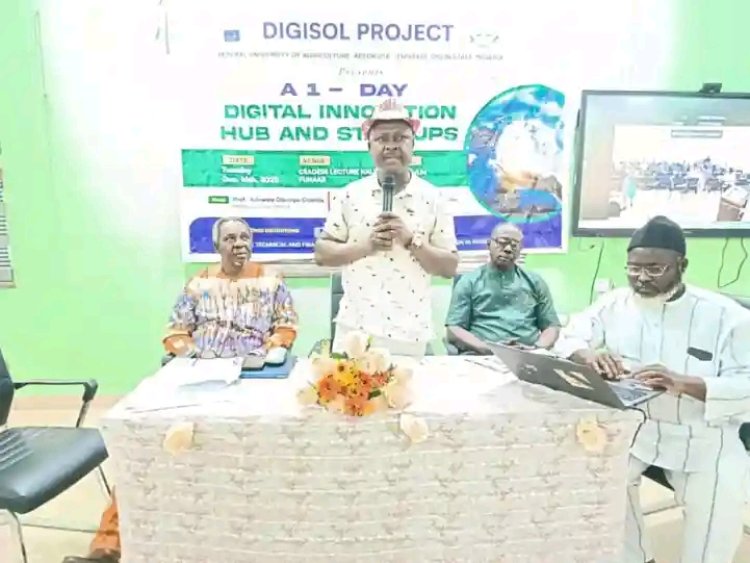
The Federal University of Agriculture, Abeokuta (FUNAAB), today, December 16, 2025, concluded a two-day DIGISOL Digital Innovation Hub Workshop, reinforcing its commitment to leveraging digital technologies and strategic partnerships to drive sustainable agriculture and strengthen Small and m Medium-scale Enterprises (SMEs).
Speaking at the Closing Ceremony, the Vice-Chancellor, Prof. Babatunde Kehinde, who was represented by the Director, Centre of Excellence in Agricultural Development and Sustainable Environment (CEADESE), Prof. Adeboye Fafiolu, urged stakeholders to rethink conventional approaches to achieve more impactful outcomes. He disclosed that FUNAAB has invested significantly in the project and expects innovative outputs that would deliver tangible benefits to society.
He commended the University’s approach to research and development through private-sector collaboration, noting that such partnerships were critical for translating academic research into practical solutions that address real-world challenges in agriculture and enterprise development.
The two-day workshop was structured to address different participant groups, while the first day focused on foundational engagement, the second day, themed “Digital Innovation Hub and Startups,” brought together tech hubs, SMEs, cooperatives, academic institutions, and local authorities. At the closing session, the Vice-Chancellor of the University of Agriculture and Environmental Sciences, Umuagwo, Prof. Christopher Eze, highlighted the pivotal role of universities in generating research-driven innovations. He stressed that collaboration with tech hubs and SMEs was essential for transforming research outputs into viable solutions that promote entrepreneurship, sustainable development, and stronger links between academia and industry.
Presenting the Agricultural Market Information System (AMIS) Dashboard, the Permanent Secretary, Ogun State Ministry of Forestry, Dr. Augustine Oyesanwen, represented by the Management Information System (MIS) Officer, Mr. Adefisayo Adebayo, underscored the dashboard as a digital platform that provides timely, accurate, and transparent agricultural market data, including prices, production, supply, demand, and trade of key commodities. Its interactive features were highlighted as tools for reducing information gaps, minimising price volatility, and improving coordination along the agricultural value chain.
Further discussions on digital innovation in agriculture were led by the Director, Directorate of Innovations and Partnerships (DRIP), Prof. Mutiu Busari. He explained how mobile advisory services, digital extension platforms, and precision agriculture tools are empowering farmers and SMEs with timely information, optimised input use, and climate-smart practices, thereby enhancing productivity, resilience, and sustainability.
The AKILIMO Digital App was presented by the Director, Agricultural Extension Services, Ogun State Agricultural Development Programme (OGADEP), Mr. Olufemi Akinniyi. He described the app as an innovative decision-support tool that provides site-specific recommendations on crop varieties, fertilizer application, planting density, and weed management. According to him, the farmer-friendly interface supports informed decision-making, reduces production risks, and boosts farm income, contributing to sustainable food systems.
In a presentation on Digital Access and Innovation for SMEs in Ogun State, the Special Adviser, Bureau of Information and Technology, Ogun State, Mrs. Olatundun Adekunte, highlighted how digital platforms are transforming SME operations through expanded market access, streamlined processes, and improved customer engagement. She emphasised that promoting digital literacy and access among SMEs was vital for inclusive growth, economic resilience, and stronger food systems.
Dr. Saidat Onikosi-Aliyu of Al-Hikmah University, Ilorin, Kwara State, examined gender perspectives in digital innovation, stressing the need to integrate gender considerations into digital agricultural tools to ensure equitable participation and benefits for women, who play critical roles in farming but often face barriers to accessing technology, finance, and information. She noted that gender-sensitive approaches enhance productivity, strengthen decision-making, and build resilient food systems.
Similarly, Dr. Tajudeen Ajala of Al-Hikmah University presented a Practical Public–Private–Academic–CSO Partnership Model, drawing from best practices in Kwara State. He explained that collaborative frameworks involving government agencies, private sector players, academic institutions, and civil society organisations promote mentorship, capacity building, and access to innovation hubs, thereby strengthening agricultural value chains and fostering inclusive growth.
Earlier, in his Opening Remarks, the Zonal Coordinator of the DIGISOL Project, Prof. Adewale Dipeolu, expressed appreciation to the European Union for its support of inclusive, sustainable, and innovation-driven development. He described Digital Innovation Hubs as platforms for collaboration, experimentation, learning, and scaling of climate-smart solutions that connect farmers, innovators, researchers, policymakers, and investors while remaining responsive to local needs and contexts.