FUTA Strengthens Agricultural Infrastructure to Fight Hunger
The Federal University of Technology, Akure (FUTA), has expanded its agricultural research and food production initiatives to help tackle food insecurity in Nigeria. Vice-Chancellor Prof. Adenike Oladiji said the university is investing in poultry production, greenhouse farming, feed mill operations, and technology-driven agriculture with support from TETFund. She noted that FUTA’s poultry project has grown from 150 birds to thousands, while students are also being trained in value-added agricultural production and feed formulation. The university also inspected new research, farm, and accommodation facilities aimed at supporting learning, innovation, and international research collaboration.
 judithhh

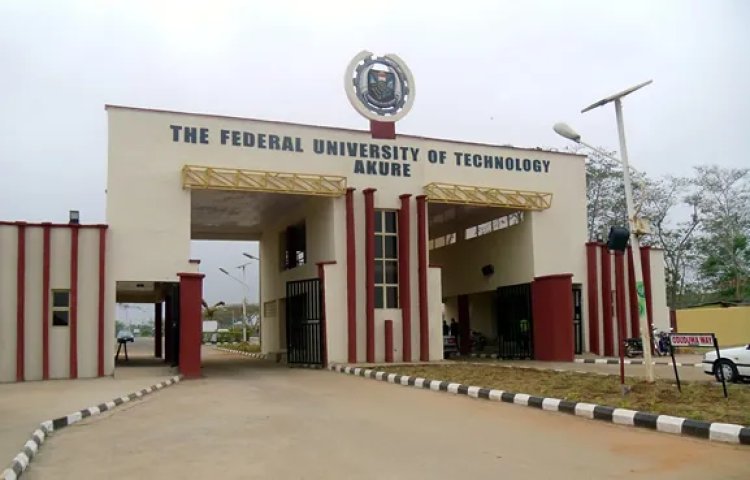
Federal University of Technology, Akure (FUTA), Ondo State, has intensified investments in agriculture and technology-driven food production as part of efforts to address Nigeria’s growing food insecurity challenge. The Vice-Chancellor of the institution, Prof. Adenike Oladiji, disclosed this on Friday during an inspection of ongoing projects across the university campus, many of which were funded through the Tertiary Education Trust Fund (TETFund).
According to her, FUTA is leveraging its strengths in agriculture, engineering, and sciences to develop practical solutions that can boost food production and agricultural innovation in the country.
“We have visited the farm where we think that as a university of technology, as a university that has a long-standing school of agriculture, school of engineering, and we are known for sciences,” she said.
“As a kind of university, we must do something different to solve the problem of food insecurity in the country.”
Oladiji explained that the university was deliberately expanding its agricultural infrastructure to strengthen its contribution to national food production, particularly in poultry and crop value chains.
“That is one of the things that is driving our vision. Now, with the support of TETFund, we have funds to expand agricultural infrastructure.
“We are expanding the poultry that has gone moribund. We have revived it, and not only revived it, we are expanding what we are doing. We started like a university. We started with 150 birds,” she added.
The Vice-Chancellor noted that the poultry project has experienced significant growth, with production capacity increasing from an initial 150 birds to 500, then 1,000, and now an additional 4,500 birds.
She said the expansion is aimed at positioning FUTA as a major player in poultry production within Ondo State and beyond.
Oladiji further disclosed that the university now operates a feed mill where students are trained in agricultural production, feed formulation, and value addition.
According to her, FUTA has shifted from merely producing and selling raw crops to adopting a more value-driven agricultural model that equips students with practical skills.
“So over the years, we produce corn, and we sell the corn. But we said it is not ideal as a university to produce corn and sell it like the farmers,” she explained.
“So what we are doing now is we teach them how to produce the corn, we teach them how to make feed mill from the corn through our feed mill industry, and then we also teach them to compound different types of feed for different types of animals.
“So well, we can do for broilers, we can do for layers, we can do for turkey, we can do for fish, and that’s again one of the things we are doing.”
She added that the institution has also embraced greenhouse farming to ensure all-year-round crop production, including bell peppers and other vegetables.
The Vice-Chancellor said several of the university’s agricultural and research projects were designed to support students, staff, and international researchers who frequently visit the institution.
To improve hospitality and research collaboration, FUTA has also constructed a dedicated accommodation facility for visiting researchers, accreditation teams, and scholars.
“We receive researchers, accreditation teams and scholars from across the world regularly, and we felt the university needed a befitting accommodation facility for such visitors,” she said.
Projects inspected during the tour included a locally fabricated greenhouse, teaching and research farms, hostel facilities, laboratory infrastructure, and a museum complex.