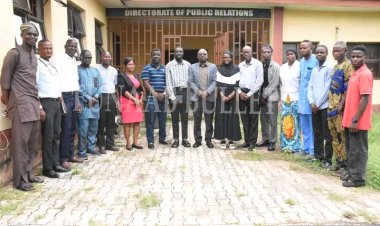
FUNAAB Reaffirms Commitment to Ethical Research and Capacity Development
The Federal University of Agriculture, Abeokuta (FUNAAB) has restated its dedication to academic excellence by strengthening research ethics, enhancing staff training, and implementing structured manuscript evaluation processes to uphold integrity and global best practices.
 Philip22

The Federal University of Agriculture, Abeokuta (FUNAAB) has restated its dedication to academic excellence by strengthening research ethics, enhancing staff training, and implementing structured manuscript evaluation processes to uphold integrity and global best practices.
This assurance was made during a Research and Ethics Training Programme held on April 21, 2026, at the University’s World Bank Centre of Excellence in Agricultural Development and Sustainable Environment (CEADESE).
Representing the Vice-Chancellor, Prof. Babatunde Kehinde, Deputy Vice-Chancellor (Development) Prof. Olawale Dairo emphasized that continuous staff training is vital for institutional growth and professional competence. He urged participants to actively engage in the programme to improve service delivery and overall effectiveness.
Delivering the keynote address, Prof. Isaac Aiyelaagbe described research ethics as the moral principles guiding scientific inquiry, stressing their importance in protecting participants and safeguarding academic integrity. He warned against unethical practices such as plagiarism, data fabrication, and sexual harassment, while highlighting the role of the University Research Ethics Committee (UREC) in reviewing proposals to minimize risks.
Prof. Isaiah Adejumobi underscored the relevance of FUNAAB’s Research Ethics Policy, revised in 2022, which provides a framework for humane and internationally acceptable research standards, including financial transparency.
On manuscript evaluation, Prof. Mutiu Busari noted that ethical compliance requires originality, proper citation, risk mitigation, and responsible communication of findings.
The programme concluded with a call for researchers and students to uphold ethical standards and embrace continuous capacity development to produce credible, impactful research.