ESUT Monitor IT Students Embark on Excursion to Printing Press in Enugu
ESUT Monitor IT Students Embark on Excursion to Printing Press in Enugu
 UmarFarouk123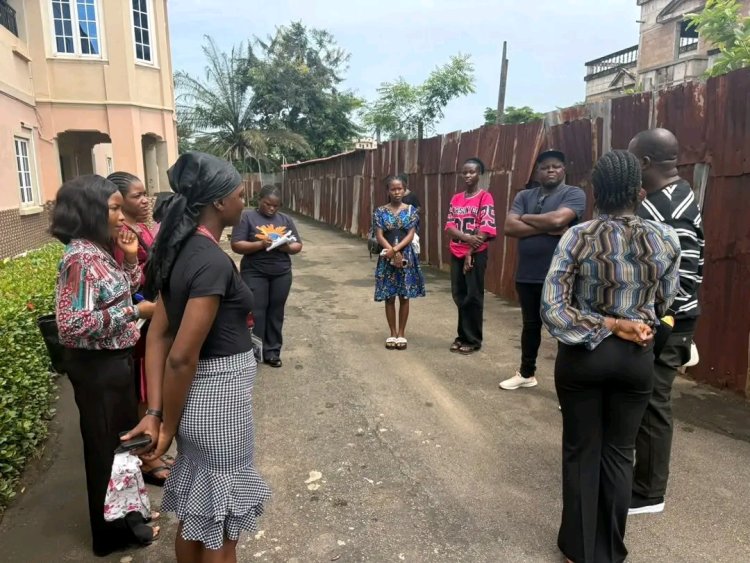
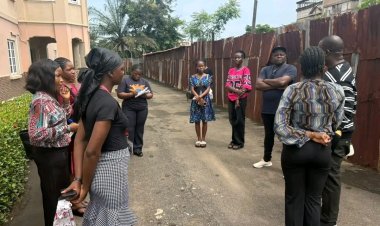
As part of efforts to enhance hands-on training, Industrial Training students of ESUT Monitor Newspaper, Enugu State University of Science and Technology, on Wednesday embarked on an excursion to Choice Flame Communications, Enugu, to acquire practical knowledge in print media production and digital skills.
The team, led by the Staff Adviser, Mr Amaechi Agbo, arrived at the organisation's office at Holy Ghost Cathedral, Enugu, at 11am. The visit exposed the students to different stages involved in newspaper production, from news gathering and design to printing, folding, binding and finishing.
Speaking during the tour, the Director of Choice Flame Communications, Rev. Fr. Anthony Aneke, explained that the printing process begins from the newsroom, where reporters and editors gather and prepare news before it is sent to graphic designers.
He said graphic designers arrange stories and other materials before the work moves to the Computer-to-Plate (CTP) room, where information is transferred from computer to metallic plates used for printing.
According to him, offset printing uses plates to transfer text and images onto paper, with colour separation into four major colours: Cyan, Magenta, Yellow and Black, commonly known as CMYK.
He explained that the organisation uses different machines, including one-unit, two-unit and four-unit machines, depending on number of colours being printed at a time.
The Director also educated the students on different types of paper and their uses, noting that bond paper is commonly used for exercise books, while art paper is used for brochures, magazines and gazettes.
He added that different paper grammages are used depending on type of production, with lighter paper suitable for some publications and thicker paper preferred where more ink is required.
He said after printing, papers go through folding and compilation, after which they may be stitched or hot-bound before trimming to produce neat finished work.
He warned that printing requires careful attention because an error at an early stage could affect entire production and force reproduction at additional cost.
The Director said Choice Flame Communications also handles other forms of production, including books, brochures, gazettes, magazines, banners and customised materials.
Speaking on importance of technical skills, he said Mass Communication students should not depend only on classroom knowledge but should acquire practical skills that would make them more useful in the media industry.
He introduced the students to the organisation's Innovation Hub, explaining that the unit was created to encourage young people to develop new ideas and find creative solutions.
The students were also taken through the organisation's archive, where old newspapers and important documents are kept. The Director described an archive as a place where important documents are stored for future use, noting that the organisation could trace newspapers produced many years ago.
He stressed that archives remain important to the media because printed documents can serve as evidence when proper documentation is required.
The students also visited the graphics section, where they were told that knowledge of graphic design is an important skill for Mass Communication students.
He also showed them a smart conference room under construction, explaining that the facility would allow visual meetings with people in other countries without travelling.
The students were later taken to the podcast studio, where they were introduced to facilities used for podcasting, live streaming and recording.
Speaking on digital skills, the ICT expert, Mr Chike Ogbonna, urged students to develop technical skills beyond news writing, reporting and broadcasting.
Ogbonna, who also studied Mass Communication, said he had to develop beyond traditional areas of the discipline by learning technical skills.
He said the media industry is changing rapidly and students need to prepare for realities of modern workplace, noting that there are not enough jobs for everyone after graduation.
He encouraged students to learn digital skills such as animation, website development, video editing and other technology-related skills.
He introduced students to use of Artificial Intelligence as a learning tool, advising them to use AI to understand and improve their skills rather than depending on it to do all work.
He warned against complete dependence on AI, saying students should first understand basic principles of whatever skill they are learning.
He stressed importance of continuous learning, practice and consistency, adding that mastery comes from applying what one has learned, correcting mistakes and continuing to improve.
He also showed students equipment in the studio, including teleprompter, green screen, lighting equipment and background stand used for photography.
He urged students to develop mindset of learning, improving, unlearning and relearning to remain relevant in changing media industry.
The 2026/2027 IT programme, which commenced on August 24, ended on Friday, October 9, 2026.