Caleb University VC Professor Asikhia Delivers Landmark Lecture on Eradicating African Poverty Through Functional Businesses at Babcock University
Caleb University VC Professor Asikhia Delivers Landmark Lecture on Eradicating African Poverty Through Functional Businesses at Babcock University
 UmarFarouk123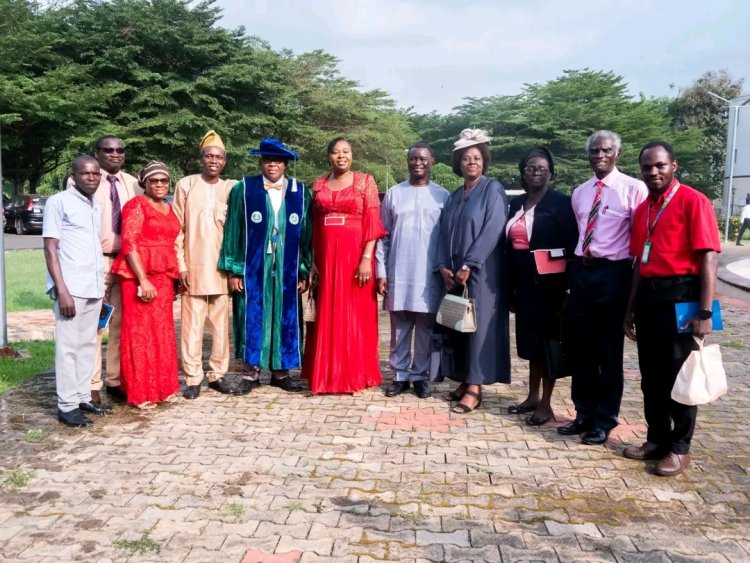
The academic town of Ilishan-Remo erupted in colour and intellectual excitement as scholars, diplomats, industrialists and university leaders converged for the 57th Inaugural Lecture of Babcock University, delivered by the Vice Chancellor of Caleb University, Professor Olalekan Asikhia.
The lecture, titled “It Is Time to Use Functional Businesses to Kill Poverty in Africa,” attracted a historic audience and held amid pomp, elegance and festive ambiance, transforming the usually quiet campus into the region’s intellectual capital for the day.
Scholarship, ceremony and applause filled the grand auditorium as Prof. Asikhia spoke with precision and passion. Barely weeks after a widely-praised Hooding Lecture at Covenant University, a commanding keynote at Babcock, and a distinguished address at the Mountain Top University International Conference on Entrepreneurship, he again dazzled with a power-packed, data-driven presentation that combined research, passion and policy direction, drawing repeated applause from the packed auditorium at the institution where he was first appointed Professor many years ago.
“Africa does not lack potential, talent or resources. What we need are functional businesses, visionary thinking, integrity and institutions that work,” he declared, calling for a decisive shift from charity-based poverty reduction to enterprise-driven prosperity anchored on innovation, entrepreneurship and accountability.
The gathering attracted academics, policy experts, business leaders, students, and traditional rulers, who responded with repeated ovations to a lecture described by many as “transformational.” Observers noted that the theme aligns perfectly with Caleb University’s status as Nigeria’s pioneer entrepreneurial university and speaks directly to national and continental priorities of job creation, youth empowerment and economic independence.
Prof. Asikhia began with stark data that framed the scale of Africa’s poverty.
He noted that 546 million Africans were living in poverty in 2022, the continent currently carries the highest global proportion of the world’s poor, and projections for 2025 suggest extreme poverty may reach 43.9 per cent, affecting more than 438 million people. Nigeria, he stressed, holds the largest share of global extreme poverty, while South Sudan, Somalia, Nigeria and Madagascar are projected to record some of the continent’s highest rates. He identified the root causes as income inequality, weak governance, policy inconsistencies and institutional deficiencies, insisting that a continent so endowed in resources cannot afford to remain trapped in poverty.
Reviewing decades of poverty alleviation efforts across Nigeria, Senegal, Egypt, Ethiopia, Kenya and Zambia, the professor argued that many programmes failed because they distributed money rather than creating wealth. “The missing link is that Africa has spent too long sharing cash instead of deliberately building functional businesses capable of generating wealth,” he submitted, highlighting more than forty failed poverty schemes in Nigeria alone, undermined by corruption and policy discontinuity.
He proposed a paradigm shift anchored on what he termed a Functional Business Model; enterprises designed not only for profit, but for societal development, civic value and sustainable prosperity. Functional businesses, he emphasised, embed themselves within the community, co-creating wealth, generating livelihoods and ensuring equitable distribution of value. “Africa will not escape poverty through donations,” he warned, “but through deliberate creation of businesses that share wealth, build capacity and give people dignity.”
A major thrust of the lecture focused on the role of universities. Prof. Asikhia challenged higher institutions to move beyond theory to practice, serving as hubs of innovation and enterprise. Findings from a survey of 581 SMEs in Nigeria showed that only 15 per cent of wealth created contributed to poverty alleviation. To reverse this trend, he called for practical entrepreneurship to be embedded into every curriculum, formal registration of student start-ups in partnership with the Corporate Affairs Commission, and the transformation of university-owned ventures — water production, bakery and agribusiness — into instruments for community empowerment. He further advocated the adoption of SEPA (Social Entrepreneurship for Poverty Alleviation), enabling students to engage in community development projects, grant writing, research and business incubation.
Caleb University’s top management, led by the Chancellor, Pro-Chancellor, Registrar and Deans, attended radiantly, turning the occasion into a celebration of scholarship and institutional pride. The Pro-Chancellor and Chairman of Governing Council, Professor Sunday Ajayi, received multiple acknowledgements for his role in strengthening governance and excellence at Caleb University.
Many speakers described him as “a strategic thinker, a quiet reformer and a gentleman of distinction whose steady hands have helped make Caleb University a model in Nigerian higher education.”
The host institution was equally effusive. Performing his first major assignment since assuming office, the new Vice Chancellor of Babcock University hailed the lecture as “a gift to Africa.” According to him, “the clarity, scholarship and practicality were exceptional. Professor Asikhia did not just speak; he offered solutions. This lecture will influence thinking, policy and strategy in the months ahead.” The audience responded with a standing ovation.
In a moment of emotion, Professor Asikhia paid tribute to his wife, Professor Mrs Asikhia, describing her as “my first audience, my honest critic and my greatest source of encouragement.” He acknowledged the support of their children, including one who is already a PhD scholar, noting that scholarship is a tradition in their home.
He also praised Caleb University’s Visitor, Dr Oladega Adebogun, for his visionary leadership. “Caleb University is blessed with a Visitor who believes in excellence, values research and invests in ideas that change society. Dr Adebogun gave me the biggest platform of my career,” he stated.
As the lecture drew to a close, the auditorium rose in sustained applause for the scholar whose clarity, humility and conviction resonated with the audience. Observers described the presentation as bold, evidence-driven and timely for a continent searching for solutions.
In a press statement, Caleb University, Lagos. Information, Media and Publication Specialist, Olawale Adekoya, affirmed that “the Inaugural Lecturer is not merely teaching about poverty reduction; he is modelling it. He speaks with the authority of research and the humility of service. He is one of the few scholars whose work is already changing communities and will change a continent.”
The evening ended with handshakes, photographs, media interviews and a cocktail, as guests departed with a sense of history made and a strong conviction that the lecture will shape conversations on poverty reduction and enterprise-building for years to come.
For many present, it was more than an academic exercise; it was a manifesto for African prosperity. As one participant concluded after the final ovation, “Asikhia did not just deliver a lecture. He delivered a movement.”