FUNAAB Explores AI-Enabled Hydroponic Farming in Partnership with Alt Bank and Tulima Farms
The Federal University of Agriculture, Abeokuta (FUNAAB) is set to advance cutting-edge agricultural innovation as it engages in high-level discussions with Sterling Financial Holdings’ Alternative Bank Limited and Egypt-based Tulima Farms and Agri-Processing LLC to establish an AI-enabled hydroponic farming ecosystem on campus.
 Philip22
The Federal University of Agriculture, Abeokuta (FUNAAB) is set to advance cutting-edge agricultural innovation as it engages in high-level discussions with Sterling Financial Holdings’ Alternative Bank Limited and Egypt-based Tulima Farms and Agri-Processing LLC to establish an AI-enabled hydroponic farming ecosystem on campus.
The discussions took place on February 24, 2026, underscoring FUNAAB’s growing role as a hub for technology-driven agriculture in Africa.
The initiative seeks to integrate Artificial Intelligence (AI) with precision hydroponic systems to cultivate exotic vegetables and staple crops under climate-controlled conditions, creating a scalable, commercially viable, and technologically advanced smart farming model. The partnership combines finance, innovation, and research expertise to drive sustainable agricultural enterprise on campus.
Welcoming the delegation, Vice-Chancellor Prof. Babatunde Kehinde affirmed the University’s readiness to host and drive the project, citing FUNAAB’s extensive research ecosystem, innovation-driven centres, farmlands, and skilled human capital. He emphasised that the University possesses the technical depth and infrastructure required to successfully launch and sustain the AI-enabled hydroponic initiative.
The project aims to strengthen local food systems, promote year-round productivity, and enhance climate resilience by leveraging data-driven nutrient management, optimised water use, and controlled-environment agriculture. Beyond increasing domestic food production, the initiative is expected to boost agribusiness growth, create jobs, and support economic diversification, providing a scalable model for smart agriculture across Africa.

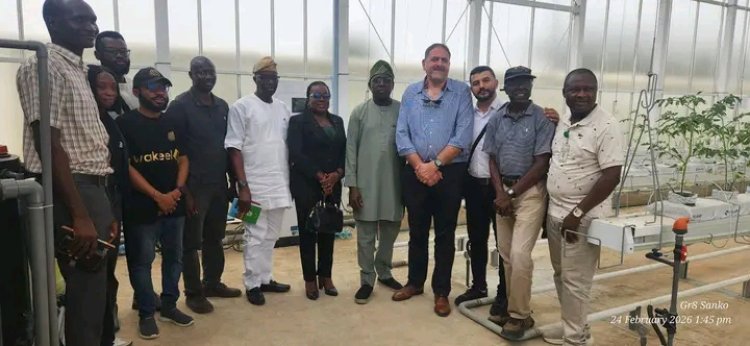
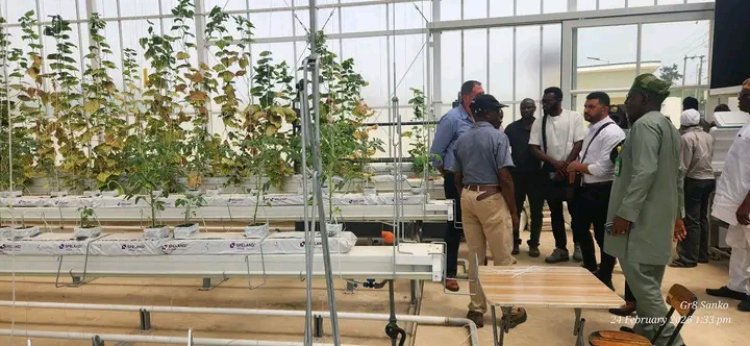
During the engagement, the joint team conducted site inspections across the University, assessing infrastructure readiness, climatic suitability, and preliminary water and soil nutrient profiles. Mr. Mohamed Salama, Founder and CEO of Tulima Farms, presented the production model, investment structure, operational framework, and proposed risk-sharing strategies. He stressed the importance of constituting a cross-functional University team of experts in agriculture, engineering, research, infrastructure, and enterprise development to ensure technical depth and accelerated implementation.
Tulima Farms is internationally recognised for its sustainable, high-tech indoor farming systems, including climate-controlled greenhouses and modular container farms producing pesticide-free, nutrient-rich crops within an integrated farm-to-table model. The delegation toured FUNAAB’s Automated Greenhouse Facility, Musarchy Farms, and the Centre of Excellence in Agricultural Development and Sustainable Environment (CEADESE), demonstrating the University’s preparedness to host advanced agricultural technologies.
Key FUNAAB officials present at the meeting included the Registrar, Dr. Titus Adeniyi; Bursar, Mr. Olukayode Osinuga; Director of CEADESE, Prof. Adeboye Fafiolu; Ag. Director, DRIP, Dr. Oluwagbemiga Adeleye; University Legal Officer, Mrs. Olanrewaju Tanimowo, among others.
The collaboration is poised to position FUNAAB at the forefront of technology-driven agriculture in Africa, merging AI innovation, sustainable farming, and enterprise development to address food security and agribusiness challenges.