FUTA, NASRDA to Establish Institute of Aerospace Development, Deepen Collaboration in Space Science
The Federal University of Technology, Akure (FUTA), and the National Space Research and Development Agency (NASRDA) have agreed to deepen institutional collaboration through the proposed establishment of an Institute of Aerospace Development, aimed at strengthening Nigeria’s advancement in aerospace science and engineering.
 Philip22

The Federal University of Technology, Akure (FUTA), and the National Space Research and Development Agency (NASRDA) have agreed to deepen institutional collaboration through the proposed establishment of an Institute of Aerospace Development, aimed at strengthening Nigeria’s advancement in aerospace science and engineering.

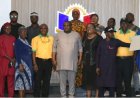
The agreement emerged from a working visit by the Director-General of NASRDA, Dr. Matthew Adepoju, to FUTA on Wednesday, January 21, 2026, where he and his delegation were received by the University Management led by the Vice-Chancellor, Professor Adenike Oladiji.
Dr. Adepoju described FUTA as the natural partner for the initiative, citing the University’s strong track record and the professionalism of its Centre for Space Research and Applications (CESRA), which he referred to as a trailblazer in space science and technology in Nigeria. He commended Professor Joseph Akinyede, a former Director of CESRA, for his pioneering contributions to space research and his role as the pioneer Director of Strategic Space Applications at NASRDA.
The NASRDA Director-General also praised FUTA graduates who have undergone internships at the Agency, noting their depth of knowledge and technical competence. He specifically referenced Temidayo Oniosun, a FUTA alumnus who in 2025 collaborated with the United States National Space Agency on a project that sent egusi seeds into space, describing him as a product of FUTA’s rigorous training who had interned under his supervision at NASRDA.
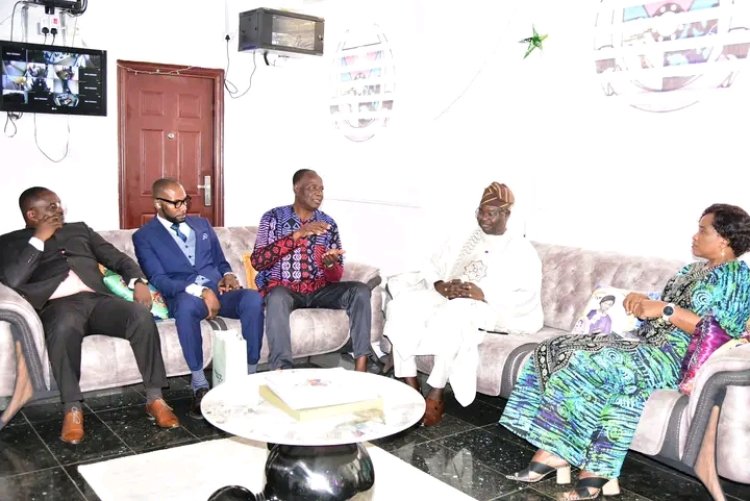
According to Dr. Adepoju, the proposed Institute of Aerospace Development will bridge the gap between academic training and industry practice, ensuring that research, teaching, and innovation are closely aligned with real-world aerospace applications. He emphasized that the fusion of theory and practice is critical to producing globally competitive outcomes in aerospace development.
In her response, Professor Oladiji welcomed the collaboration, stating that NASRDA could not have chosen a better partner. She highlighted FUTA’s depth of expertise, strong faculty base, and growing research output as key assets that would drive the success of the Institute. She reaffirmed the University’s commitment to excellence, describing FUTA as a technology-driven institution distinguished by measurable research impact rather than rhetoric.
The Vice-Chancellor recalled FUTA’s landmark achievement in space technology with the launch of NigeriaEduSat-1 (EDUSAT-1) on July 7, 2017, through a collaboration involving CESRA, NASRDA, and the Kyushu Institute of Technology, Japan. The satellite, which lifted off from Florida on June 3, 2017, was part of the BIRDS-1 Project initiated in October 2015 and represented Nigeria’s first university-owned CubeSat. She noted that the project was led by FUTA in partnership with NASRDA, with Mr. Ibukun Adebolu of the Department of Mechanical Engineering serving as Nigeria’s representative.
Professor Oladiji also referenced a more recent milestone, noting that on Friday, August 1, 2025, a SpaceX Falcon 9 rocket launched from Cape Canaveral, Florida, carrying egusi seeds from Oyo State to the International Space Station, an initiative facilitated by FUTA alumnus Temidayo Oniosun. She disclosed that the University maintains close ties with Oniosun, a leading African space expert and former President of FUTA’s Space Club, who continues to support the University’s aerospace development initiatives, including the proposed collaboration with NASRDA.
Both institutions expressed confidence that the partnership would significantly advance Nigeria’s aerospace capacity through innovation, research, and industry-relevant training.