FUTMinna 128th Inaugural Lecture: Prof. Gimba Says Weak Link Between Mathematics Education and National Problems Hinders Development
FUTMinna 128th Inaugural Lecture: Prof. Gimba Says Weak Link Between Mathematics Education and National Problems Hinders Development
 UmarFarouk123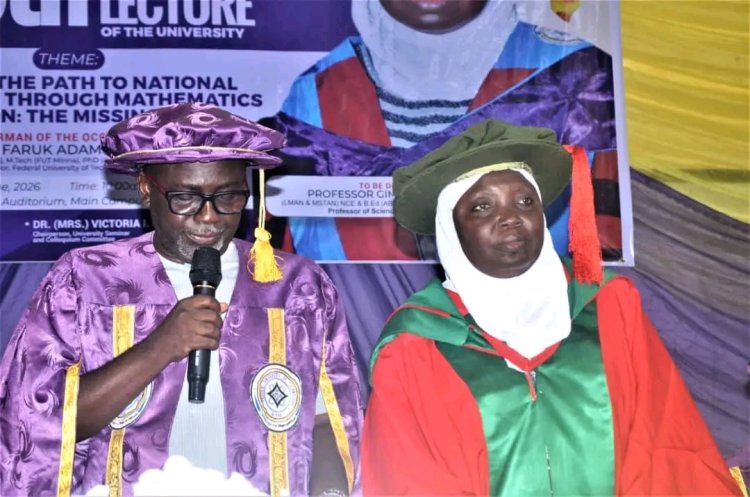
Professor of Science Education (Mathematics), Federal University of Technology, Minna (FUT Minna), Prof. Ramatu Wodu Gimba, has identified the inadequate application of Mathematics Education to national challenges as the missing link hindering Nigeria’s quest for sustainable development and self-reliance.
She made the assertion while delivering the University’s 128th Inaugural Lecture titled: “Modelling the Path to National Development Through Mathematics Education: The Missing Link”on Thursday, June 25, 2026, at the University Auditorium, Main Campus.
Prof. Gimba described Mathematics Education as more than numbers and calculations. She said it is a vital tool for nurturing critical thinking, reasoning and problem-solving skills needed for national growth.
According to her, it contributes to intellectual development, scientific advancement, social and cultural values, discipline, vocational skills and psychological growth, making it indispensable to human existence and national transformation.
She stressed that 21st-century Mathematics teaching should be innovative and learner-centred to cultivate thinkers and innovators, and that students should see Mathematics as an engaging discipline shaped by diverse cultures.
Speaking on sustainable development, Prof. Gimba described it as balancing environmental, economic and social progress. She argued that Mathematics Education should sustain growth in human thinking through creativity, flexibility and critical reflection.
She lamented declining student interest in Mathematics despite its importance to STEM, noting this has weakened Nigeria’s capacity to produce manpower for Science, Technology, Engineering and Mathematics.
She identified gaps including weak links between classroom Mathematics and real-world problems, poor foundational knowledge at basic and secondary levels, dominance of teacher-centred methods, limited use of technologies like GeoGebra and Desmos, and reliance on foreign-based examples instead of Nigerian contexts.
Prof. Gimba said the missing link lies in the failure to translate Mathematics into practical solutions through relevant curricula, empowered teachers, innovative methods, equitable technology integration and cultural reorientation. Addressing these, she said, would turn Mathematics from a classroom subject into a catalyst for innovation, equity, industrial growth and sustainable development.
She highlighted her research on computer-assisted instructional packages and educational technologies to address learning difficulties, and studies on retention, motivation, gender inequality, attitude and ability.
On mentorship, she disclosed supervising 80+ undergraduate projects, 30 Master’s and 19 PhD students, serving as a resource person in teacher training, and participating in 40+ committees. She also serves as a NUC resource verification expert and accreditation panelist.
Concluding, Prof. Gimba recommended regular training for Mathematics teachers, mentorship networks, culturally relevant curricula, periodic curriculum reviews, adequate instructional resources, and ICT integration. She described Mathematics Education as “the key to sustainable growth and self-reliance,” noting that “the future of civilisation depends largely on the quality of Mathematics Education available to society.”
Vice-Chancellor Prof. Faruk Adamu Kuta commended the lecture as thought-provoking and timely, saying it provided valuable insights into the nation’s educational challenges and pathways for growth. He applauded Prof. Gimba’s contributions to teaching, research, mentorship and service, describing her journey as an inspiration to younger scholars.