McPherson University Hosts Maiden Scientific Conference
McPherson University Hosts Maiden Scientific Conference
 UmarFarouk123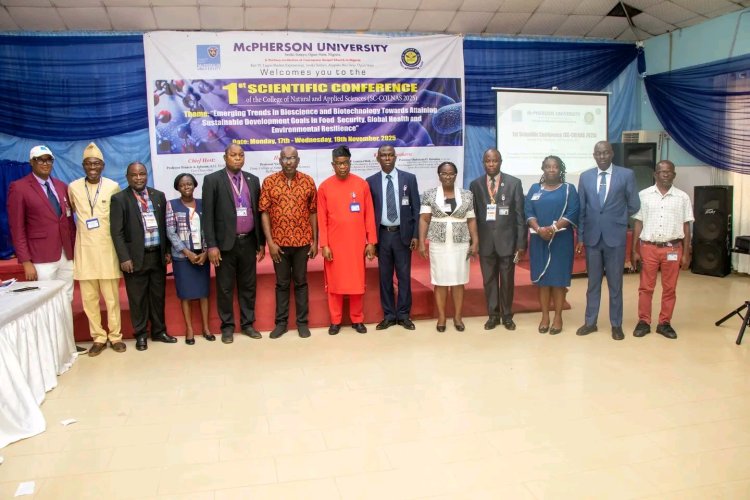
McPherson University has taken a significant step in advancing scientific inquiry and innovation with the successful hosting of the maiden Scientific Conference of the College of Natural and Applied Sciences, known as SC COLNAS 2025.
The conference marked a major milestone for the institution as it gathered scholars, researchers and industry experts to share insights on emerging scientific challenges and opportunities.
The conference, themed “Emerging Trends in Bioscience and Biotechnology Towards Attaining Sustainable Development Goals in Food Security, Global Health and Environmental Resilience,” held from Monday, November 17 to Wednesday, November 19, 2025, set the tone for an in-depth exploration of the vital role of science and biotechnology in global sustainability.
The Vice Chancellor of McPherson University, Prof. Francis Igbasan, opened the event with a compelling address, commending the college for bringing together experts to interrogate advances in biosciences and biotechnology. He described the conference as timely, especially as the world faces rising threats from climate change, food insecurity, public health crises and environmental degradation.
Prof. Igbasan reaffirmed the university’s commitment to supporting robust scientific research and innovation. He assured participants that McPherson University would continue to strengthen its research infrastructure, expand funding opportunities and develop policies aimed at positioning the institution as a leading contributor to Africa’s scientific advancement.
He emphasized that universities must drive national transformation by generating knowledge that directly responds to societal needs. According to him, science remains the most reliable instrument for building resilient systems capable of supporting sustainable development.
Following the Vice Chancellor’s address, the Dean of the College of Natural and Applied Sciences, Professor Victor Oyetayo showed the central role of science in national development. He noted that meaningful progress is only possible when societies invest in research, experimentation and problem solving, adding that science forms the foundation for innovation-driven growth.
A major highlight of the conference was the plenary session, and presentations from Prof. Ganiyu Oboh of the Federal University of Technology, Akure; Prof. Olubukola O. Babalola of North West University, South Africa; and Assistant Prof. Opeyemi O. Lawal of the University of Windsor, Canada. Each speaker brought unique expertise reflecting years of research and global collaboration.
In his keynote lecture, Prof. Oboh examined the transformative power of biotechnology in agriculture, healthcare and environmental restoration. He explained that many nations are already leveraging scientific innovations to enhance food systems, improve disease management and safeguard ecosystems.
However, Prof. Oboh expressed concern that Nigeria has yet to fully harness the potential of biotechnology. He lamented the nation’s slow pace in adopting scientific innovations and warned that continued neglect risks leaving the country behind in a rapidly advancing global scientific landscape.
“It is high time we stopped paying lip service to biotechnology,” he declared. He urged both government and private stakeholders to invest meaningfully in research, innovation hubs and technological infrastructure capable of driving the nation’s development.
The conference concluded with a renewed call for sustained collaboration among universities, industries, government agencies and global partners. Participants agreed that such partnerships are essential for turning scientific discoveries into workable solutions that address environmental, health and food security challenges.
SC COLNAS 2025 ended on a promising note, with attendees expressing optimism that the conference would become an annual platform for scientific dialogue, innovation and capacity development, ultimately strengthening Africa’s voice in global scientific advancement."