UI Prioritises Partnerships that Solve Real-World Problems — DVC Academic
The Deputy Vice-Chancellor (Academic) of the University of Ibadan, Professor Juwon T. Arotiba, has reaffirmed that the institution places high value on partnerships and collaborations that directly address pressing societal challenges.
 Philip22

The Deputy Vice-Chancellor (Academic) of the University of Ibadan, Professor Juwon T. Arotiba, has reaffirmed that the institution places high value on partnerships and collaborations that directly address pressing societal challenges.
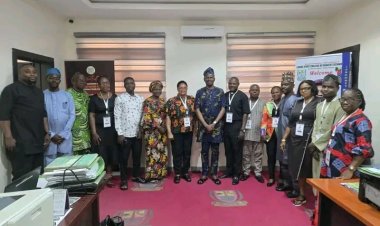
Professor Arotiba made this known while receiving a delegation from the Humboldt Research Hub during a courtesy visit to the office of the Vice-Chancellor, Professor Kayode O. Adebowale, mni, FAS, fspsp. Speaking on behalf of the Vice-Chancellor, he noted that as Nigeria’s premier university, UI remains committed to research, innovation, and global partnerships that create measurable impact and advance national development.
He described the Humboldt Research Hub initiative as one that aligns perfectly with the University’s mission of translating knowledge into practical solutions for the betterment of society.
The Principal Investigator of the Humboldt Research Hub at the University, Professor James O. Olopade, explained that the Hub was established through a network of research centres created by the Alexander von Humboldt Foundation in collaboration with German and African institutions. He stated that six such hubs were set up across Africa to enhance epidemic and pandemic preparedness and to strengthen research capacity on the continent, with one domiciled at the Faculty of Veterinary Medicine, University of Ibadan.
According to him, the grant, which spans from 2021 to 2026, has been used to procure essential research equipment and facilitate seminars, workshops, and conferences aimed at fostering knowledge exchange and collaboration.
Professor Arotiba later commissioned a fully equipped, virtually functional seminar room of the Humboldt Research Hub for Zoonotic Arboviral Diseases located in the Department of Veterinary Anatomy.

The Humboldt Ambassador in Nigeria, Professor Oluwatoyin Odeku, described the new facility as a crucial step toward transforming Nigeria’s scientific potential into tangible national gains. She emphasized that the presence of two Humboldt Research Hubs in the country — at UI and LAUTECH — presents an opportunity for Nigeria to reverse brain drain and build local research leadership.
Professor Odeku urged the Nigerian government to create policies that support scientists and encourage them to remain in the country to train the next generation of researchers.
During the opening of a workshop organised to groom future research leaders at the University, Professor Arotiba challenged participants to aspire to excellence and become global reference figures in their respective fields. He described them as the future of UI’s biological research, encouraging them to take up leadership roles that will strengthen both national and international research capacity.
He also expressed the University’s appreciation to Professor Martin Groschup of the Friedrich Loeffler Institute, Germany, for his long-standing mentorship of African scientists.
Representing the Dean of the Faculty of Veterinary Medicine, Professor B. O. Olugasa, Professor T. O. Omobowale urged the participants to be attentive, actively engage with facilitators, and cultivate a passion for research-intensive careers.
The workshop featured two sessions and concluded with a roundtable discussion. Facilitators included distinguished Nigerian scholars such as Professors I. O. Igbokwe, M. B. Abubakar, D. O. Oluwayelu, James O. Olopade, Olawale Adelowo, George Ademowo, and Oluwatoyin Odeku, alongside international collaborators Professor Martin Groschup (Friedrich Loeffler Institute, Greifswald), Professor Marc Stadler (Helmholtz Infection Centre, Braunschweig), and Dr. Yasmina Marin-Felix.