Changing the Narrative, My Biggest Motivation — Sarah Ayashim, UDUS Best Graduating Nursing Student
Changing the Narrative, My Biggest Motivation — Sarah Ayashim, UDUS Best Graduating Nursing Student
 UmarFarouk123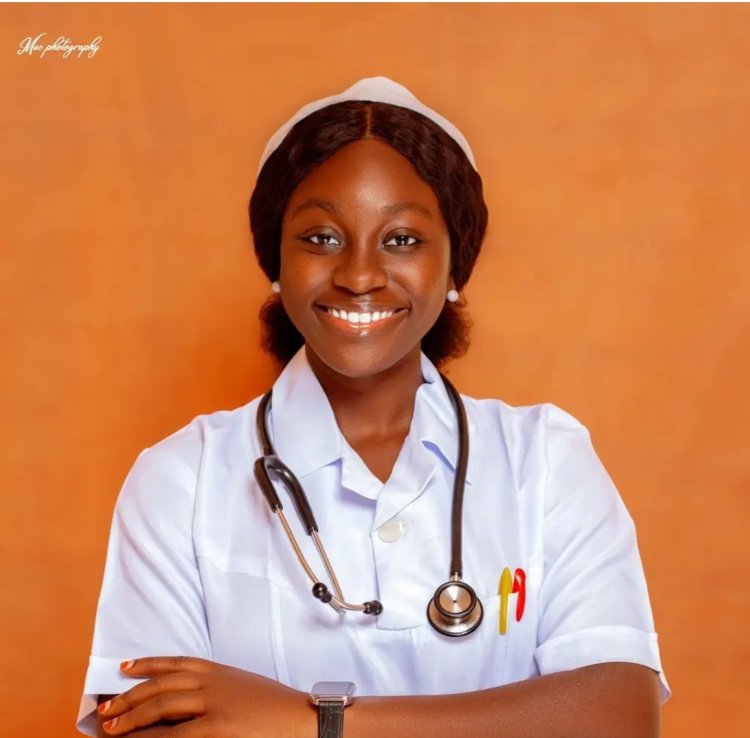
Sarah Ayashim, the best nursing graduate at UDUS, overcame personal and societal challenges to achieve academic excellence & redefine the narrative around single motherhood and resilience.
For Sarah Ayashim, success wasn’t just a matter of ambition—it was an act of defiance
Hailing from Zangon Kataf in Kaduna State, Sarah recently graduated with First Class honors from the Department of Nursing Science at Usmanu Danfodiyo University, Sokoto (UDUS). Her 4.61 GPA, on a 5-point scale, made her the best-graduating nursing student of the 2023/2024 academic session. But her achievement was about more than grades. It was about rewriting a story that society had tried to assign her from birth.
When Sarah first arrived at UDUS, she encountered a troubling pattern: no Christian student before her had ever graduated with a First Class in Nursing. Some had started strong, but they never made it to the finish line. That unwritten narrative might have discouraged others. For Sarah, it sparked resolve. “If only one person in this class gets an A,” she told herself, “it has to be me.”
Yet nursing wasn’t her original path. Sarah had wanted to study Medicine. But after her first JAMB result in 2017 failed to secure her admission, she refused to let the setback define her. Rather than wait idly, she enrolled in the College of Nursing and Midwifery in Kafanchan. By the next year, having discovered a genuine passion for the profession, she sat for the exam again and applied to UDUS—this time with nursing in mind. The acceptance letter marked not just a turning point, but a reaffirmation of her chosen path.
Her mother, a single parent, had mixed emotions. She had dreamed of her daughter becoming a doctor and was deeply concerned about her going far north amid rising insecurity. But despite her initial reservations, she stood by Sarah’s decision. That unwavering maternal support would become a pillar of strength through the years that followed.
The road, of course, was anything but smooth. In her second year, Sarah underwent surgery—just as her classmates were going on break. Recovery was physically and emotionally draining, yet she still found herself attending ward rounds and poring over textbooks. In her fourth year, things took another hit when her mother lost her job. The financial strain was suffocating, and the demanding nature of the course left little room for side hustles or part-time work.
Despite the setbacks, Sarah never lost sight of her goal. In fact, the very weight of her circumstances became her greatest source of fuel. “I was the child who wasn’t supposed to be born,” she said. “People look at children born out of wedlock and assume we’re useless. I wanted to prove that my existence is not a mistake.”
The desire to change the narrative wasn’t just symbolic. It was deeply personal. She wanted her father—largely absent from her life—to feel pride. She wanted her mother to know that every sacrifice had been worth it. Her academic pursuit, in that sense, was never just about career prospects. It was a way of claiming dignity.
From her earliest days, Sarah committed to a rigorous routine. She started studying from the very beginning of each semester, refusing to coast until exams loomed. She understood her rhythms, knew when her mind was sharpest, and broke her day into efficient two-hour study intervals, totaling around six hours a day. But what truly distinguished her approach was her attention to detail during lectures. She learned to spot what others might miss—those subtle cues when a lecturer lingered on a subtopic, signaling likely exam material. She took concise, strategic notes and treated every class as an opportunity to read between the lines.
Her consistency paid off. From the outset, she maintained stellar grades: a 4.71 GPA in her first year, followed by 4.73 in second year, 4.71 in third, 4.64 in fourth, and finally 4.61 in her final year. The numbers tell a story of unrelenting excellence—one that never dipped below First Class territory.
Her message to other Nigerian students aspiring to academic success is direct: start early. Don’t wait for pressure or panic to push you into gear. More importantly, she says, resist the pull of the crowd. “Do what works best for you,” she advises. “Push beyond what you think are your limits—that’s where growth happens.”
Looking ahead, Sarah envisions herself not just as a practitioner, but as a mentor and advocate. She hopes to transition into academia, guiding the next generation of nurses and reminding them that the field is not just a career, but a calling. “It’s about improving lives,” she says. “It’s about being the reason someone smiles.”
But her ambitions don’t end at the classroom or the bedside. She wants to represent Nigeria globally through her practice, to embody the kind of empathy that patients remember long after discharge. She also hopes to further her education, not just to advance personally, but to help address the systemic lapses that continue to hold back the Nigerian healthcare system.
For Sarah Ayashim, nursing is more than a profession. It’s a platform. And she’s determined to use it not just to heal bodies—but to rewrite stories. Especially her own.