EKSU 96th Inaugural Lecture: Prof. Fadeke Ojelabi Advocates for Physics Funding, “Brains Before Bridges”
Professor Fadeke Matthew Ojelabi, of Ekiti State University (EKSU), has called for massive and sustained funding in Physics, emphasizing the crucial role of Condensed Matter Physics (CMP) in driving Nigeria’s technological and economic development.
 Philip22
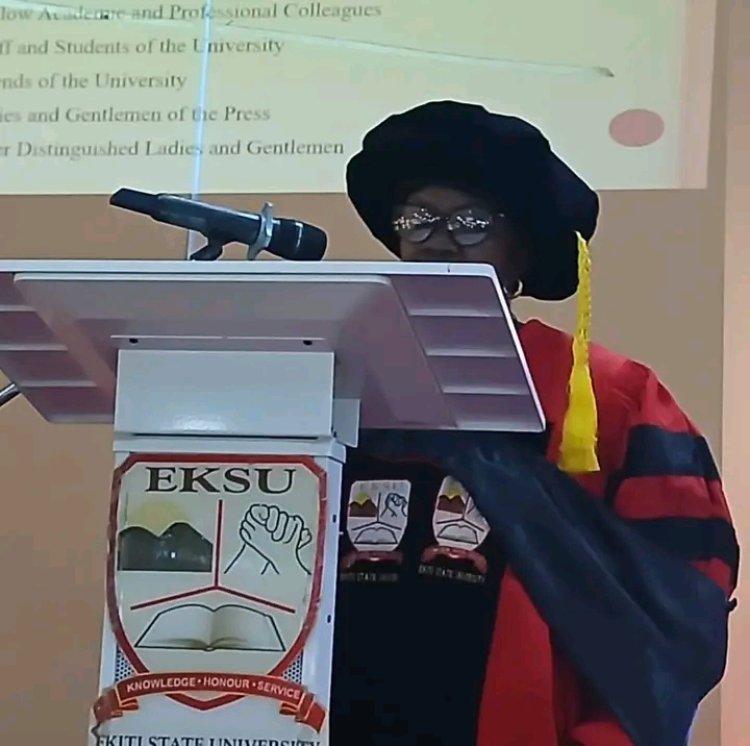
Professor Fadeke Matthew Ojelabi, of Ekiti State University (EKSU), has called for massive and sustained funding in Physics, emphasizing the crucial role of Condensed Matter Physics (CMP) in driving Nigeria’s technological and economic development.
Delivering the 96th inaugural lecture at the university’s main campus, Prof. Ojelabi titled her presentation: “Quantum Leaps and Economic Spikkes: How Condensed Matter Physics Can Drive Nigeria’s Technological Revolution.” She highlighted the lack of laboratories, modern equipment, and practical learning opportunities, which she said hampers students’ grasp of abstract physics concepts. Many secondary schools, she noted, either lack dedicated Physics laboratories or operate with poorly equipped, outdated, or inaccessible facilities.
Prof. Ojelabi also pointed out the limited access to computers, internet, and educational software, which restricts the integration of modern teaching methods. She stressed the dual challenge of brain drain and the low participation of women in advanced Physics, calling for targeted interventions to increase female representation in Science, Technology, Engineering, and Mathematics (STEM) fields.
The lecturer made a strong case for strategic federal investment in Theoretical Condensed Matter Physics (TCMP), describing it as essential not only for academic advancement but also for addressing energy, security, advanced manufacturing, and digital defense challenges, while fostering a self-sustaining knowledge economy. She urged the government to prioritize “brains before bridges” and establish robust funding mechanisms to unlock Nigeria’s developmental potential.
Prof. Ojelabi recommended that undergraduate Physics curricula include courses on the historical evolution of scientific discoveries, allowing students to contextualize contributions of past scientists and identify where they can make meaningful impact.
In his brief remarks, EKSU Vice-Chancellor, Prof. Ayodele Babatola, encouraged academics yet to deliver their inaugural lectures to act without delay, assuring continued support from the university for scholarly initiatives.
The lecture underscores EKSU’s commitment to research excellence, innovation, and practical solutions to national development challenges through strategic investments in Science and Technology.