FUNAAB Strengthens Laboratory Workforce with Orientation on Best Practices and Emerging Technologies
The Directorate of Technologists and Technical Staff (DITTECS) at the Federal University of Agriculture, Abeokuta (FUNAAB) conducted a One-Day Orientation Programme for newly employed, upgraded, and converted laboratory personnel on February 24, 2026, aimed at enhancing professional competence and laboratory efficiency.
 Philip22
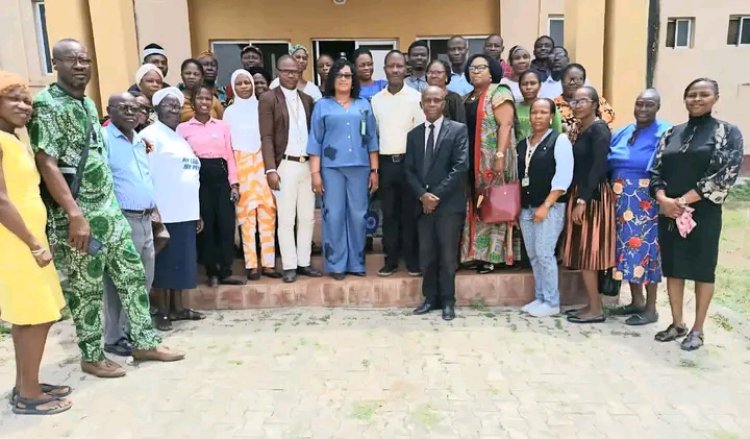
The Directorate of Technologists and Technical Staff (DITTECS) at the Federal University of Agriculture, Abeokuta (FUNAAB) conducted a One-Day Orientation Programme for newly employed, upgraded, and converted laboratory personnel on February 24, 2026, aimed at enhancing professional competence and laboratory efficiency.

Opening the programme, Dr. ‘Wunmi Abimbola-Okuneye, Director of DITTECS, highlighted the critical role of technologists and scientists in advancing FUNAAB’s academic, research, and innovation mandate. She described laboratory personnel as highly trained professionals with expertise spanning physical, biological, chemical, biomedical, and engineering sciences. The training was designed to improve laboratory capacity while instilling professional best practices among staff.
“The laboratory is the powerhouse of science, a controlled environment for experiments, measurements, and analysis. Excellence requires responsibility, efficiency, consistency, and self-discipline,” Dr. Abimbola-Okuneye said, adding that laboratory professionals impact research, academia, clinical services, and industry, translating scientific ideas into societal benefits.
The orientation featured a lecture titled “Essential Laboratory Practices”, delivered by Engr. Tunde Shofolahan, who introduced participants to Lab 4.0, highlighting how the Internet of Things (IoT) and predictive maintenance are transforming laboratory operations. He demonstrated how IoT-enabled sensors monitor equipment performance and conduct automated diagnostics, improving operational efficiency.
While acknowledging the advantages of emerging technologies, Engr. Shofolahan cautioned against over-reliance on automation: “IoT sensors can perform automated diagnostics, but they cannot replace a guardian mind,” he said. He stressed the importance of rigorous manual checks, including inspecting equipment cleanliness, verifying calibration tags, and identifying potential faults, noting that technology complements—but does not replace—human vigilance.
Other resource persons reinforced foundational laboratory principles. Ms. Jolaade Adegbite delivered a session on work ethics and time management, while Mrs. Christine Awe-Mathias addressed laboratory safety and health. Both emphasised security consciousness, ethical adherence, and punctuality as essential for effective laboratory operations.
The orientation marks a key initiative by FUNAAB to develop a technically skilled, disciplined, and forward-looking laboratory workforce, capable of integrating modern technologies with professional best practices to advance research and innovation.