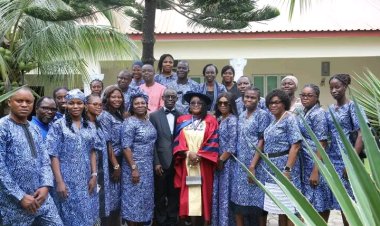
FUTA Repositions Academic Technologists as Key Drivers of Research and Innovation
The Federal University of Technology Akure (FUTA) has reaffirmed the critical role of academic technologists in strengthening research output, innovation, and the production of self-reliant graduates, as the institution intensifies efforts to align with global scientific and technological standards.
 Philip22

The Federal University of Technology Akure (FUTA) has reaffirmed the critical role of academic technologists in strengthening research output, innovation, and the production of self-reliant graduates, as the institution intensifies efforts to align with global scientific and technological standards.

This position was emphasized by the Vice-Chancellor, Professor Adenike Oladiji, during a two-day capacity-building workshop organized by the Office of the Vice-Chancellor through the Quality Assurance Management Unit. The training, themed “Navigating the Future: The Evolving Role of Academic Technologists in Research and Emerging Technologies in Nigerian Universities,” brought together laboratory and research technologists from across the institution.
Represented by the Deputy Vice-Chancellor (Development), Professor Sunday Oluyamo, the Vice-Chancellor noted that continuous training remains essential for academic technologists to remain effective in supporting teaching, research, and innovation. She stressed that their role directly impacts the quality of FUTA graduates and the institution’s broader research competitiveness.
The Vice-Chancellor commended the keynote speaker, Dr. Peter Oluwafisoye, Director-General and Registrar of the Nigerian Institute of Science Laboratory Technologists (NISLT), Ibadan, for his contributions to advancing laboratory science practice in Nigeria.
Delivering the keynote address, Dr. Oluwafisoye urged academic technologists to actively engage in global research and scholarly publication, emphasizing that their relevance in the modern academic system depends on expertise, innovation, and professional visibility. He encouraged multi-disciplinary collaboration, industry-driven innovation, and commercialization-oriented research as pathways for career advancement.
He further noted that academic technologists must not restrict themselves to traditional support roles but should actively contribute to national policy discussions and global scientific development. According to him, the evolving research environment demands accountability, measurable impact, and continuous professional development.
Dr. Oluwafisoye also emphasized regulatory compliance, transparent documentation, and the transition from support staff roles to active technical partnership in research innovation. He cautioned against professional isolation, urging technologists to complement academic staff by ensuring precision, safety, and integrity in laboratory processes. He further warned against data manipulation and stressed the importance of laboratory safety and continuous training.
A lecture on laboratory safety and biosecurity, delivered by Dr. Abolarin Ibitoye, former Laboratory Manager at the FUTA Julius Okojie Central Research Laboratory, highlighted the importance of risk assessment, hazard identification, and strict adherence to safety protocols. He emphasized that laboratory safety is a shared responsibility and warned against unsafe practices, particularly in sensitive environments involving radioactive materials.
The Director of the Centre for Gender Issues in Science and Technology, Professor Mary Olowokere, also delivered a lecture on emerging technologies and innovation trends. She identified artificial intelligence, biotechnology, robotics, nanotechnology, renewable energy systems, and quantum computing as transformative tools reshaping global industries. She urged participants to continuously upgrade their digital and technical competencies in response to rapid technological change.
In another presentation, Professor Ganiyu Oboh, Director of the Centre for Entrepreneurship, FUTA, spoke on research productivity and publication ethics. He encouraged participants to translate laboratory work into impactful publications while warning against plagiarism, falsification of results, and duplication of research outputs.
Earlier, the Director of the Quality Assurance Management Unit, Professor Salawu, described academic technologists as evolving contributors to research excellence rather than mere laboratory support staff. He noted that their expanding responsibilities are central to how Nigerian universities adapt to global trends in science, technology, and innovation.
The workshop underscored FUTA’s commitment to strengthening technical capacity within its research ecosystem and repositioning academic technologists as strategic partners in advancing institutional excellence.