UNIUYO Students’ Union Bans Use of Permanent Markers in All Lecture Halls
The Students’ Union Government (SUG) of the University of Uyo has announced a strict prohibition on the use of permanent markers in all lecture halls and classrooms across campus.
 Philip22
The Students’ Union Government (SUG) of the University of Uyo has announced a strict prohibition on the use of permanent markers in all lecture halls and classrooms across campus.
The directive, communicated via the Office of the Director of Academics, is part of the ongoing “Campus Clean Slate Project”, aimed at ensuring whiteboards remain clean, legible, and conducive for effective learning.
Background:
In a memorandum dated January 23, 2026, Director of Academics, Miracle Victor Etim, highlighted concerns over students using permanent markers, noting that the practice:
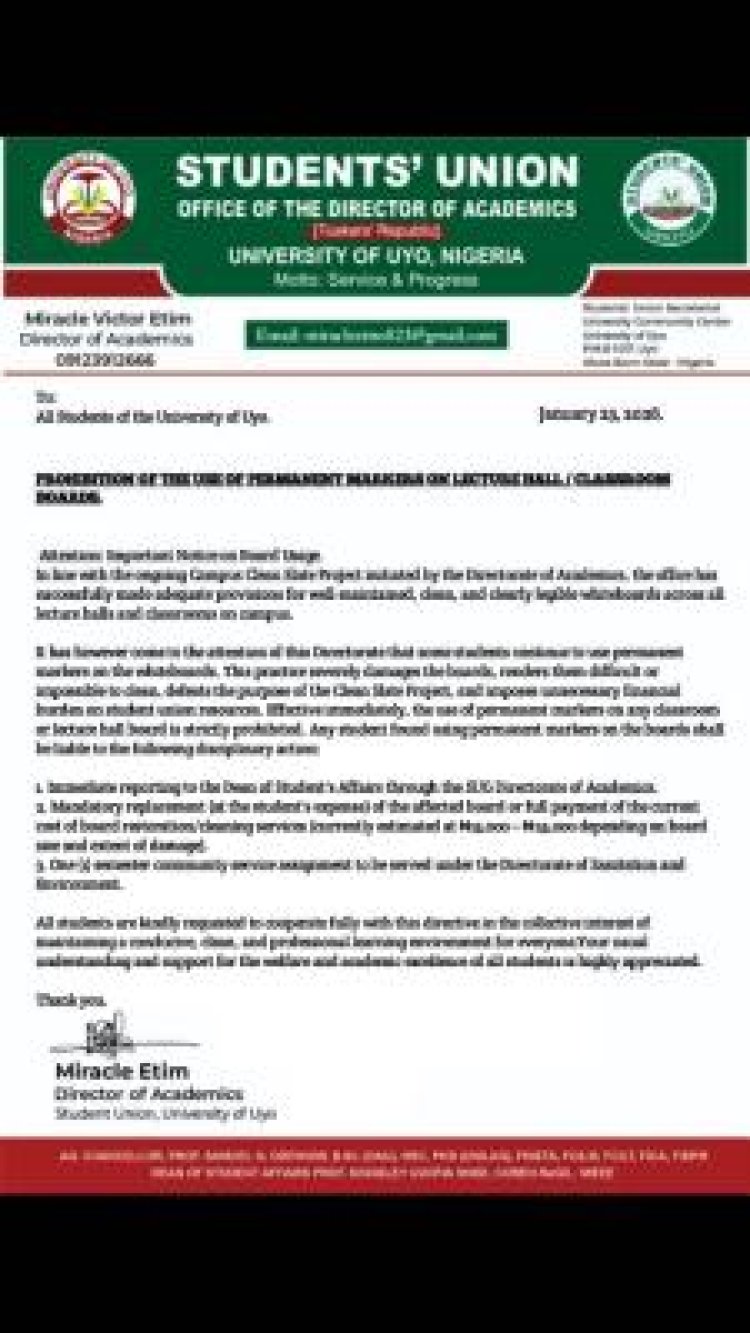
- Makes whiteboards difficult or impossible to clean.
- Undermines the objectives of the “Clean Slate Project.”
- Imposes unnecessary financial burdens on student union resources.
Enforcement and Disciplinary Measures:
Effective immediately, students found violating this policy will face the following penalties:
- Official Reporting: Referral to the Dean of Student Affairs via the SUG Directorate of Academics.
- Financial Restitution: Mandatory replacement or professional restoration of the damaged whiteboard, costing between ₦15,000 and ₦25,000 depending on severity.
- Community Service: Completion of a one-semester assignment under the Directorate of Sanitation and Environment.
The SUG leadership has called on all students to adhere strictly to this directive to maintain a professional and conducive academic environment. The measures are designed to protect university resources and promote collective responsibility among students.