FUNAAB Don Urges FG to Prioritize National Industrial Catalyst
FUNAAB Don Urges FG to Prioritize National Industrial Catalyst
 UmarFarouk123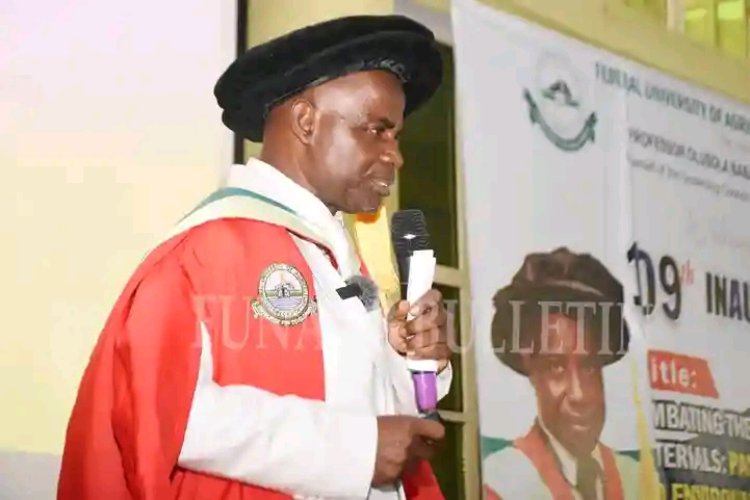
A leading Corrosion and Materials Engineering expert, Prof. Olayide Adetunji of the Department of Mechanical Engineering, College of Engineering (COLENG), Federal University of Agriculture, Abeokuta, has called on the Federal Government to urgently revive the long-dormant Ajaokuta Steel Complex, describing it as a strategic catalyst for industrial growth, foreign exchange conservation, and sustainable national development.
Delivering the University’s 109th Inaugural Lecture today, February 25, 2025, Prof. Adetunji stated that resuscitating the steel complex would significantly boost local steel production, reduce Nigeria’s heavy reliance on imports, and strengthen domestic manufacturing capacity. He emphasised that a functional steel industry remains fundamental to infrastructure development, energy systems, transportation, and national security.
In his lecture titled “Combating the Hidden Menace of Metallic Materials: Panacea for Industrial Growth and Environmental Sustainability,” the scholar identified corrosion as a major but often overlooked economic threat. He described corrosion as a “silent destroyer,” capable of triggering structural failures, industrial accidents, chemical leaks, and environmental disasters if not properly managed.
According to him, corrosion affects critical sectors including infrastructure, transportation, manufacturing, and energy. He warned that neglecting corrosion management could result in catastrophic building and bridge collapses, equipment breakdowns, pipeline failures, and fire outbreaks, ultimately undermining public safety and environmental sustainability.
To address the challenge, Prof. Adetunji outlined several mitigation strategies, including improved engineering design, appropriate material selection, protective coatings, and the adoption of cathodic protection systems, particularly in the oil and gas sector. He also stressed the importance of corrosion inhibitors and smart monitoring technologies to detect early signs of deterioration in buried facilities such as pipelines and storage tanks.
Specifically, he recommended that filling stations and fuel depots nationwide adopt sacrificial anode cathodic protection systems to prevent underground tank leakages and environmental contamination. He further urged the government, through the Council for the Regulation of Engineering Practice in Nigeria, to make corrosion resistance a mandatory requirement in public procurement processes and infrastructure design standards.
The 109th Inaugural Lecturer also advocated the integration of Corrosion Engineering into university curricula to equip graduates with industry-relevant skills. He encouraged manufacturing firms and tertiary institutions to establish corrosion monitoring and control units to reduce maintenance costs and extend infrastructure lifespan. Strengthening collaboration between academia and industry through targeted research funding, he noted, would further stimulate industrial growth and deepen local content development.
In addition, Prof. Adetunji called on all tiers of government to officially recognise April 24 as Corrosion Awareness Day in alignment with the World Corrosion Organisation initiative, to promote public awareness and preventive best practices.
Earlier, the Vice-Chancellor, Prof. Babatunde Kehinde, commended the 109th Inaugural Lecturer for his distinguished academic career and scholarly contributions.
He noted that Prof. Adetunji’s research interests span Corrosion Engineering, advanced materials development, machinery systems, energy materials, and nanotechnology, fields he described as critical to Nigeria’s industrial transformation and sustainable development agenda.