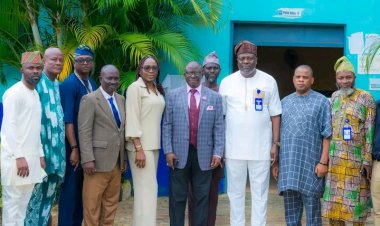
NSUK Vice-Chancellor Calls for Policy-Driven Academia at PUU Colloquium
The Vice-Chancellor of Nasarawa State University, Keffi (NSUK), Professor Sa’adatu Hassan Liman, has urged African universities to reposition themselves as catalysts for economic transformation and drivers of public policy across the continent.
 Philip22
The Vice-Chancellor of Nasarawa State University, Keffi (NSUK), Professor Sa’adatu Hassan Liman, has urged African universities to reposition themselves as catalysts for economic transformation and drivers of public policy across the continent.

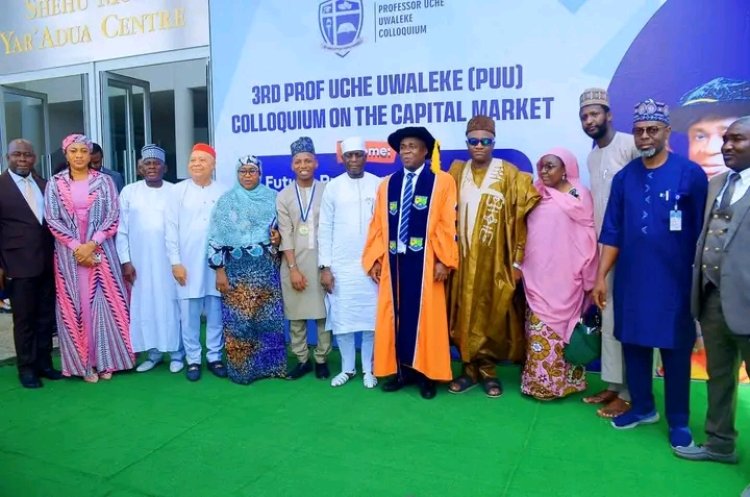
Speaking at the 3rd Professor Uche Uwaleke (PUU) Biennial Colloquium on Monday, 23 February 2026, at the Shehu Yar'Adua Centre in Abuja, Professor Liman stressed that academic knowledge must extend beyond lecture halls to tackle real-world developmental challenges. Represented by the Deputy Vice-Chancellor (Research, Innovation and Linkages), K’tso Nghargbu, she highlighted the importance of universities serving as strategic platforms for national discourse, noting that scholarship achieves true value only when it informs evidence-based policy and societal advancement.
Professor Liman commended the colloquium for fostering collaboration between academia, government, and industry—partnerships she described as essential for Africa’s integration under the African Continental Free Trade Area (AfCFTA). She emphasized that sustainable integration requires robust scholarship, resilient institutions, and sustained cross-sector collaboration.
Highlighting NSUK’s leadership in financial education, she noted that the University hosts Africa’s first university-based Institute of Capital Market Studies, with NUC-approved postgraduate programmes attracting international faculty and students. She also praised Professor Uche Uwaleke for maintaining the colloquium as a credible forum for high-level dialogue on Africa’s development trajectory, urging participants to translate discussions into actionable policy recommendations.

Delivering the keynote address, Professor Uwaleke underscored the need for a deliberately designed, future-ready integration strategy for Africa. He outlined three critical pillars for continental prosperity: infrastructure development, innovation-driven competitiveness, and robust capital markets. He stressed that trade agreements must be supported by physical and digital connectivity, including fiber-optic networks, data centres, and smart infrastructure, alongside policies that enable innovation in AI, fintech, and green technologies.
On capital markets, Professor Uwaleke emphasized their role in mobilizing long-term development finance, calling for regulatory cooperation, cross-border listing frameworks, and harmonized settlement systems. He warned that macroeconomic instability, including exchange-rate volatility and inflation, remains a barrier to investment. He concluded with a strong appeal for financial inclusion, highlighting that Africa’s integration must empower SMEs, women, and youth to ensure broad-based prosperity.
The well-attended colloquium drew top policymakers, regulators, and industry leaders, reinforcing its reputation as a premier platform for advancing Africa’s economic integration agenda.