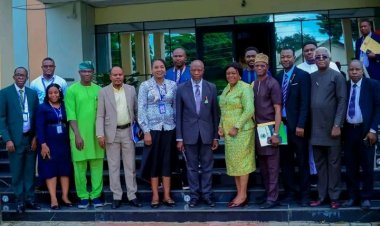
NSPRI Chief Urges Stronger Innovation, Research Commercialisation for National Development
The Executive Director of the Nigerian Stored Products Research Institute, Lateef Sanni, has called for intensified innovation and effective commercialisation of research outputs as critical drivers of national development, particularly across agriculture, health, and technology sectors.
 Philip22

The Executive Director of the Nigerian Stored Products Research Institute, Lateef Sanni, has called for intensified innovation and effective commercialisation of research outputs as critical drivers of national development, particularly across agriculture, health, and technology sectors.

Sanni made the call while delivering a keynote address at a strategic retreat organised by the Institute of Food Security, Environmental Resources and Agricultural Research at Federal University of Agriculture, Abeokuta. The event, held on April 2, 2026, brought together academics, researchers, and stakeholders to explore ways of strengthening research impact and global competitiveness.
Speaking on the theme of building world-class research institutions, Sanni emphasised that creativity, innovation, and access to modern infrastructure remain fundamental to solving complex national challenges. He noted that research in Nigeria has evolved significantly, driven by increasing adoption of digital tools and emerging technologies, but stressed that more needs to be done to translate academic findings into practical solutions.
He highlighted the link between agriculture and public health, pointing to innovations such as crop improvement, animal breeding, and biofortification initiatives as key contributors to improved nutrition outcomes. According to him, research must move beyond theoretical outputs to deliver measurable societal impact.
Drawing comparisons with global institutions such as the Chinese Academy of Sciences and the Massachusetts Institute of Technology, Sanni identified three core pillars for achieving world-class status: skilled human capital, well-equipped laboratories, and strong international collaborations. He also flagged weak patenting systems and poor commercialisation of research outputs as major gaps within Nigeria’s academic ecosystem.

Declaring the retreat open, the Vice-Chancellor of Federal University of Agriculture, Abeokuta, Babatunde Kehinde, represented by Deputy Vice-Chancellor (Development) Olawale Dairo, described the initiative as timely and aligned with the institution’s mandate. He reiterated the need for research to address real-world challenges and encouraged academics to pursue both local and international funding opportunities.
A second keynote lecture delivered by Olusegun Osinowo focused on Nigeria’s National Agricultural Research System, highlighting the importance of multidisciplinary collaboration and partnerships across government, academia, and industry. He stressed that sustainable development depends on coordinated efforts that promote knowledge exchange, capacity building, and innovation.
Osinowo also raised concerns about limited awareness and access to academic resources among researchers, urging institutions to prioritise sensitisation and improved accessibility. He noted a decline in industry-backed research sponsorships and called for renewed engagement with private sector partners to support emerging scholars.
Earlier, the Director of Institute of Food Security, Environmental Resources and Agricultural Research, Kazeem Bello, described the retreat as a significant milestone in the institute’s development. He said ongoing investments in infrastructure and research capacity have strengthened output, citing achievements such as international conferences on climate-smart agriculture and revitalised agricultural projects.
The retreat underscored a growing consensus among stakeholders on the need for Nigerian universities to prioritise innovation, strengthen partnerships, and align research with national development goals.