ABU Taskforce Submits Report on Responsible Energy Use; University Electricity Costs Drop Significantly
ABU Taskforce Submits Report on Responsible Energy Use; University Electricity Costs Drop Significantly
 UmarFarouk123
The Taskforce Committee on Responsible Energy Use has presented its report to the Vice-Chancellor, Prof Adamu Ahmed.
It outlined concrete measures taken to address the institution’s rising energy costs and proposed a comprehensive energy policy for sustainable power management.
Presenting the report, the Chairman of the Committee, Prof M Bello, said the importance of energy to the university community could not be overemphasised.
He said ABU had in recent times been confronted with extremely high electricity bills, including a 30-day blackout due to unpaid power charges.
According to him, despite the efforts of previous administrations, the current Vice-Chancellor approached the challenge with renewed vigour by setting up a taskforce to specifically address responsible energy use across the university.
He explained the committee carried out extensive field work as it visited 14 out of the university’s 18 faculties, about 70 departments and all student hostels.
He said the assignment involved an aggressive sensitisation campaign, the introduction of load shedding and the replacement of high-voltage bulbs.
According to him, hall administrators played a crucial role in the successful implementation of these measures.
He further informed that the taskforce went beyond immediate interventions to propose a draft energy policy for the university, which was submitted alongside the report.
“The report contains a compendium of the energy problems identified within the university and corresponding solutions,” he said.
While advising that the institution should remain open to new ideas on energy management, Prof Bello stressed that such solutions should be properly vetted by a statutory committee.
He expressed optimism that with unity of purpose, ABU would overcome its power challenges and emerge as a model for other universities and institutions.
In his response, the Vice-Chancellor, Prof Adamu Ahmed, expressed appreciation on behalf of Council, staff, students, and the entire university community for the diligence and commitment of the taskforce.
He recalled that at the inception of his administration, the university was confronted with an electricity bill of about ₦378 million in a single month, amounting to an average of nearly ₦4 billion annually.
This was obviously not sustainable, the Vice-Chancellor said, adding that university management often had sleepless nights at the end of every month over electricity bills.
He noted, however, that within the first month of the committee’s work, the bill dropped by about ₦2 million, and as of the previous month, it had reduced to ₦213 million.
The Vice-Chancellor commended the committee for translating long-standing theoretical solutions into practical actions that have yielded measurable results.
Prof Ahmed said the work of the taskforce was not yet complete, as the target was to reduce monthly electricity costs to ₦150 million.
He urged the committee to continue its assignment until responsible energy use becomes a culture across the university.
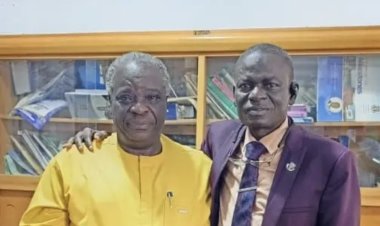
During the presentation, the Vice-Chancellor also applauded the Acting Head of the Bulk Metering Unit, Engr. Ahmad Rufai Abubakar, a member of the committee, for his outstanding performance.
He revealed that Engr. Abubakar had met the key performance indicators (KPIs) set for him within his first six months in acting capacity, leading to his appointment as the substantive Head of the unit.
Presenting the appointment letter, Ahmed said the gesture was meant to demonstrate that hard work is recognised and rewarded, and to encourage staff to deliver measurable results when entrusted with its responsibilities.
Members of the committee include Prof Garba Dahiru, Abdulkareem Giwa, SJ Salisu, Engr Ahmad Rufai Abubakar, Engr Umar Adamu, and Ibrahim Ahmed.
Others are Engr Halilu Shuaibu, Abubakar Kusogi Abdullahi, Ibrahim Nazeer Kallah, Aliyu Halilu, and Auwalu Hassan who served as secretary.