UI DVC Calls for Equitable, Collaborative Approaches to Public Health Challenges
The Deputy Vice-Chancellor (Academic) of the University of Ibadan, Professor Juwon T. Arotiba, has stressed the need for equitable and collaborative approaches in addressing public health challenges, describing them as critical to achieving effective disease prevention and control in an increasingly interconnected world.
 Philip22

The Deputy Vice-Chancellor (Academic) of the University of Ibadan, Professor Juwon T. Arotiba, has stressed the need for equitable and collaborative approaches in addressing public health challenges, describing them as critical to achieving effective disease prevention and control in an increasingly interconnected world.

Professor Arotiba made the call on behalf of the Vice-Chancellor, Professor Kayode O. Adebowale, during the opening ceremony of the 4th Ibadan International Public Health Conference organised by the Faculty of Public Health, University of Ibadan.
Speaking on the conference theme, “Planetary and Public Health Management in a Global Crisis: Ensuring Equity in Disease Prevention and Control,” he described the topic as broad, timely, and relevant to the realities confronting nations across the globe.
According to him, the conference addresses critical issues including public health, planetary health, disease prevention and control, environmental sustainability, and health equity.
Professor Arotiba explained that health equity means ensuring that all individuals, regardless of geographical location, gender, age, cultural background, or socioeconomic status, have access to quality healthcare services and preventive interventions.
He noted that while public health threats often have global dimensions, their effects are usually felt more severely by vulnerable and underserved populations.
The Deputy Vice-Chancellor observed that the world continues to grapple with complex challenges such as emerging infectious diseases, climate change, environmental degradation, food insecurity, and widening health inequalities.

According to him, these challenges demonstrate the inseparable link between the health of the planet and the health of human populations, requiring multidisciplinary collaboration and innovative solutions.
He emphasised that contemporary global health crises cannot be addressed in isolation, noting that the conference provides an important platform for knowledge exchange among researchers, policymakers, healthcare professionals, development partners, and other stakeholders.
Professor Arotiba expressed confidence that discussions at the conference would generate practical solutions capable of strengthening health systems, promoting environmental sustainability, enhancing disease surveillance, and improving preparedness for future public health emergencies.
The Oyo State Commissioner for Health, Dr. Oluwaserimi Adewumi Ajetunmobi, who attended as Special Guest of Honour, commended the Faculty of Public Health for sustaining a platform that encourages dialogue, innovation, and collaboration in addressing pressing public health concerns.
She described the conference theme as timely and strategic, noting that public health systems worldwide are increasingly challenged by climate change, environmental degradation, rapid urbanisation, emerging and re-emerging infectious diseases, antimicrobial resistance, population displacement, and growing health inequalities.
Dr. Ajetunmobi stated that public health can no longer be approached solely from a biomedical perspective but must be addressed through integrated and multidisciplinary frameworks that recognise the interconnectedness of human, animal, and environmental health.
She highlighted the efforts of the Oyo State Government in strengthening health security through investments in disease surveillance, epidemic intelligence, emergency preparedness and response, workforce development, laboratory systems, and risk communication.
The Commissioner also disclosed that the state has established a Climate Change and Health Desk Office within the Ministry of Health to develop evidence-based adaptation strategies and address the increasing impact of climate change on public health outcomes.
Also speaking at the event, the Executive Secretary of the Oyo State Primary Health Care Development Board, Dr. Muyideen Babatunde Olatunji, described Primary Health Care as the most inclusive, equitable, and cost-effective platform for delivering essential health services.
He noted that primary healthcare remains central to immunisation programmes, maternal and child healthcare, disease outbreak detection, health promotion, and community trust-building within the health system.
Dr. Olatunji stressed that efforts toward disease prevention and control must extend beyond hospitals and clinics to include policies that promote social inclusion, environmental sustainability, economic opportunity, and human dignity.
According to him, the future of public health will depend not only on scientific discoveries and technological innovations but also on the willingness of stakeholders to collaborate, share knowledge, invest in resilience, and place equity at the centre of decision-making.
The Dean of the Faculty of Public Health, Professor M. D. Dairo, said the conference was designed as a strategic platform for engagement among stakeholders within the scientific and professional communities.
He explained that the gathering aims to facilitate the exchange of knowledge and experiences, foster mentorship for emerging scholars, and strengthen interdisciplinary collaboration and professional networking.
The opening ceremony featured a keynote address delivered by Professor Nusirat Elelu, Executive Secretary of the Kwara State Primary Health Care Development Agency.
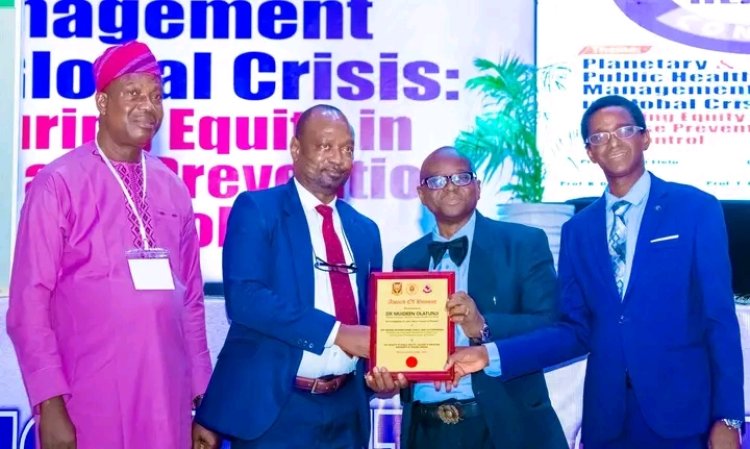
Awards were also presented to Ambassador Dr. Mrs. Florence Ajimobi, founder of the Access to Basic Medical Care Foundation and former First Lady of Oyo State, and Professor Temitope Alonge, a former Chief Medical Director of the University College Hospital, in recognition of their contributions to healthcare and public service.