FUNAAB’s DUFARMS Drives Innovation, Revenue Strategy at 2026 Pre-Season Seminar
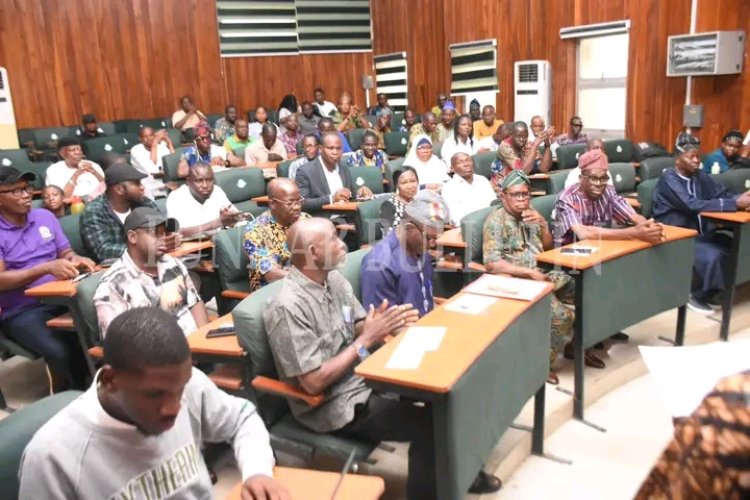
Federal University of Agriculture Abeokuta, through its Directorate of University Farms (DUFARMS), convened key stakeholders on April 8, 2026, for its 2026 Pre-Season Farming Seminar, with a clear focus on agricultural innovation and sustainable revenue generation.
 Philip22

Federal University of Agriculture Abeokuta, through its Directorate of University Farms (DUFARMS), convened key stakeholders on April 8, 2026, for its 2026 Pre-Season Farming Seminar, with a clear focus on agricultural innovation and sustainable revenue generation.

Declaring the seminar open, the Vice-Chancellor, Babatunde Kehinde, underscored the strategic importance of collaboration, knowledge exchange, and continuous learning in driving institutional growth. He described the seminar as both timely and critical to advancing the university’s mandate beyond teaching and research, particularly in strengthening community engagement and supporting farmers to enhance productivity.
The Vice-Chancellor commended DUFARMS for advancing value addition initiatives and challenged the Directorate to scale up operations across livestock segments, including poultry, beef, pork, and egg production, to boost the visibility and economic impact of the university’s agricultural enterprise. He also highlighted the revitalised Graduate Farmers Employment Scheme (GRADFES) as a key intervention reinforcing the institution’s commitment to graduate empowerment and agribusiness development.
Delivering the keynote address, Basiru Ojo, spoke on “The University Farm as an Incubation Ground for Innovation and Revenue Generation,” outlining a shift from traditional farm models to integrated hubs for entrepreneurship, research, and industry collaboration. He identified core innovation drivers including research and development, student-led enterprises, technology transfer, and interdisciplinary partnerships.

Dr. Ojo further mapped out revenue pathways such as commercial-scale production, agro-processing, consultancy services, research collaborations, agritourism, and intellectual property commercialisation. He, however, flagged structural constraints including funding gaps, weak industry linkages, climate-related risks, and limited commercial orientation, advocating for the adoption of agribusiness models, deployment of modern technologies, and development of resilient value chains.
Reflecting on the evolution of DUFARMS, he paid tribute to the institution’s founding leadership, particularly Nimbe Adedipe, whose vision laid the foundation for the university farm system. He also acknowledged subsequent milestones, including the expansion of cashew and oil palm plantations and the establishment of processing facilities to drive value addition.
As part of forward-looking recommendations, Dr. Ojo proposed the development of crop collection plots, revival of underutilised crops, exploration of cashew nutshell liquid production, and further expansion of tree crop plantations to unlock new revenue streams.
Earlier, the Acting Director of DUFARMS, Emmanuel Bankole, called for deeper collaboration among stakeholders, while appreciating participants for their engagement.
The seminar concluded with a unified commitment to reposition DUFARMS as a high-impact hub for innovation, practical training, and sustainable revenue generation, aligned with global best practices in agricultural enterprise management.