
UNILORIN Develops AI-Powered ECG System Tailored for Africans, Prof. Katibi Confirms
The University of Ilorin’s Central Research Laboratories has developed a locally designed artificial-intelligence system capable of interpreting ECG readings for African populations, according to Professor Ibraheem Adeola Katibi, Director of the Laboratories.
 Philip22
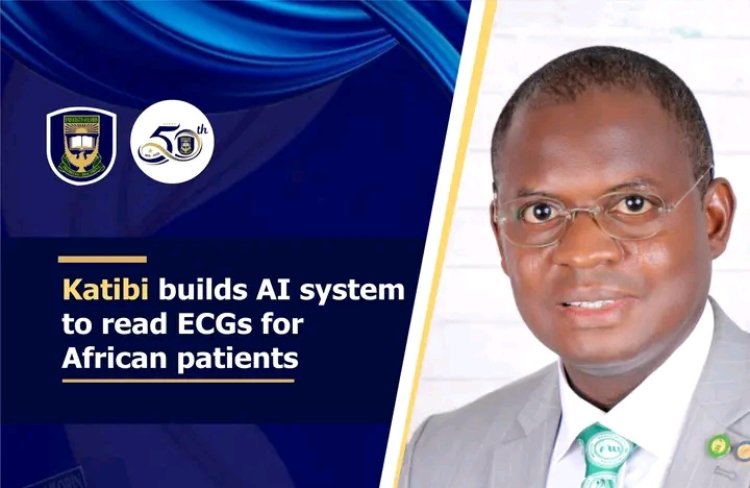
The University of Ilorin’s Central Research Laboratories has developed a locally designed artificial-intelligence system capable of interpreting ECG readings for African populations, according to Professor Ibraheem Adeola Katibi, Director of the Laboratories.
The innovation is currently undergoing final validation before large-scale trials and potential commercialisation.
Speaking to the UNILORIN Bulletin on December 7, 2025, Prof. Katibi, a renowned cardiologist and former Dean of the Faculty of Clinical Sciences, explained that conventional diagnostic machines are often calibrated for Caucasian physiology, leading to inaccuracies when used for African patients. Years of research by his team have documented clear physiological differences in ECG patterns among Africans, British, Indian, and Chinese populations.
“Our AI-powered diagnostic tool and digital ECG system allow an individual to record and interpret an ECG using a mobile phone, providing results specifically calibrated for Africans,” Prof. Katibi said. He noted that while the device is fully functional, it is not yet on the market as larger trials are needed. Once completed, the system could enable people to monitor their heart health at home, similar to checking blood sugar or blood pressure.
Prof. Katibi also highlighted broader challenges facing research and healthcare in Nigeria. He criticised inadequate funding for scientific research, citing gaps in infrastructure such as unstable electricity, water, and essential laboratory equipment. He argued that sustained investment is critical for Nigerian scientists to produce solutions tailored to local needs.
Addressing the migration of medical professionals, he noted that young Nigerian doctors leave the country not due to lack of competence but because of poor remuneration, insecurity, and inadequate working conditions. “Labour is global; workers will naturally move to places where their skills are valued,” he said, noting that Nigerian doctors excel abroad because they operate within organised systems that reward effort.
Prof. Katibi urged government leaders to prioritise peace, education, health institutions, and research funding. He also encouraged citizens to support leadership constructively and make informed electoral choices.
On preventive healthcare, he advised Nigerians to reduce salt and seasoning in diets, exercise regularly, rest, and consume fruits and vegetables. For individuals with hypertension or diabetes, he emphasised adherence to medications and hospital appointments.
He also highlighted the potential of integrating traditional medicine with modern healthcare. Citing examples from Morocco, India, and China, he called for Nigeria to refine and safely package traditional herbs into scientifically backed formulations, which could improve healthcare outcomes and contribute to foreign exchange earnings.