FUNAAB Researcher Unveils Cost-Effective, Healthier Fish Feed Alternative
FUNAAB Researcher Unveils Cost-Effective, Healthier Fish Feed Alternative
 UmarFarouk123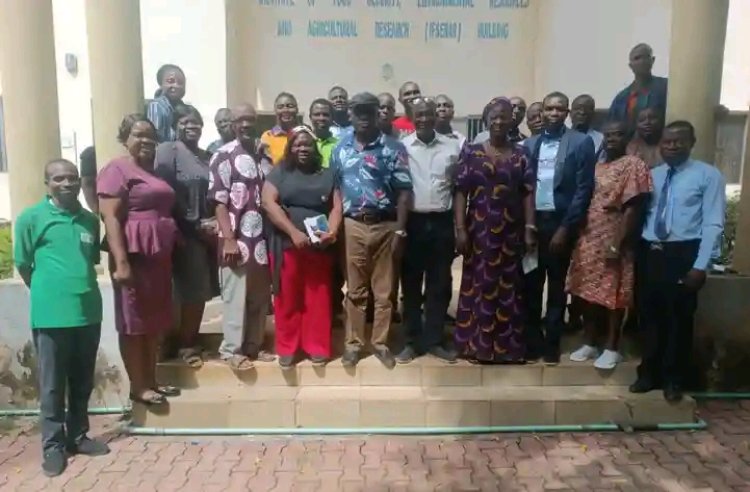
The Federal University of Agriculture, Abeokuta (FUNAAB) has recorded another major research breakthrough with the unveiling of an innovative, cost-effective and sustainable fish feed alternative that promises to transform aquaculture production.
The study, presented at the February Monthly Seminar of the Institute of Food Security, Environmental Resources and Agricultural Research (IFSERAR), revealed that the partial replacement of conventional fishmeal with probiotic-fortified insect larvae significantly improves fish health while reducing feed costs.
Delivering the presentation, Dr. Nathaniel Bamidele, Programme Coordinator, Aquaculture and Fisheries Research Programme at IFSERAR, explained that the research was designed to tackle one of the most pressing challenges in global aquaculture, the high cost of feed. According to him, feed accounts for between 60 and 70 percent of total production expenses, with fishmeal alone constituting a substantial proportion of feed ingredient costs.
Dr. Bamidele noted that with declining wild fish stocks caused by pollution, climate change and overfishing, aquaculture must meet the protein needs of a rapidly growing global population projected to reach 9 billion by 2050. However, rising feed costs continue to limit the profitability and expansion of fish farming.
To address this, the research investigated the use of Black Soldier Fly Larvae Meal (BSFLM), derived from _Hermetia illucens_ , as a sustainable substitute for fishmeal in the diet of _Oreochromis niloticus_ (Nile tilapia), one of the world’s most widely cultivated freshwater fish species. The insect larvae were reared at FUNAAB, while feeding trials were conducted at the University’s Hatchery Unit in Abeokuta, Ogun State.
Five experimental diets containing approximately 35 per cent crude protein were formulated, replacing fishmeal with BSFLM at graded inclusion levels of 0, 25, 50, 75 and 100 percent. The feeds were pelleted, air-dried and properly stored. To address potential digestive challenges associated with high insect meal inclusion, particularly due to chitin content, probiotics were incorporated to enhance digestion, improve gut structure and promote a balanced intestinal microbiota.
Findings from the study showed that probiotic-fortified BSFLM improved fish carcass quality without adversely affecting blood parameters. Optimal growth performance and feed utilisation were achieved when 50 per cent of fishmeal was replaced with the fortified insect meal. Importantly, probiotic supplementation helped mitigate intestinal stress linked to moderate insect meal inclusion.
Describing the innovation as both economically viable and environmentally sustainable, Dr. Bamidele stated that probiotic-fortified insect protein could sustainably replace up to 50 percent of fishmeal in Nile tilapia diets without compromising fish health or productivity. He emphasised that the development holds significant potential for reducing production costs and improving profitability for fish farmers.
The researcher recommended further long-term studies to support large-scale commercial adoption of probiotic insect-based aquafeeds.
The seminar was attended by the Director of IFSERAR, Prof. Kazeem Bello; the Chairman of the occasion, Prof. Wilfred Alegbeleye; and other distinguished academic staff, including Prof. Victor Olowe and Prof. John Oyedepo, among others.